
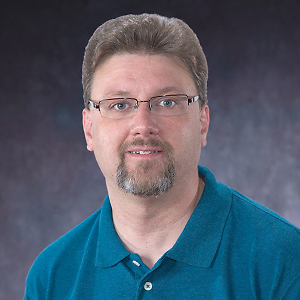
Gregory Harry Professor CAS | Physics
- Degrees
- PhD, physics, University of Maryland
MS, physics, University of Maryland
BS, physics, California Institute of Technology - Bio
-
My research is on gravitational waves, which were predicted by Einstein in his General Theory of Relativity and come from astronomical events like black holes, neutron stars, pulsars, and the Big Bang. AU is a member of the LIGO Scientific Collaboration, which uses the LIGO gravitational wave detectors in Louisiana and Washington State to probe the universe using gravitational waves. On campus, we do laboratory research on the optics of these detectors, working to reduce the noise caused by the optical coatings. This involves material science research on glassy materials and crystals, determining which will be the best choices for future upgrades of the LIGO detectors.
The AU Gravity and Thermal Noise Laboratory serves as the primary work place for AU undergraduate students making measurements and performing computer simulations of LIGO optics. Undergraduate students are the primary researchers in the lab since AU does not have a graduate program in physics. Past students have shown that storage of glassy coatings for years before installation in the future LIGO India detectors does not degrade their noise properties, that crystalline aluminum-gallium-arsenide (AlGaAs) coatings have very low thermal noise properties and are an excellent candidate for future upgrades, and that there are different sources of noise within the current LIGO coatings. This work has been published in professional physics journals such as Physical Review D, Classical and Quantum Gravity, and Physics Letters A with students as co-authors.
Collaborations
The AU LIGO group works closely with other members of the LIGO Scientific Collaboration, especially those working on improving optics and coatings. This includes collaborations on AlGaAs with Syracuse University, the University of Arizona, and Embry-Riddle Aeronautical University and on general coatings with Stanford University, the Massachusetts Institute of Technology (MIT), and the California Institute of Technology (Caltech). We also work with international collaborators in Benevento, Italy, Hannover, Germany, Adelaide, Australia, and Glasgow, Great Britain. Past students who worked in the AU LIGO group have done summer research projects in Germany, Japan, and Scotland, and have gone on to PhD programs at Syracuse University, the University of Glasgow, the University of Washington, and Caltech among other schools.
Previous Experience
I got my undergraduate degree in physics at Caltech, having been inspired to study gravitational waves by Kip Thorne (who is now a Nobel Laureate), and my PhD at the University of Maryland, where I worked on the older resonant bar gravitational wave detectors which were invented there. I started my LIGO research at Syracuse University then moved to the LIGO Laboratory at MIT, where I was a research scientist for about 10 years. From MIT, I move to my faculty position at AU, where in addition to my LIGO work I expanded PHYS-440 Advanced Laboratory, created PHYS-326 Science for Policymakers and CORE-105 Exoplanets in Fact and Fiction, and served as the chair of the physics department during the COVID crisis. I am now involved in advancing the Engineering Physics major to increase opportunities for AU students who want to do hands-on technical work.
- See Also
- Physics Department
- LIGO Scientific Collaboration
- For the Media
- To request an interview for a news story, call AU Communications at 202-885-5950 or submit a request. Explore all AU Faculty Experts in our media guide.
Teaching
Fall 2025
-
CORE-105 Complex Problems Seminar: Exoplanets in Fact and Fiction
-
PHYS-326 Science for Policymakers
Spring 2026
-
CORE-105 Complex Problems Seminar: Exoplanets in Fact and Fiction
-
PHYS-385 How Physicists Work