
A Century of Economics at AU: 100 Years of Scholarship and Impact
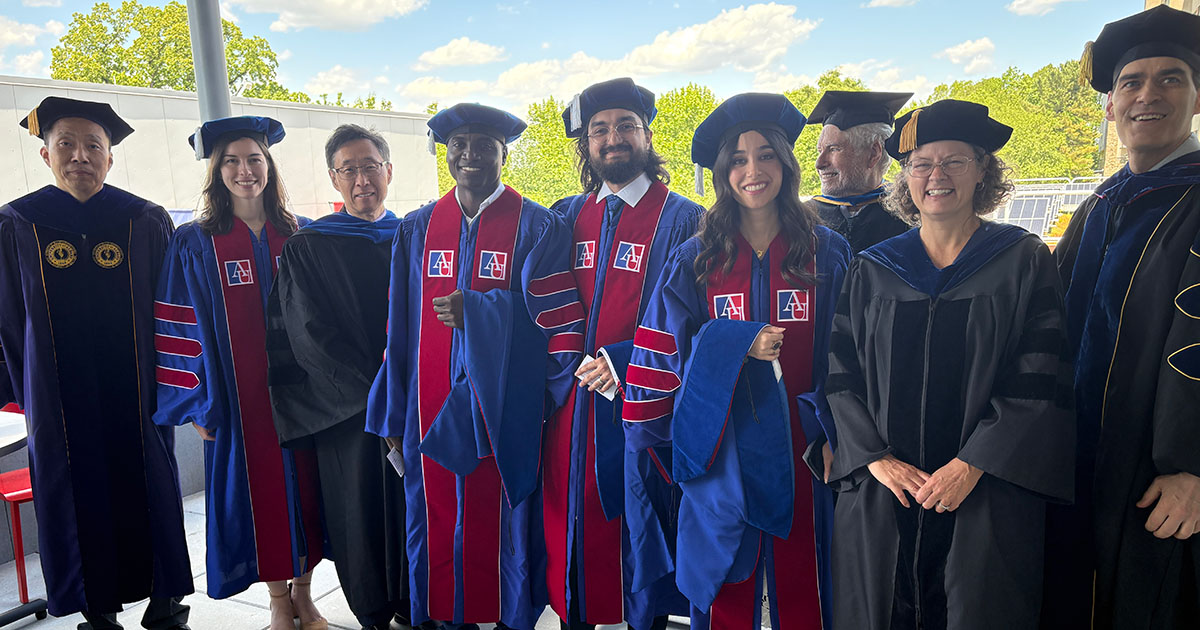 From left to right: Simon Sheng, Aina Puig, Walter Park, Seyni Da, Makar Golosheykin, Aya Aboul Hosn, John Willoughby, Kara Reynolds, Nathan Larson
A lot has changed in 100 years. In 1926, American University awarded its first PhD in economics to Lee Somers, a former federal government employee who studied how the United States managed its workforce during World War I.
A century later, AU has awarded more than 540 economics doctorates, and the program has grown into the university's largest doctoral degree program.
Somers's dissertation, Policies of the War Labor Administration, examined the federal government's efforts to manage labor shortages, resolve disputes, and keep industries running during the war. Drawing on his own experience in the War Labor Administration, he explored questions at the intersection of economics, government, and public policy.
That focus remains central to American University’s Department of Economics today.
With its location in Washington, DC, the program gives students access to federal agencies, international institutions, and policymakers. Its graduates have gone on to careers at the International Monetary Fund, World Bank, Organisation for Economic Co-operation and Development, federal agencies, universities, and think tanks around the world.
Over the decades, the program has developed strengths in economic development, international trade and finance, gender analysis, and macroeconomic policy. Its faculty and students study issues ranging from income inequality to the economic forces shaping communities and countries.
The program also plays an important role in AU's standing as an R1 research university. Over the past decade, economics students have accounted for 20 percent of doctoral enrollment across the university—and 40 percent of doctoral enrollment in the College of Arts and Sciences.
Most recently the Department of Economics was chosen to host the American Economic Association Summer Program, an eight-week initiative preparing aspiring economists for doctoral study through rigorous coursework, research, and faculty mentorship, backed by more than $2.3 million in external funding.
As AU celebrates the centennial of its first economics doctorate, the program continues to build on a century-old tradition: connecting economic research to the real-world challenges facing Washington and the world.
The AU Way, Then and Now
A century later, Somers’s dissertation reads like an early blueprint for what an AU economics PhD still is: rooted in Washington, focused on policy, and interested in how economic institutions work for people.
Today the program’s distinctive strengths include:
- Applied, Policy-oriented Research. Somers studied a policy he had helped carry out and weighed in on legislation before Congress. Today’s students do the same, with federal agencies and international institutions just a Metro ride away.
- Economic Development. From domestic labor policy in 1918 to growth and poverty in developing economies today, AU economists study how institutions shape people’s livelihoods.
- International Trade and Finance. Students examine trade, capital flows, and the global rules that govern them, with Washington’s international institutions close at hand.
- Gender Analysis in Economics. Somers’s dissertation reflected an early interest in the key role of women in industry. Professor Barbara Bergmann later was a leader in the emerging field of gender analysis in economics, and Professors Maria Floro, Caren Grown, John Willoughby and Mieke Meurs founded the Program for Gender Analysis in Economics in 1995 to institutionalize the work. Generations of graduates are leaders in this field in the US and abroad, contributing to greater equality and more effective policy.
- Macroeconomic Policy and Income Distribution. Through the Institute for Macroeconomics and Policy Analysis (IMPA), AU economists have developed a macro model to simulate the effects of tax and labor market policies on income inequality. Nobel laureate Joseph Stiglitz has been an active speaker at IMPA events.
The program’s strength matters to AU as a whole. AU is now an R1 institution, the top classification for research universities, an honor that depends in part on doctoral graduates, where economics is a major contributor.
A Century of Graduates
The centennial-year doctoral recipients in economics are Aya Aboul Hosn, Seyni Da, Makar Golosheykin, Laura Heras Recuero, Joan Koo, Malek Owain, Aina Puig, Matthew Templeton, and Hao Vo.
For recent graduates, one of the program's greatest strengths is its commitment to different ways of thinking about economics.
“The economics department at AU has been exceptional in its ability to mix rigorous instruction with a diversity of thought,” says Golosheykin, an assistant professor at the University of Southern Maine. “Few programs in the country have recognized the importance of pluralism in economics, and fewer still have built that recognition into their curriculum.”
That breadth of perspectives has also shaped how graduates approach their own work.
“Learning macroeconomics from various perspectives across the core sequence as well as the political economy and gender courses was central…and continues to shape how I think about the economy and the individuals in it,” adds Puig, a clinical assistant professor of economics at Pace University.
A Century-Long Legacy
Somers’s legacy continues through the Lee Somers Endowed Library Fund, which gives American University researchers access to Congressional Research Service reports via ProQuest and to AM Explorer Arts and Humanities, a digital collection of historical government records and manuscripts.
For more information about American University’s Department of Economics, PhD program, and faculty, visit its website.