
CAS Faculty Recognized for Excellence in Teaching, Scholarship, and Inclusion

Physics Professor Nate Harshman, known for bringing energy, humor, and a touch of whimsy to everything from introductory physics to quantum theory, has received American University’s 2026 Scholar/Teacher of the Year Award. He is one of four College of Arts and Sciences faculty members recognized with 2026 University Awards for excellence.
Joining Harshman are three colleagues whose work highlights the dynamic mix of disciplines and ideas within the College. Hurst Senior Professorial Lecturer Mary Frances Giandrea, a medieval historian who brings the worlds of Anglo-Saxon England to life for her students, is recognized for outstanding teaching. Writing Studies Senior Professorial Lecturer Sarah Trembath, Interim Executive Director of AU’s Antiracist Research and Policy Center, earns honors for advancing inclusive excellence, bringing a decolonial, public-facing approach to her teaching and scholarship that challenges students to think critically about the world around them. And History Professor Dan Kerr, Director of the Public History Program, is celebrated for building scholarship that moves beyond campus in the Humanities Truck, which brings community-centered history and storytelling directly into neighborhoods across the DMV.
“Together, these four honorees exemplify the very best of the College of Arts and Sciences,” says Linda Aldoory. “They bring energy to the classroom, a deep commitment to their fields, and a lasting influence on the students and communities they serve. Their achievements reflect the spirit of Meet Our Moment, especially our commitments to curiosity, community, and preparing students to make meaningful contributions in the world.”
Meet the Honorees
Nate Harshman: Scholar/Teacher of the Year Award
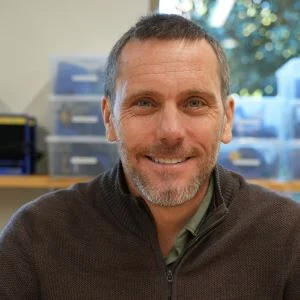
A theoretical physicist specializing in symmetry and topology in quantum systems, Harshman has published widely across fields ranging from particle physics to quantum information and ultracold atomic systems. In the classroom, he’s known for pairing rigorous concepts with hands-on learning, problem-based approaches, and memorable demonstrations that keep students engaged. A dedicated mentor, he also works closely with students on research projects that lead to conference presentations and publications, while supporting internships, fellowships, and other professional opportunities.
Beyond the classroom, Harshman’s leadership roles—including serving as department chair, directing the NASA DC Space Grant Consortium, and co-founding the Initiative for STEM Education, Equity, and Ethics—reflect a deep commitment to building programs and supporting both faculty and students.
“Trying to balance teaching, research, and service sometimes feels like walking on wire in windy weather,” Harshman says. “This award feels special because it acknowledges the breadth of what a professor does, and what I have been doing at AU for over 20 years. And I have been gratified by all the colleagues from over the years who have reached out to congratulate me.”
That balance also shows up in how he brings his research into the classroom. This semester, Harshman gave a guest lecture on his research in the one-credit course How Physicists Work to students he has taught previously in introductory or intermediate physics courses. “Most of them hadn’t seen me talk about my passion for symmetry in physics and my fascination with how mathematics limits what is knowable, and what is decidable in physical models of reality,” he says.
Mary Frances Giandrea: Outstanding Teaching in a Full-Time Appointment Award (Term/Continuing Appointment)

A scholar of medieval history, Mary Frances Giandrea focuses on the religious and political culture of Anglo-Saxon and Anglo-Norman England. She is the author of Episcopal Culture in Late Anglo-Saxon England, a foundational study of the many roles that bishops played in early English society, and her work continues to explore topics such as sanctity, manuscript culture, and the development of ecclesiastical institutions. In the classroom, she teaches a wide range of courses—from the ancient world to the Viking Age and capstone seminars—guiding students through complex historical questions with clarity and depth.
Colleagues and students alike point to Giandrea’s thoughtful, student-centered approach to teaching, one that reflects both deep expertise and a genuine commitment to helping students make meaningful connections across time, a quality that makes this recognition for teaching excellence especially fitting.
“In a world where students get most of their information in short bursts from the internet, it is important to show that the roots of most of our modern problems can be found in the past, and often in the deep past,” Giandrea says. “At the same time, it is harder than ever for students to empathize with historical people, especially when they held views or acted in ways we now abhor. Reading the words people wrote centuries or even millennia ago reminds us that the human condition hasn’t changed all that much and that we still grapple with the same big questions they did. I live for the ah ha! moments that lead to perspective and empathy.”
It may sound like a cliché, Giandrea says, but teaching really does keep you young. “I love the rhythm of the academic calendar, the collegiality of university life, meeting new students every year, and helping graduates move on to the next chapter of their lives,” she says. “Teaching here is a real labor of love because AU students are thoughtful, intellectually curious, kind, and absolutely passionate about history!
Sarah Trembath: Faculty Award for Inclusive Excellence
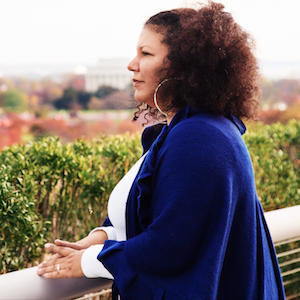
An educator, writer, and public scholar, Trembath has been teaching since 1998 and joined the AU faculty in 2014. Her work centers on reading and writing pedagogies that deepen critical thinking and expand students’ understanding of the world, particularly in the context of contemporary challenges such as misinformation, book bans, and debates over curriculum.
A decolonial scholar, she brings her research to broader audiences through accessible public writing, including her column “The Critical Reader.” She is also the author of two books and a contributor to a wide range of literary and scholarly publications, and she currently serves as Interim Executive Director of American University’s Antiracist Research and Policy Center (ARPC).
“This is a really lovely moment in my career,” Trembath says, noting that work she has been committed to since she was her students’ age is now being recognized beyond grassroots activist communities. As a student, she was involved in activism opposing apartheid, advocating for AIDS health care, and supporting global movements in places including United States, Haiti, Palestine, and Nicaragua—often working outside formal systems to push for change, as she sometimes still does in academia.
“But this award tells me that institutions and activists can have common ground. I am so honored that American University likes the Antiracist Praxis Subject Guide, values my work at the ARPC, and gives me seats at college-, department-, and program-level tables,” she says. “It shows me that there is common ground. I feel very fortunate to be operating in that space, being recognized by this prestigious university in this sociopolitical moment for doing what has always mattered to me.”
Daniel R. Kerr: Outstanding Contribution to Fostering Collaborative Scholarship Award
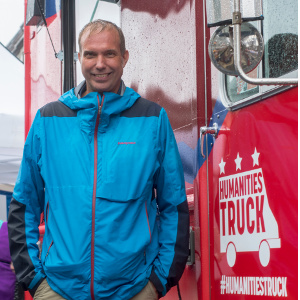
Dan Kerr is a historian of community, oral, and public history whose work centers on collaboration and shared authority in storytelling. He directs (and drives!) American University’s Humanities Truck, a literal truck that brings humanities research directly into communities.
For nearly eight years, Humanities Truck has been on the road, collecting the diverse experiences and perspectives of residents: people facing the effects of drug criminalization, living in homeless camps, struggling to find healthy groceries in “food deserts,” fighting to improve Black women’s healthcare, and more. "The truck is a mash-up of old-school people's history projects with the latest tools and techniques that inform the digital humanities today," says Kerr.
Kerr has led major projects such as the Cleveland Homeless Oral History Project and the Homeless Voices Amplification Cooperative in Washington, DC. His scholarship explores the intersections of history, activism, and social change, including in his book Derelict Paradise: Homelessness and Urban Development in Cleveland, Ohio. He also serves as president-elect of the Oral History Association.