
Varsity Swimmer Daniel Coughlin’s Quest to Measure the Runner’s High
What exactly is a runner’s high?
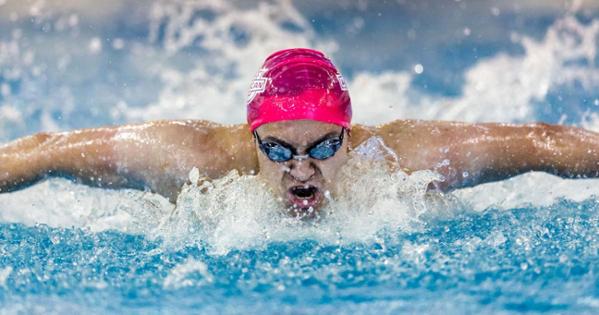
Scientists describe it as a fleeting euphoria—a calm, almost transcendent state brought on by prolonged, punishing exercise. But for Daniel Coughlin (BS biology ’26), a varsity swimmer and team captain at American University, it wasn’t theoretical. It was something he felt during his early-morning practices at the Reeves Aquatic Center, where workouts begin before most of campus is awake.
“We do a lot of distance training where we have to repeat very challenging swim sets. During some of those long practices, I noticed that after pushing through the initial fatigue and discomfort, I would start to feel calmer, more focused, and almost energized,” Coughlin explains. “Then, on the following set, I realized I could push even more and go even faster. That made me curious about what was happening in my brain and why swimming could make me feel this way.”
Coughlin’s curiosity didn’t stay in the pool. He took it to the lab and turned it into something few undergraduates ever achieve: first co-authorship on a publication in Bioelectrochemistry.
Chasing a Chemical Signal
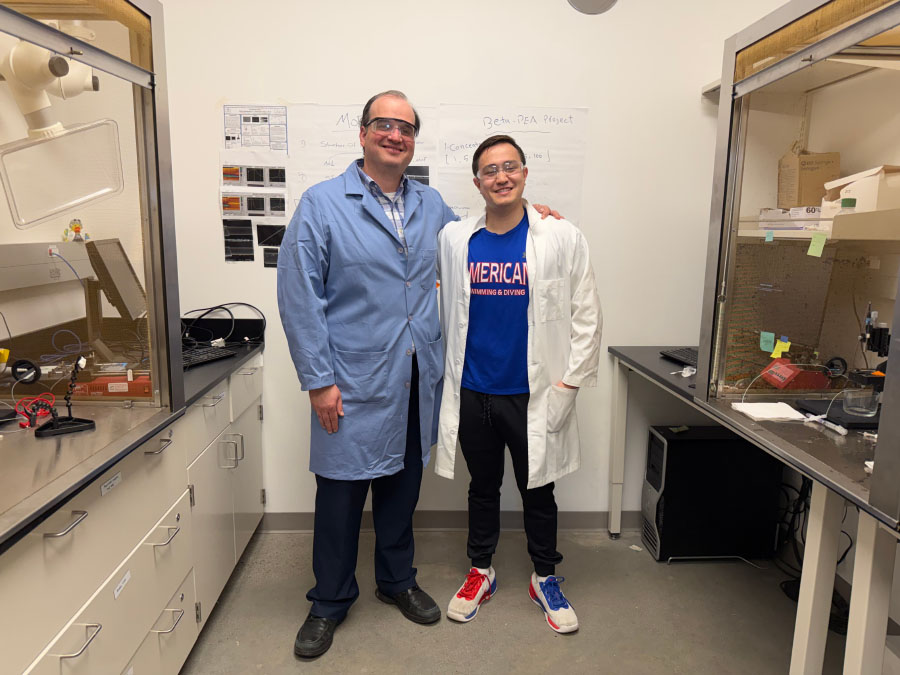 Professor Alex Zestos and Daniel Coughlin
Coughlin brought his question to Chemistry Professor Alex Zestos, whose lab builds carbon-fiber sensors—tools designed to measure neurotransmitters like dopamine and serotonin levels in the brain.
But Coughlin was interested in something more elusive: endorphins, and their role in runner’s high. He wondered if Zestos’ tools could be used to explore these. At the time, he was working as an orthopedic medical scribe, where he regularly saw opioid-based pain medications such as hydrocodone prescribed to patients. Watching how often those drugs were used to manage pain pushed him to think more deeply about the body’s own natural equivalents.
“I learned that pain medications are essentially synthetic opioids,” Coughlin says. “And beta-endorphins bind to the same receptors to mitigate pain. That made me wonder if we could actually detect them.”
There was just one problem. Scientists had never successfully measured endorphins using the lab’s core technique, fast-scan cyclic voltammetry (FSCV). Without a reliable way to measure them, their role in the brain remained difficult to study in real time.
But Coughlin decided it was worth a try, and with Zestos’ support, the idea became a full research project.
The Challenges of Measuring Endorphins
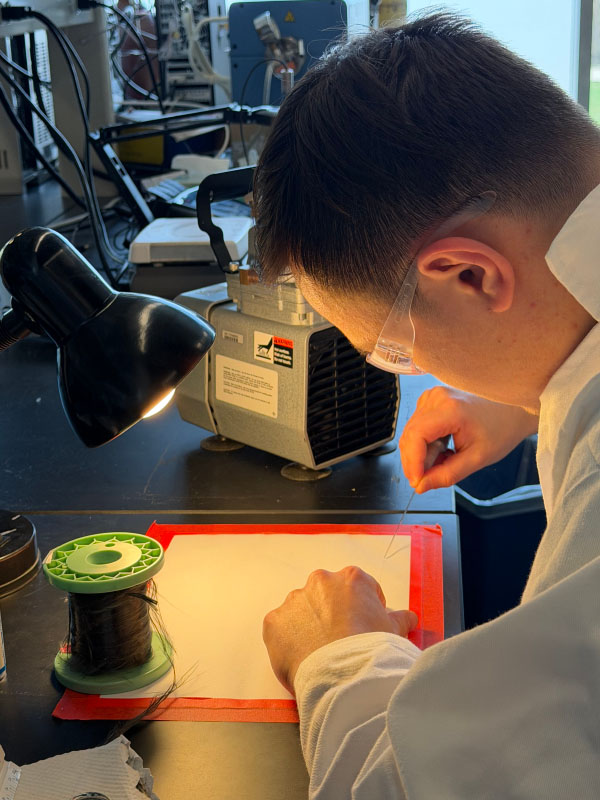
In the laboratory, Coughlin learned how to build the sensors that would make his research possible. The process required extreme precision. Each electrode is made from a strand of carbon fiber thinner than a human hair, pulled into glass capillaries. Each one must be carefully sealed, heated, cut to the correct length under a microscope, and tested to make sure it can detect chemical signals.
“Making electrodes was one of the hardest parts,” Coughlin says. “If you make a mistake at any step, you have to start over.”
Coughlin’s tenacity stood out. “Daniel has really impressed me with his dedication and persistence in the laboratory,” says Zestos. “He’s spent countless hours in the lab and genuinely tries to understand the complex problems we are studying, rather than just completing a task. He also comes up with his own research ideas and troubleshoots issues as they arise.”
After weeks of trial and error, the team built working sensors. Then came the real test: could they actually detect endorphins?
They could. The team successfully demonstrated that endorphins could be detected and characterized using fast-scan cyclic voltammetry (FSCV). Even more, the sensors could measure them alongside major neurotransmitters like dopamine, serotonin, and norepinephrine.
This technical breakthrough has broad implications. For the first time, scientists have a path toward tracking endorphin activity as it happens—during exercise, stress, or pain (including the runner’s high), offering a new window into how the brain regulates performance and resilience. These insights could also extend beyond athletics. Scientists are still uncovering the many roles that endorphins play in the brain, and being able to measure them alongside other brain chemicals could help researchers better understand how these systems interact.
Life at 4 a.m.
For Coughlin, completing the project meant balancing several demanding worlds.
Coughlin is a Division I athlete and team captain of American University Swim and Dive, training 20-plus hours a week. At one point, he juggled 40-hour weeks as a medical scribe with another 20 hours in the lab, all while maintaining pre-dawn practices during the summer.
“I was swimming at 4 a.m. just to stay in shape,” he says.
The effort paid off. As an AU Student-Athlete Advisory Committee representative and DeBoer Team Elite Athlete, he ranks among the program’s all-time top 10 in the 200 butterfly, 200 medley relay, and 400 medley relay. One highlight came during a meet against Howard University, when AU swept both the men’s and women’s teams for the first time in eight years. Coughlin helped set the tone on the 200-yard medley relay and later won the 200-yard butterfly.
On the clinical front, Coughlin has built an impressive clinical portfolio through roles as a medical scribe at OrthoVirginia and an advanced clinical associate at INOVA GoHealth Urgent Care, complemented by physician shadowing at Inova Fairfax Medical Campus and service as a volunteer caseworker with the Navy-Marine Corps Relief Society.
He served as lead undergraduate researcher in the Zestos Lab and earned multiple awards supporting his summer research, including a Schwartz Fellowship, a grant from NASA’s District of Columbia Space Grant Consortium, a CAS Summer Undergraduate Fellowship, and an AU Summer Scholars & Artists Program grant. He has presented his research at the SUGER Research Poster Showcase and at the chemistry department’s Meet and Greet and AU’s Summer Scholars and Artists Presentation Dinner. Most recently, he assisted with a study using metal-organic frameworks to enhance carbon fiber sensitivity and gained a second co-authorship publication in ChemElectroChem journal.
For Coughlin, the takeaway is simple but hard-won: “Being an athlete and a scholar is tough,” he says. “But I want other athletes to know it’s possible to do both.”