
From AU to the Grammys: Daniel Pérez Engineers Record of the Year
When Kendrick Lamar’s “Luther” won Record of the Year at the 2026 Grammys, Daniel “Dani” Pérez (MA audio technology ’21) wasn’t tucked away in a control room as usual—he was in the ballroom itself, celebrating the win. Pérez served as an audio engineer on “Luther,” the Kendrick Lamar and SZA track from Lamar’s GNX album that won the 2026 Grammy for Record of the Year.
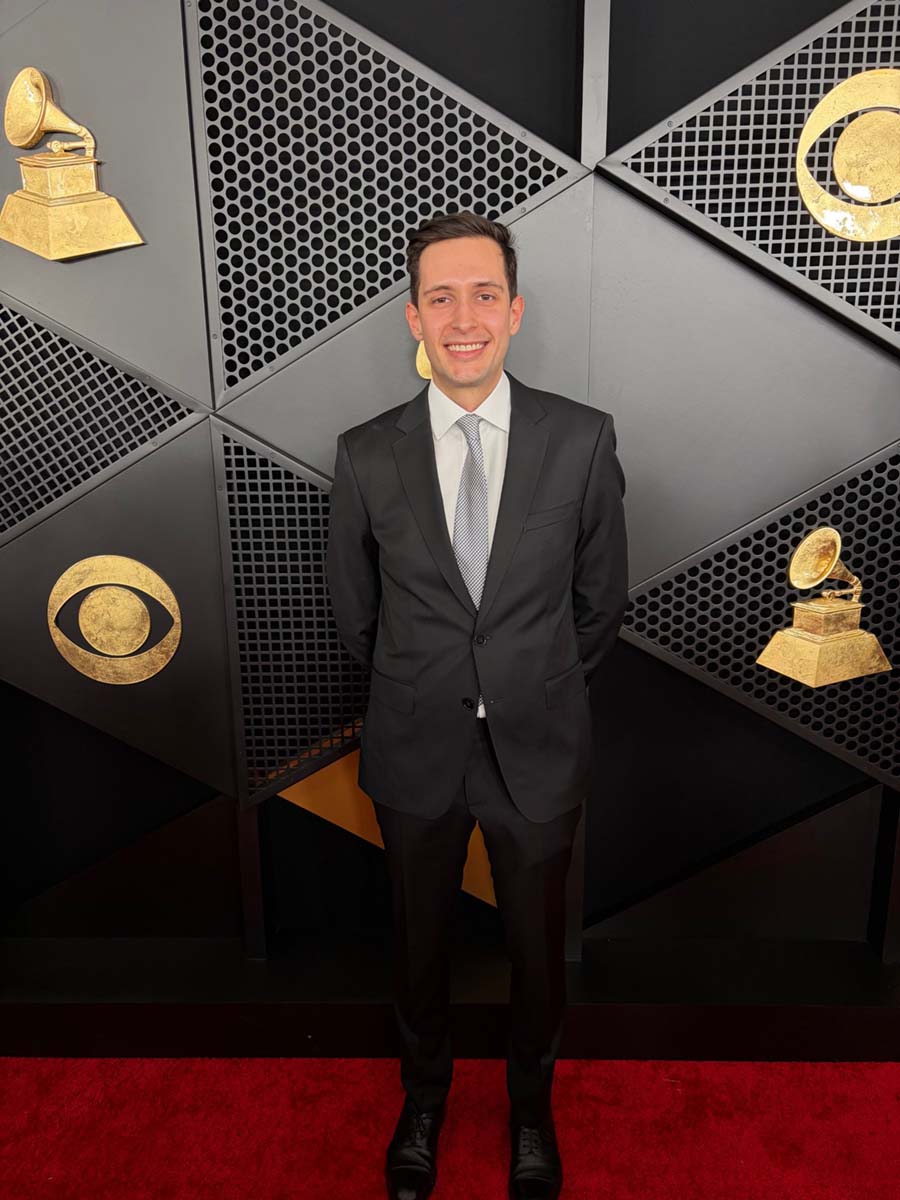
Pérez works at New York City’s legendary Electric Lady Studios, founded by Jimi Hendrix in 1968 and long considered one of the world’s premier recording destinations, hosting artists from Led Zeppelin and David Bowie to Lady Gaga and Beyoncé. Lamar recorded “Luther” at Electric Lady.
Michael Harvey, director of American University’s Audio Technology Program, says the audio tech faculty, students, and staff are thrilled to see Dani’s success at Electric Lady. “Electric Lady was the first studio designed by John Storyk—his Walters-Storyk team also designed our studios here at AU—so it’s especially fitting to have one of our hardest-working students working in such a historic space.”
As Pérez’s journey continues to unfold, we asked him what it felt like to wait through the final awards of the night, what he learned starting at the bottom in a high-pressure studio, and what advice he has for AU students hoping to follow a similar path.
PH: You were at the Grammys when “Luther” won Record of the Year—what was that moment like in the room, and when did it really sink in that you were part of a Grammy-winning record?
DP: I was nominated in two categories (Record of the Year and Album of the Year), which happen to be the very last awards of the night. The wait was definitely nerve-wracking. When Cher came out and opened the envelope to read out the Record of the Year winner, I could literally hear my heart pounding.
The moment we heard “Luther,” there was just this huge wave of excitement and happiness. I was sitting right next to close friends who had also engineered on the record, and we immediately started hugging each other. It was really beautiful.
It’s not that an award validates all the work and hours we put into the project, but it was an incredibly sweet and meaningful moment to share together.
PH: You started at Electric Lady cleaning studios and running sessions back-to-back. What moment made you realize, “Okay… I’m really doing this?”
I started at Electric Lady as an intern, running errands and helping in any way possible to make sure sessions ran smoothly behind the scenes. The moment I was given the opportunity to be in rooms with some of the most talented artists in the world, I knew that was the environment I wanted.
Being there made me realize how much I still had to learn and how hard I needed to work to reach that level. I’m a big believer in discipline, so even though I didn’t know how long it would take me to “make it,” I was fully ready to dedicate myself completely to studio life.
PH: Without breaking any studio rules, what can you tell us about what it’s like working on a Kendrick Lamar project from an audio engineer’s perspective?
DP: Any project at Electric Lady Studios requires you to be at the top of your game. There’s a reason it’s considered by many to be the best recording studios in the world, and why so many major artists choose to work there.
As an engineer, your role is to facilitate the creative process. Technology should never get in the way of the music. That means being fast in Pro Tools, confident on the console and outboard gear, and always ready for curveballs.
Versatility is key; you must adapt quickly. Beyond the technical side, being a good presence in the room matters just as much: reading social cues and knowing when to contribute and when to give space (sometimes the best way to serve a session is to step out and let the artist create freely).
PH: Looking back at your time at AU, what skills or habits helped you most once you landed in a high-pressure studio like Electric Lady?
DP: I was a graduate student at American University during COVID, and since there wasn’t much else happening, I spent every possible day in the recording studios. I mixed multitracks I downloaded online, learned every console inside and out, experimented with different microphones, and really paid attention to what made each one unique.
Reaching out to faculty members was also incredibly helpful. Professors Mike Harvey and Andros Rodriguez gave me honest insights into what working at a commercial studio was really like. They didn’t sugarcoat it (I’ll never forget Professor Harvey saying, “It’s brutal out there if you wanna follow that route,”) but they also told me it was possible.
PH: For current AU students dreaming of major credits one day, what’s one piece of advice you would share?
DP: Take full advantage of your time at AU: educate yourself as much as possible, use the facilities, and lean into the knowledge of your professors. And be ready to start from the bottom if you want to work at a major commercial studio.
If people can’t trust you to run for coffee or set up a mic correctly, they won’t trust you to be in the room with an A-list artist. Be patient, there’s no timeline in music. Some people find success young; others later in life.
Stay dedicated, believe in yourself, and have faith that the work you’re putting in will eventually pay off.