
Defining Dramaturgy: A CAS Conversation with Lindsey R. Barr
 In CAS Conversations, we sit down with students, faculty, staff, and alumni to dive into their unique insights, experiences, and ideas. From classroom innovations and personal stories to community impact, CAS Conversations offers fresh perspectives from the incredible people shaping our campus and beyond.
When theatergoers settle into their seats for the AU production of Disarming Girls, few may realize how much behind-the-scenes storytelling happens before opening night. That’s where Lindsey R. Barr comes in. A dramaturg, educator, and arts administrator, Barr helps shape the meaning and momentum of a play long before the curtain rises.
What is a dramaturg? We spoke with Barr about the art of dramaturgy and her work with Disarming Girls.
EW: Firstly, what does a theater dramaturg do?
LB: We help bring a play to fruition by supporting a playwright or director’s vision and ensuring that the story resonates with audiences. People have different euphemisms for what we do, including “the play’s doula” or “the play’s first audience member.”
Personally, I think of myself as a contextual, creative problem-solver. We think a lot about what the audience will see and take away, so we examine the play’s clarity, pacing, setting, and character relationships. We look to see what lines or scenes can be cut if that’s what the playwright is looking for, or what should be revised to serve its intended purpose. Dramaturgs also serve as researchers-on-demand, so we can answer questions about the world the play is based in, like “What season is it?” or “What does this uniform look like?”
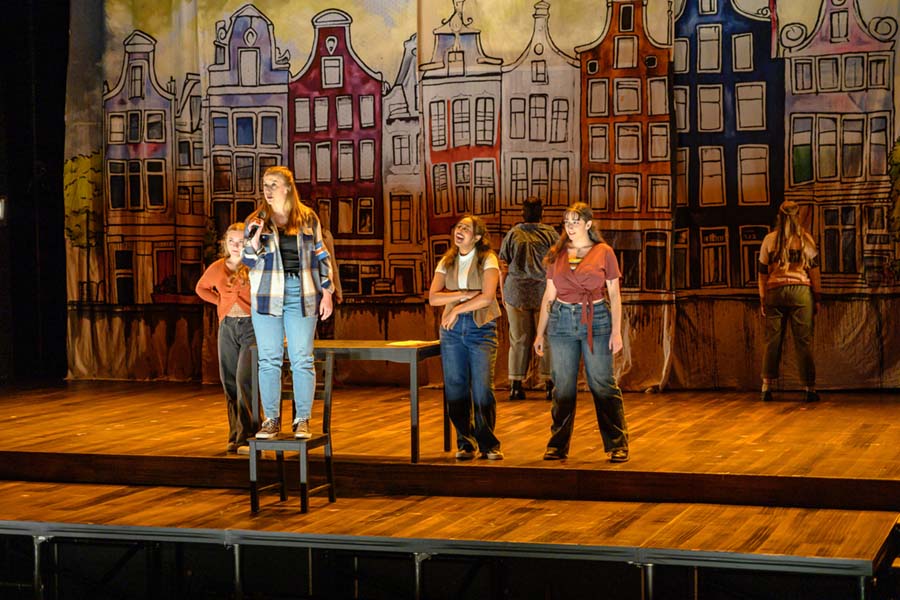 Disarming Girls cast. Photo: Jeff Watts.
EW: You mentioned that dramaturgs collaborate with both playwrights and directors. How does working with each differ?
LB: I break dramaturgy into two big camps: new play and production dramaturgy. In new play dramaturgy, I work with a playwright during the writing, workshop, and/or development process. I’m an objective eye to help them figure out what’s working in the story and what might not be working as well as it could. I ask questions to help clarify the playwright’s ideas and ensure they will translate to audiences. Production dramaturgy provides the context for the play, including historical research and background information. We work with the play’s director to determine whether the play is working on stage, and asking questions like, “How do you want the audience to feel while watching this scene?” and making sure those intentions come through. Dramaturgs also work in an educational capacity and create materials for intended audiences to understand the play more deeply.
EW: How did you first discover dramaturgy as a field of study?
LB: I have a background in theater production design and as a student, I thought that my options were either acting or designing. I took a dramaturgy elective as an undergraduate by chance, and I thought it was so neat and encompassed my greatest interests in theater. A decade ago, you typically only saw dramaturgy classes at the graduate level. Now, there are more robust dramaturgy programs and classes for undergraduates, and some students are hearing about it in high school!
EW: What has your work on Disarming Girls involved?
LB: Disarming Girls is part of the AU Core curriculum this semester—so every AU freshman will see it—and it’s a new play, so Theatre Program faculty saw a need for a seasoned dramaturg to step in.
I’ve worked with the playwrights, cast, and creative team, and created educational materials for the audience. It’s a unique position to do both new play and production dramaturgy at the same time. After reading and analyzing the play with my spring dramaturgy class, I met with the playwrights and director to ask questions and ensure we all shared an understanding of the play. In response to those conversations, the playwrights made some revisions to the script.
In August, the playwrights came to AU to workshop the play with the cast and crew, and I helped facilitate those conversations. After that, I became a conduit for the playwrights. If someone had a question about how something should be interpreted, I would be able to answer those questions with a greater understanding of the script and what the writers want to achieve. I came to the first rehearsal with context about the play, plus I gave all the actors a glossary and pronunciation guide. I also created a guide and lobby display for audiences to shape how they interact with the play before and after the show.
As the executive director of the Literary Managers and Dramaturgs of the Americas and a professorial lecturer in American University’s Arts Management Program, Barr bridges the academic and professional world of theatre. Disarming Girls, a new play by Sarah Caroline Billings and Kallen Prosterman is on stage now—from October 16–26—at the Harold and Sylvia Greenberg Theatre. The play tells the extraordinary true story of Hannie Schaft, Truus Oversteegen, and Freddie Oversteegen—three young women who became unexpected heroes of the Dutch resistance in the Nazi-occupied Netherlands during World War II.
Read Barr’s Dramaturgy packet for Disarming Girls.