
AU Student Creates Video Game for World’s Largest LEGO Cathedral
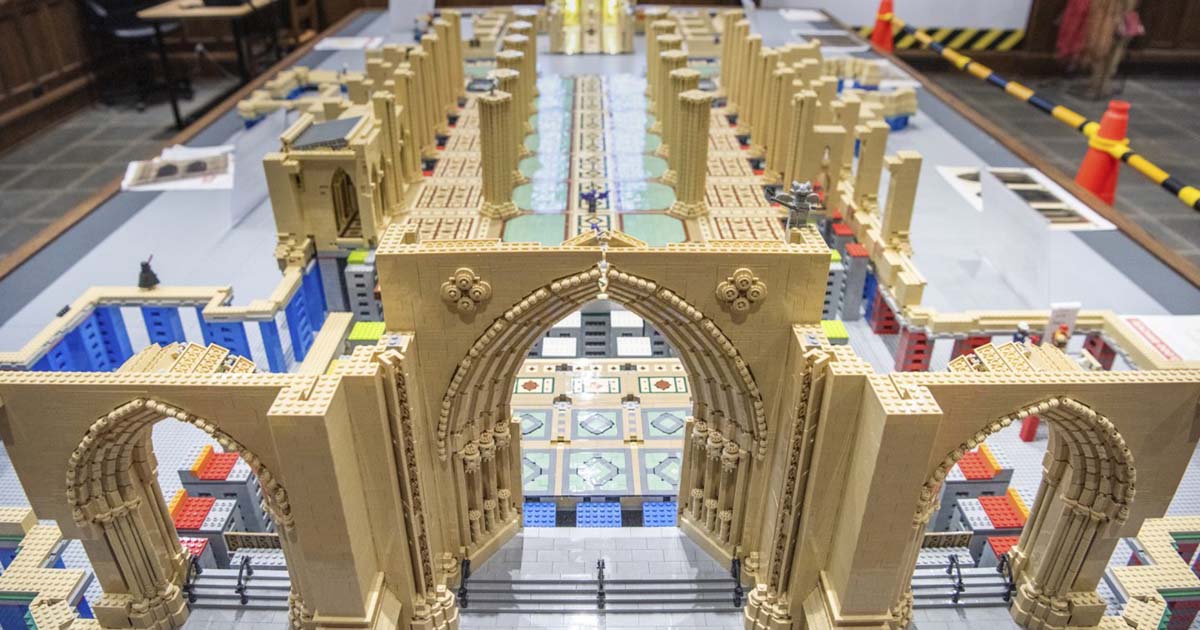 Photo by Danielle E. Thomas/Washington National Cathedral
When volunteers at Washington National Cathedral set out to build the world’s largest LEGO cathedral—an eight-foot-tall, 13-foot-long, 350,000-brick replica roughly the size of a minivan—American University computer science student Joseph DeNavas decided to take the project one step further.
Balancing full-time studies and a full-time job as a dispatcher for the American University Police Department (AUPD), DeNavas assembled a team of fellow students, faculty mentors, and even AUPD colleagues to help transform the LEGO model into a digital experience. The result: the National Cathedral Game, a playful companion to the real-world LEGO cathedral. Inspired by Super Mario Bros., the game invites players to explore a virtual version of the cathedral, collect LEGO bricks, and complete quests—blending creativity, learning, and technology in one imaginative game.
National Cathedral Game - Development Gameplay Footage
An early glimpse of the National Cathedral Game as it comes to life. Game produced by American University Computer Science student Joseph Denavas.
Merging Coding and Love of Lego
It all began as a casual weekend visit to the National Cathedral, just a mile from AU’s campus. DeNavas, who had spent countless hours as a child building LEGO and pirate ship models, was thrilled to see the Cathedral’s massive LEGO replica in progress. As he admired the design, he found himself wondering how it was all coming together and whether the builders were using a digital model to guide construction.
Curious, he reached out to Faith Wang, Visitor and Engagement Specialist at the Cathedral, to learn more. Their conversation sparked an idea: what if there was a video game companion to the LEGO cathedral? “I could probably make something cool,” he remembers thinking.
Wang shared a copy of the digital model—a CAD file containing more than 300,000 virtual LEGO bricks, designed by LEGO model maker Romão Santos in Portugal. From there, DeNavas began collaborating with Wang, fellow AU students Nathan Payson (BS computer science ’24) and Catherine Carroll (BS computer science ’26), and faculty from AU’s Computer Science Department and the AU Game Center to turn the digital model into an educational video game.
“When Joseph first pitched the project to me, I thought he was just brainstorming,” says Computer Science Professor Mark Nelson, his capstone advisor. “But he already had a 3D model running on his laptop—and the cathedral’s team on board. He created this opportunity for himself and delivered on it.”
The Creative and Digital Process
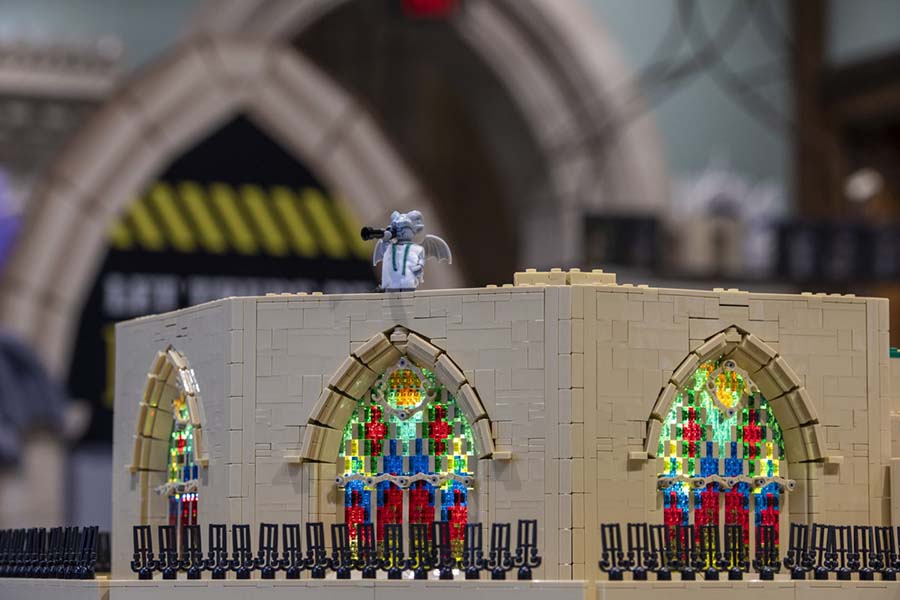 Tiny LED lights illuminate the chapel windows. Photo by Danielle E. Thomas/Washington National Cathedral
DeNavas first experimented with OpenProcessing.org, a platform for creative coders, where he built a simple prototype game. This led him to a teaching assistant position in AU’s Creative Coding course, giving him hands-on experience and mentorship under Psychology Professor Arthur Shapiro. Eventually, as part of his capstone, DeNavas transitioned the project to Unity, the software behind many professional video games. It opened new possibilities, allowing detailed character interactions, dynamic lighting, and more complex exploration than the earlier sketches could handle.
The project became a perfect blend of DeNavas’s computer science training and his self-taught passion for 3D modeling and game design. Re-creating the cathedral in digital form took months of experimentation—poring over photographs, blueprints, and even volunteer schematics from the cathedral’s LEGO team. Working in Unity, DeNavas and his team built a virtual world from the ground up, layering in dialogue, mini-games, and intricate 3D environments until the virtual cathedral came to life.
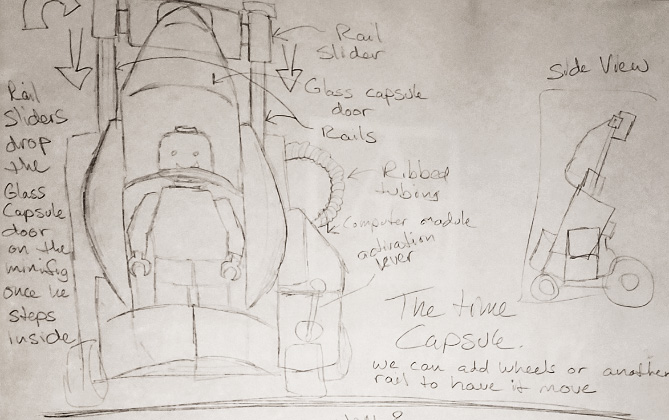 Time Machine Concept Sketch by AUPD Sgt. Kyle Johnson
As the project expanded, DeNavas brought in more collaborators. He found eager volunteers at AUPD. Sergeant Kyle Johnson contributed as a prototype designer, building LEGO models and sketches that were digitized and added to the game. Fifteen-year-old Jahdia Monroe Hood, the son of AUPD colleague Ruth Johnson, also contributed designs as part of his high school community service, making the project a multigenerational effort.
Just the Beginning
Now, as DeNavas continues to refine the game, visitors to the Cathedral are testing early versions and offering creative ideas for what could come next. He expects to complete the full version by summer 2026. Until then, cathedral visitors can play the evolving prototype on-site.
DeNavas hopes the project will serve as a model for museums and cultural centers seeking new ways to connect with digital-age learners, blending play, discovery, and education as a companion to real-world exhibits. “If we could produce more games like this in partnership with museums,” he says, “AU students would gain real-world experience, connect with people from all these prestigious institutions, and showcase their work. AU could become a hallmark for interactive learning, because the expertise is already here.”
For DeNavas, though, the cathedral game is just the beginning. He dreams of teaching creative coding, designing public AI art installations—and maybe one day bringing his creativity to Hollywood.
To Learn, Visit, and Play
You can watch the LEGO Washington Cathedral’s construction progress (or volunteer to help build) on the National Cathedral’s website. To play DeNavas’s video game, visit the Cathedral’s Family Fun Days each month—the next on November 8. Once all game updates have been completed, the game will remain in the National Cathedral’s Lego Exhibit for visitors to play during visiting hours.