
100 years of Undergrad Exhibit: Remarks from the Curator
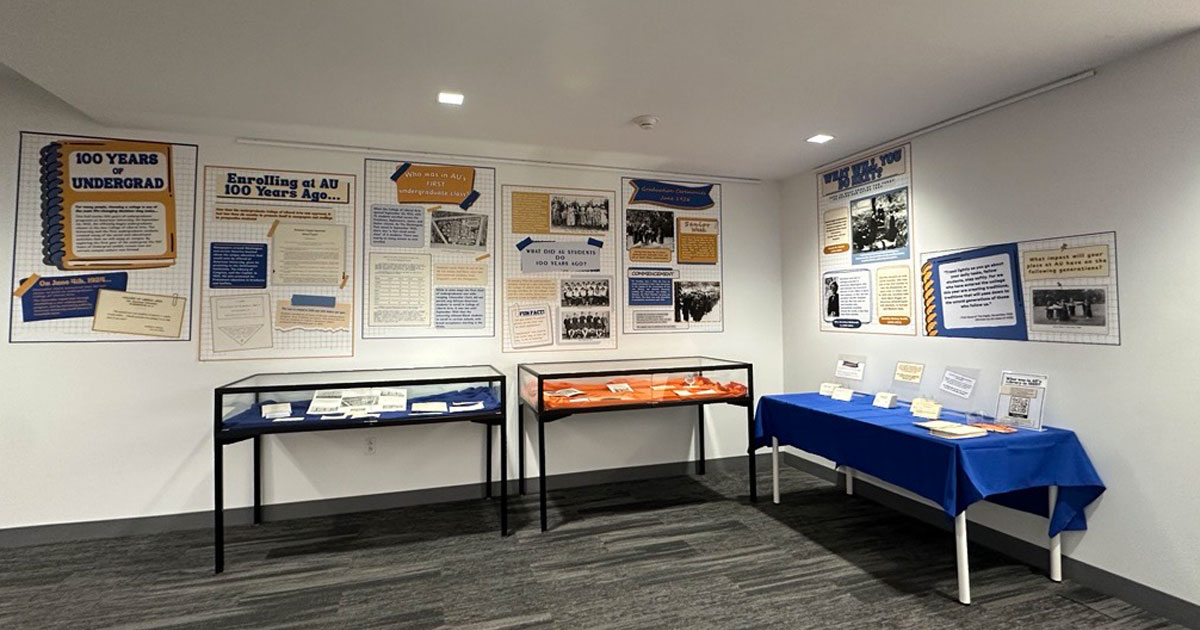 Fall 2025 marks the 100th anniversary of undergraduate programs at American University. On September 23, 1925, AU officially began undergraduate classes in the new College of Liberal Arts. To commemorate this milestone, I designed an exhibit titled 100 Years of Undergrad through my role as the Outreach Fellow for the University Library’s Archives and Special Collections. The exhibit explores the first year of undergraduate life at AU and illustrates how early student traditions and values laid the foundation for today’s campus culture. This article describes the process of curating the exhibit and presents several fascinating discoveries from the experience.
Research and Concept Development
Leslie Nellis, the Head Archivist, proposed the idea of creating an exhibit to celebrate the centennial of AU’s undergraduate programs. As a Public History Master’s student with a focus on museum studies, I was elated by the opportunity to serve as the sole curator of 100 Years of Undergrad. While I have previously assisted with exhibition development in the past, this was the first full exhibit I independently researched, wrote, designed, and installed. To meet the university’s centennial timeline, I completed the entire curatorial process within one month—from concept to installation.
My research began with the six seniors who graduated in June 1926—the first class to earn bachelor’s degree from American University. Their academic journeys, extracurricular leadership, and professional accomplishments after graduation revealed how the very first AU undergraduates were already determined to build a legacy that would outlive them. This discovery led me to use this compelling narrative to guide the exhibit which invites today’s seniors to reflect on this history and consider how they, too, will shape AU’s future.
Designing a Historical Narrative
After solidifying my knowledge on the 1925-1926 school year, I consolidated my research into a chronological exhibit script: beginning with the university board’s decision to establish the College of Liberal Arts, continuing through the first class’s activities and graduation ceremony, and concluding with the early achievements and evolving legacy of AU’s first alumni. Once the script was finalized, I developed a visual design to present this history in an engaging and accessible format.
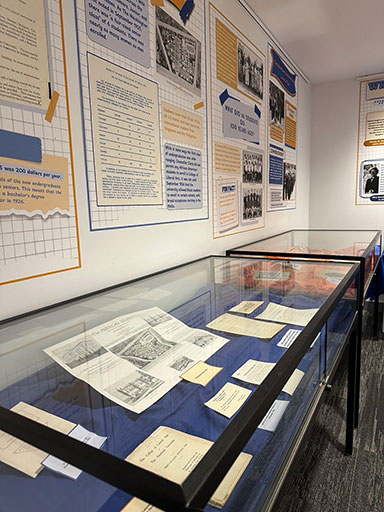
The exhibit’s theme, blue and orange, is a nod to the colors selected by the first undergraduate class in January 1926 for the College of Liberal Arts’ motto and seal. I designed the exhibit panels to resemble pages from a college notebook, creating the impression that visitors are flipping through a scrapbook of the first undergraduate year. The first panel, featuring the main exhibit label, resembles the front cover of a notebook; the final panel mirrors the back cover. Each panel in between appears as graph paper with the exhibit’s historical information written on top.
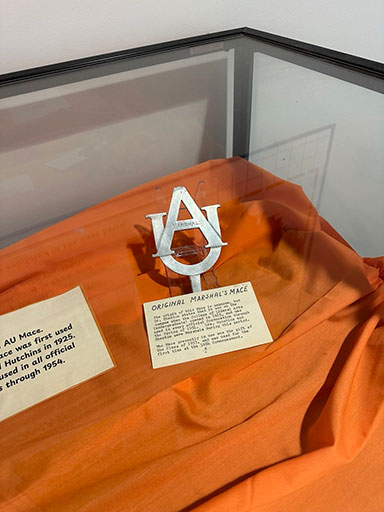
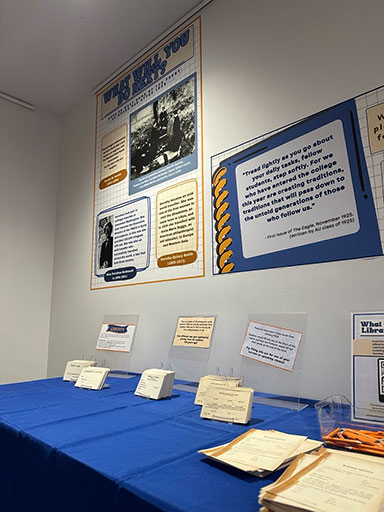
After inserting the exhibit text and images into the design, I selected and removed the corresponding artifacts from AU’s archive. On installation day, I arrived at Bender Library and hung the panels along two adjourning walls and arranged the artifacts in display cases below. Beside the cases, there is an interactive activity table that invites visitors to engage with replicas of 1920s documents.
Unearthing Histories: Discoveries and Decisions
While researching for the exhibit, I discovered 1920s slang in The Eagle, AU’s first undergraduate student-run newspaper. One student journalist wrote that school spirit was “only so much applesauce” if students failed to take action to improve their campus. In the 1920s, “applesauce” was slang for what we might now refer to as “nonsense” or “a bunch of bologna.” I included this phrase in the exhibit to bring the era to life and illustrate how student humor and critique have long been a part of AU culture.
A more sobering discovery came in the form of letters between the AU Chancellor, Lucius C. Clark, and John Haywood, a dean at another university. These letters revealed that Chancellor Clark opposed admitting African American students to the College of Liberal Arts undergraduate program. Including this correspondence in the exhibit was a difficult but necessary decision. As a curator, I believe it is essential to present history in its full complexity—even when it reflects uncomfortable truths about an institution’s past.
Reflection and Legacy
Curating 100 Years of Undergrad taught me how deeply the first undergraduate class influenced the spirit that still defines AU today. My biggest takeaway from this experience, which I highlighted in the exhibit, is that the first undergraduate class fostered a culture of vibrant energy, student involvement, and entrepreneurial initiative. These qualities continue to shape AU students in 2025.
The first class created sports teams, a drama society, a student newspaper, and a student government, among many student organizations. Notably, all these organizations still exist today, in one form or another, a testament to the enduring passion, creativity, and resilience of American University students over the last 100 years.
100 Years of Undergrad is located on the first floor of the Bender Library at American University and will remain on display until February 2026. Visitors to the exhibit can experience filling out facsimiles from 1925, including an undergraduate enrollment form and a class registration card. The exhibit is permanently available online through ArcGIS StoryMaps. To explore a collection of rare books that were in AU’s collection during the 1925-1926 school year, click here. For more information on the Archives and Special Collections, click here.