Stay up-to-date
Be the first to hear our new episodes by subscribing on your favorite podcast platform.
Like what you hear? Be sure to leave us a review!

School of International Service on a map
4400 Massachusetts Avenue NW Washington, DC 20016 United StatesOver a 20-year span, countries in the Global North spent more than $70 billion to control migration in the Global South—but with evidence that, in some cases, those funds aided autocracy. SIS professor Nick Micinski and Rice University professor Kelsey Norman join Big World to explore how aid intended to control migration has led to increased repression in the Global South. Micinski and Norman are coauthors of the new book Aiding Autocrats: Migration Management, Governance, and Repression in Africa, which examines the history of migration management aid—a form of aid the United States recently used to deport Venezuelans to El Salvador. In this episode, they trace how this form of aid leads to repression and consider what other solutions exist.
0:07 Madi Minges: From the School of International Service at American University in Washington, this is Big World, where we talk about something in the world that truly matters.
0:15 Kelsey Norman: The root causes of migration are multifaceted, but this type of aid aims to improve living conditions for people to such a great extent that they wouldn't even choose to migrate in the first place. It sounds nicer than other forms of migration control and migration management, but this kind of funding just keeps flowing, even though we have evidence to show that it doesn't actually accomplish its aims, which is reducing migration.
0:40 Nick Micinski: We're deporting people back to sort of legal black holes, right? What is the legal process for someone who's an asylum seeker in the US but now has been deported to somewhere like Equatorial Guinea? These are legal black holes that they have not resolved yet and are pushing us into really dangerous territories for rule of law.
0:58 Madi Minges: I'm Madi Minges, and that was SIS professor Nick Micinski and Rice University Professor Kelsey Norman. They join us today to talk about the history, impacts, and shortcomings of migration management aid. Nick is a professor here at SAS in the Department of Peace, Human Rights, and Cultural Relations, whose research focuses on the global governance of migration. Kelsey is a fellow at Rice University's Baker Institute for Public Policy and Director of the Women's Rights, Human Rights and Refugees Program. Her research focuses on the politics of migration and refugee hosting. Here is our conversation. Nick Micinski and Kelsey Norman, thank you for joining Big World and welcome to the show.
1:40 Kelsey Norman: Thanks for having us.
1:40 Nick Micinski: Thank you.
1:41 Madi Minges: So today we're going to spend some time exploring the topic of migration management aid, considering how it's used to reduce migration, and also examining some of its pitfalls. All of these are topics that you two have explored in a co-authored book entitled Aiding Autocrats: Migration Management, Governance and Repression in Africa.
2:01 Madi Minges: Just to help situate us a bit, in the book, you define migration management aid as foreign aid from donor countries or international organizations to countries of origin or transit with the purpose of controlling migration. So, Nick, to kick us off, I want to pose the first question to you. Can you tell us about any recent examples of migration management aid that our audience might recognize?
2:25 Nick Micinski: Yes, sure. Thank you again for hosting us. I think it's good to start with the US and this Trump administration. So the US has negotiated several deals for third country deportations. Think the Venezuelans who were deported to El Salvador in early March 2025. The US negotiated $6 million for El Salvador to host these people in the infamous CECOT super-max prison. And there are others, of course, more than 35 other countries around the world have signed agreements with the Trump administration since they came to power a year ago, and almost $4 million in those deals.
3:08 Nick Micinski: Usually it's the US government giving directly this money to those governments, and often they are quite shady governments with bad human rights track records. So for example, they signed last year a deal with Equatorial Guinea for $7.5 million directly to the government. This is a government that has a track record of embezzlement and repression.
3:31 Nick Micinski: 53 people have been deported to Equatorial Guinea since Trump's deal, most of whom had humanitarian protections in the past. So think they either had asylum claims or had some sort of protection from deportation because their country of origin might also have human rights violations. There've been reports that those people also have been repatriated back to those home countries, which is what they were supposed to not do to begin with.
3:58 Nick Micinski: So these are just a few larger examples from just in the last year, but we see this again and again with other countries as well. So think the EU Turkey deal. This was in 2016. The European Union negotiated with Turkey six billion euros of aid to try to prevent Syrians coming to the European Union. We have EU Libya, which is another deal, millions of euros with the Libyan Coast Guard to intervene, intercept migrants in the Mediterranean and bring them back to Libya.
4:32 Nick Micinski: But these are just the high profile deals that represent what we see as migration management aid. Although we don't just limit it to these big deals like that, we also think of more typical development aid or humanitarian aid and the ways that that also is used to control who's moving across borders and a sort of larger system in global governance.
4:55 Madi Minges: Nick, thank you so much for providing that context and some of those examples of recent examples of migration management aid to help situate us. I think that's really helpful as we're getting into this conversation. Kelsey, I'd love to pose this next question to you. Can you help us understand what are some of the goals of migration management aid and what is the vision as to how it's supposed to work?
5:21 Kelsey Norman: So its central goal is to contain or reduce migration, whether from sending countries or transit countries, countries that host a lot of refugees as well. And it's very much tied to what's referred to as this root causes narrative. So the root causes of migration are multifaceted. They can be people need to migrate or want to migrate for all sorts of reasons, but this type of aid aims to improve living conditions for people to such a great extent that they wouldn't even choose to migrate in the first place. So this can be because we improve democratic governance in a country and thus because of better governance conditions, people would choose not to migrate, or it can be about improving economic development to such a point that people have more opportunities, whether it's education or work, et cetera, that they don't even want to migrate. So it's this narrative that if we can just make the situation better for people in poor or middle income countries, they won't even want to leave.
6:19 Kelsey Norman: And there's a lot of problematic understandings of that idea of root causes of migration. We know from economic studies and political science studies that it doesn't actually work, that this type of aid doesn't really reduce migration, but it's almost become, as some scholars have argued, impervious to critique.
6:39 Kelsey Norman: It sounds so nice. It sounds nicer than other forms of migration control and migration management that this kind of funding just keeps flowing, even though we have evidence to show that it doesn't actually accomplish its aims, which is reducing migration. And so we ask in the book, well, if it doesn't really reduce migration, what does this type of aid do? And that's when we get into this idea of, well, it actually has pretty impactful consequences for governance in recipient countries. And that impacts not just migrants or would be migrants, but citizens as well. And so that question is really at the heart of this book.
7:16 Madi Minges: And we will certainly talk a bit more about the ways migration management aid is not exactly accomplishing the goals of reducing migration, as you just mentioned. But I do want to quickly go back to something that was mentioned earlier. Nick, you mentioned these current agreements under the Trump administration. Can you say a bit more about these agreements, and are these new or is there a precedent for this?
7:44 Nick Micinski: So they are new in some ways and a continuation of old policy in the past. So the Trump administration has scaled it up in ways that it has never done before. We're looking at 25,000 people over just the last year sent to third countries which are not their country of origin. And it also does not have the same human rights protections that they would've in the past. In the past, under the Obama administration or even Bush before that, there were a few countries that received these deportations. The numbers were in the 40s. It wasn't very high numbers, and they would've been considered by most human rights organizations pretty safe countries of origin. Now I think, Kelsey, do you want to talk about how Europe has responded in the past?
8:29 Kelsey Norman: Sure. Yeah. I mean, in a lot of ways, the mechanisms at play in these more recent Trump agreements look a lot like readmission agreements that the European Union has been using for a long time. So individual European states can negotiate readmission agreements, but also the EU as a whole can negotiate readmission agreements. And that means that someone who is not a national of a country would be sent back from Europe if they're someone who doesn't end up getting asylum or just another migrant to a country that they're not from.
9:00 Kelsey Norman: So that has been a mainstay of the way that Europe has used this type of aid to negotiate these agreements, across North and Sub-Saharan Africa but also much farther afield in the Mediterranean, but also in Asia, for example.
9:16 Nick Micinski: And one of the ideas embedded in that is the idea that they're a safe third country, right? And that means if someone transited through that country, they may not be a national of that, but that it would be safe to deport them back to that. Of course, there are controversies about whether or not they are actually safe or not, but it seems like the U.S. and even Europe are turning away from if empirically they need to be safe, but just practically that they'll accept them back.
9:42 Nick Micinski: This raises all sorts of human rights concerns, in addition to the idea that we're deporting people back to legal black holes. What is the legal process for someone who's an asylum seeker in the U.S. but now has been deported to someone like Equatorial Guinea? What court or system do they have to be able to get themselves out of detention, and what's the future of their legal status? These are legal black holes that they have not resolved yet and are pushing us into really dangerous territories for rule of law.
10:14 Madi Minges: This brings up, I think, another kind of contextual question for me about how did this form of aid originate. Nick, could you tell us a little bit more about the broader context of this? How did this form of aid begin?
10:30 Nick Micinski: Sure. So there's two ways to look at this. We can do a quick snapshot of what the last 20 years looks like, and that's actually where our book shines. We created a new data set and quantified for the first time a real number of how much money in this development world is being spent to control migration. And so over the last 20 years, from 2002 to 2022, we measured that $73.7 billion was spent to control migration in the Global South in poorer countries.
11:02 Nick Micinski: From there, we can see that it was massively increased over the last 20 years. It went from just 700 million in 2002 to 8.7 billion in 2022. That's an increase of a thousand percent, so dramatically, exponentially increasing in these last 20 years. Of course, this outpaces development aid. It sort of follows development aid trends, but it outpaces development aid, which only increased 200% in that same period. So migration management aid is becoming or was becoming a bigger priority in the aid sector.
11:36 Nick Micinski: What's interesting is that from the earlier parts of the data set to 2016, the U.S. and the EU are about equal donors here. But in 2016, you may remember, there was something called "the European migration crisis," and we put that in air quotes here because it is a crisis of reception, not necessarily a crisis of migrants. But after 2016, the EU starts spending four times more than the U.S. And really becomes the entrepreneur in this space, really spending a lot of money, and we see it spending it in Africa. One of them is the European Union Trust Fund for Africa, and it was specifically aiming to target this type of migration aid. And we, in the book, trace that, the origins of that, and we see how it changes and its impact.
12:25 Nick Micinski: And so the short answer, I guess that wasn't that short, but the answer there was that we see a dramatic increase in the last 20 years, and in the last few years, dramatic cuts, with the Trump administration and the EU also cutting. In the long run though, our book traces it back to colonial times when European countries were also interested in pouring money into colonies or protectorates in the Horn of Africa, one, to extract wealth and value, and two, to control populations. And we can see that throughout history, a sort of pattern of intervention and control that starts under the colonial era and continues through independence era during decolonization, and then again here in the last 20 years. And we trace those in each of our case studies, Egypt, Sudan, Kenya and Ethiopia.
13:20 Madi Minges: So yeah, it seems that there's this timeliness to this topic, but also this kind of unfortunate evergreen nature to this topic as well. Kelsey, can you talk a little bit? I know Nick had mentioned some immediate examples that would come to mind or kind of help situate our listeners of migration management aid, but can you tell us a bit about where this is happening the most?
13:45 Kelsey Norman: Yeah, sure. So Nick just gave us a snapshot of what the data in our book tells us about patterns of distribution of this type of aid over the last 20 years, and that really reverberates with sort of three corridors that we know about where we see this type of aid being used most prominently. So we talk about Europe as a norm entrepreneur in this field. Nick talked about how after 2016 it really took off, and the EU became the main leader in distributing this type of aid. But even prior to that, as the EU was created and as the Schengen area within the EU was created, Europe took a lot of measures to seal its external borders, and it did that through these agreements with countries in its periphery in Eastern Europe, across the Mediterranean and across Africa.
14:38 Kelsey Norman: So this type of aid and the agreements inherent to it have been building for quite a while, but we can't really leave out Australia, because it was also a norm entrepreneur in a lot of ways in the Pacific and the Asia Pacific region, in terms of its use of different legal mechanisms to ensure that asylum seekers no longer had access to Australian territory and the way that it brought other countries, especially small island countries, on board as part of that. And all of that was built around this model of aid distribution to countries that were willing to host asylum seekers so that they wouldn't be able to get to Australia.
15:16 Kelsey Norman: And so the U.S. is now becoming an entrepreneur in a different sense in terms of these deportation agreements that Nick talked about at the top of the show, but we see different expansions of this aid really across these three different migration corridors. And in terms of the data that's represented in the book, there are a number of different countries that receive this type of aid. So we focus a lot on aid distributed by Europe, as Nick said, through the European Trust Fund for Africa that was established in late 2015, and how countries across North and Sub-Saharan Africa have been receiving this type of aid, what it does to those countries that receive it.
15:59 Kelsey Norman: But if we look a little bit longer than that at these really protracted conflict situations across the Middle East and Africa, countries like Turkey, Iraq, Syria, the West Bank in Gaza, Lebanon, countries where money is being used to assist people, sure, but also to contain people in displacement situations so that they don't move onwards towards the Global North. And that is exactly what happened in 2015 and why we then saw this uptick of this type of aid being used by Europe in order to prevent something like 2015, 2016 from happening again.
16:39 Madi Minges: Kelsey, you talked earlier about some of these goals of migration management aid, of how it's supposed to work, and you kind of alluded to the fact that it's not necessarily working, so I'd like to pull on that thread a little bit more. Nick, I'll pose this question to you. Can you talk about how migration management aid shakes out in practice, and then how does it end up, as the title of your book alludes to, aiding autocrats?
17:09 Nick Micinski: Yeah, absolutely. So our book traces three pathways of how migration management aid can lead to repression or authoritarianism. In theory, the aid could lead to better democracy and governance. And we actually, when we were modeling this and thinking about it in our data, we're looking for those types of ways that it could lead to more democratic governance. Unfortunately, we didn't see great examples of those and so have focused the primary risks of leading to repression.
17:38 Nick Micinski: So the first pathway is that aid can be directly funding repression, but there are ways in which aid can be used to purchase new border or surveillance technologies or training for security forces, which could then be complicit in acts of state violence or repression. Alternatively, a recipient government is able to redirect aid from its intended purpose towards state violence. So in theory, we can see this happening in all the things, and we see it trace out in several of our case studies. The second pathway looks at how aid can be used as a substitute for capacity that then is used for repression. Here, it's when aid is for a specific sector like education, and it allows the recipient government to decrease its spending in another area and instead increase that spending that they would've used on that other sector for repression, a substitution effect.
18:31 Nick Micinski: And the third is when aid ties domestic actors to state power. And this is when aid formalizes a relationship between the service providing NGOs that are often working directly with refugees or internally displaced people and state institutions. Thereby, they reduce the space for criticism, accountability, and the sort of checks on power that these NGOs or civil society would've had otherwise.
18:57 Nick Micinski: So that third one sort of restricts the movement and politicizes aid in a way that it wouldn't otherwise. Those three together we can see can raise the risks and we don't conceptualize aid as sort of turning a democracy and flipping a switch and turning into a dictatorship. That's got to be way more nuanced than that. Instead, we see institutions and practices changing gradually over time and that this funding can facilitate, can support and can be redirected in smaller institutional practices in those spaces.
19:32 Madi Minges: I'm curious how, I know you two are deeply researched in this area, but I'm curious if there's this ongoing repression that is happening as a result of this, is there a push anywhere to change the approach? My main question I guess is how does this keep happening if the outcome is repression? Do you think it's a lack of tracking or a lack of awareness about it or is it something else?
20:10 Kelsey Norman: Well, maybe I can provide an illustrative example from the book that gets at how different actors are conceptualizing this in recipient states, but also in funding states. So probably the worst case example that we examine of the four cases we look at in the books, so not necessarily the worst case globally or even in North and Sub-Saharan Africa, but within the four that we look at, was Sudan.
20:36 Kelsey Norman: And part of that is because Sudan was a country that the EU really didn't have any business providing funding to from the get-go in that they couldn't work directly with the government of Sudan because there was an ICC indictment against former President Omar al-Bashir for his committing a genocide in the earlier part of the 2000s. So they had to be kind of crafty in how they even worked at all with Sudanese institutions and provided funding to the country.
21:05 Kelsey Norman: And some of the domestic programs were well-intentioned. They aimed to address traditional development needs within Sudan, with the intention still of preventing migration from Sudan or onward migration from Sudan. But nonetheless, the regional projects in Sudan were those that came under a lot of scrutiny because they were directly related to improving migration management capacity in the country. And that means patrolling borders and it means empowering certain security actors.
21:38 Kelsey Norman: And within the country, the rapid support forces, the RSF, had been appointed a few years prior to Sudan receiving funding from Europe under the EUTF, as the RSF had been appointed as the primary border force responsible for patrolling Sudan's northern borders between Libya and Egypt or from Sudan towards Libya and Egypt. And domestic actors, domestic civil society groups in Sudan went to the European Parliament and said, "Do not provide this type of funding. Do not empower security actors that are responsible for patrolling borders, specifically the RSF in the country, because this will have really dire consequences." They are a group that grew out of the Janjaweed militias that also committed atrocities in the early 2000s.
22:24 Kelsey Norman: And domestic actors were well aware of the possible consequences. And even EU documents that Nick and I examined in the book acknowledged that there were extreme risks to providing this type of funding. And in our role as researchers, we cannot identify direct funding that passed from the EU to the RSF, but there were trainings. There was the provision of equipment. There was all these sort of aspects that are part and parcel of capacitating a country's ability to manage migration by which you can assume that the RSF as well as other security actors benefited from this type of funding.
23:02 Kelsey Norman: And so now the RSF is one of two parties to the ongoing civil war in Sudan, and domestic actors were very aware that this kind of consequence could result. So I think this is a case where there was pushback and yet the EU proceeded with the type of funding. And this is, as Nick said, we're trying to be nuanced. We're not saying that because the EU supported border capacity in Sudan, that now the RSF is engaged in a three-year civil war with the Sudanese armed forces. But nonetheless, this empowerment and the legitimacy that was afforded to this known violent group within the country had consequences and the EU is very much willing to turn a blind eye to what those consequences might be.
23:46 Madi Minges: Wow.
23:47 Nick Micinski: There's also another dynamic that's really important is that the EU is not the only nefarious actor here. There is a real negotiation with African political leaders who are pushing back and using the aid for their goals. These are real negotiations where the EU wants certain things and African leaders want certain things as well. Access to aid, but also political legitimacy and otherwise. I can give an example from Ethiopia if you'd like, which is that early on in the Prime Minister Abiy Ahmed, he was given the Nobel Peace Prize for creating peace in Northern Ethiopia, very soon broke out into war, but also was welcomed to the Obama leadership summit on refugees and promised nine infamous pledges of like, "This is how we're going to help refugees in all of these ways," and was rewarded economically. They got a big aid package and otherwise.
24:45 Nick Micinski: When it came to implementing it, we saw all three of our pathways tracing the aid in it, both repression, substitution, and the sort of tying domestic actors to it. When the war broke out in Tigray in 2020, the federal government, the prime minister, directly stopped refugee aid from going to the north, politicizing it and controlling it. So you see this back and forth push and pull. Sometimes it's in the advantage and sometimes it's not. And when it does actually align, both actors have an interest in it. It may not be the interest for the entire country, but for the leaders, it has direct interest and can play to their own political agendas. So it is not just the EU telling everyone what to do here. There are deals that are being made across the board.
25:37 Madi Minges: Sure, sure. Thank you both for sharing those examples. I think it's helpful to get a sense of, especially Kelsey in your example of where there were very clear warnings from people saying, "Please don't do this." I guess the question that it brings to me after hearing these examples of when things went kind of wrong, is there anything that you found that this form of aid does manage to get right?
26:09 Kelsey Norman: So referencing the Sudan example again, Sudan, the targeted sectors for the domestic funding were things like agriculture, education and health, which we argue in the book are relatively low risk sectors where we aren't as likely to see our three pathways towards increased authoritarianism or increased repression at play. And there were some important gains in those sectors as a result of these projects. But the problem was that the regional projects, which focus entirely on security priorities, the negative impacts of those projects just totally overshadowed any positive gains from the domestic projects. And now the country is ensconced in this civil war and any progress made on those other three areas, education, health, and agriculture are basically eviscerated. And then I would say in another one of our cases in Egypt, there was a considerable amount of money put towards improving labor agreements so that Egyptian nationals would have the opportunity to migrate regularly to Germany specifically, and so there was quite a bit of labor put towards the possibility that something like, in the end, 200 Egyptian nationals would be able to migrate to Germany to work in different industries. And I think that's a very positive idea and conception, but the reality is that so few people benefited, this is a country with a population of 100 million people, that the positive results were just not widespread enough and not large scale enough to really make a difference in terms of changing people's decision making around irregular migration, which is ultimately what the project hoped to do.
28:01 Kelsey Norman: So there's a matter of scale, there's a matter of priorities. So much more money was poured into these security priorities as opposed to human rights focused priorities or just regular migration pathways that it didn't in the end make enough of a difference to really change the outcomes for people.
28:20 Nick Micinski: It could also be argued that our critique undermines the reason why we even give aid to refugees, and I would argue that's not what we're saying. We believe that there can be a reformed and better system of humanitarian aid for refugees and that food aid to refugees is important, but let's not pretend that's changing the structure of the entire system. Right now, we have a system where rich countries are paying poor countries to keep refugees away from them and in poor periphery areas with very few rights and very little access to any mobility. That system is fundamentally unjust and creates all of the problems that we're just talking about here.
29:03 Nick Micinski: Now, providing food to keep people alive, that's important, but we can also reform the rest of the system. Think about real legal pathways for people to move to different places, really redistributing economic wealth to places where it would make a difference. The aid that we're providing though is pennies on the amount that would be needed to change any of this thing, any of these issues. So instead, what we see is the aid becomes a PR exercise showing that, oh, we're doing something good for refugees abroad. Yes, we do want food aid for refugees, but it's not nearly enough to actually change the structure of the system. Yes, we do want rights for people to move to new places, but you haven't done it for nearly enough people.
29:44 Nick Micinski: And we're seeing around the world, frankly, a real walking away from the rights-based approach to migrants and refugees where people who are fundamentally vulnerable in the face of war, violence or persecution, and the governments of the Global North are looking the other way or deporting them back to really vulnerable places. This is a dire state, and the answer is not to cut food aid. The answer is to recommit ourselves to these rights and to a more equitable world around us.
30:16 Madi Minges: Nick and Kelsey, my last question, I want to give both of you the opportunity to answer. Are there better solutions out there? And if so, what are they? Can you describe them?
30:30 Kelsey Norman: So one of the main takeaways we have from the book is that we have to separate out the different components of this type of aid, of migration management aid. The part that really aims to physically prevent people from moving, or as Nick was just talking about, forcibly returning them to countries, either countries of origin or sometimes just third countries to which they have no association, that part cannot be justified. I mean, we know it doesn't work, but it also has these really incredibly negative externalities, not just for the individuals themselves, and that is so important, but our book also shows that it has negative consequences for the countries that receive it in terms of governance, in terms of opportunities.
31:15 Kelsey Norman: And so this matter is not just for migrants and refugees and asylum seekers, but for citizens, so it's actually in a lot of ways running counter to the very purposes that it alleges to improve. If it wants to improve democratic governance, well, it's actually in many of the cases that we show in the book, it's actually doing the opposite. It's making governance worse and it's making human rights violations more common, so that part cannot be justified and we argue has to become, you know, has to be disassociated from this type of aid.
31:47 Kelsey Norman: But then secondarily, as Nick was just saying, the part of this aid that focuses on humanitarian actions and improving humanitarian situations, that part can be justified, and in contrast to what we're seeing now in terms of it being cut, we're arguing that it really needs to be amplified, but it has to be done so with transparency and with accountability measures, which was not the case of how this type of aid was implemented under the European Trust Fund for Africa. So those are the two main components that we're looking at.
32:23 Nick Micinski: I would just end here with a reflection on that if we want to support migrants and refugees, one way to do that is to recommit ourselves to rule of law and democracy. In order for the European Union to push out all of this money for the European Union Trust Fund for Africa, it was actually an emergency trust fund for Africa, and in one of the footnotes of the legal document, it declared 17 African countries in "crisis," I'm putting that in air quotes again, because the crisis meant that they were able to then push out the money with less accountability and no open competitive bidding process, which is a violation of EU democratic norms of accountability, and of course there was no evidence to say these countries were in crisis in all the ways that we imagine.
33:10 Nick Micinski: And then throughout the process, we're deporting people back to places that their rights are fundamentally being violated. This is a human rights violation, it undermines and erodes what democracy is really about, and so I would say that a way to actually support migrants and refugees is commit ourselves to real democratic values in our own countries as well, in the US and in Europe as Europe is wrestling with how to move forward on the issue of migration.
33:40 Madi Minges: Nick Micinski and Kelsey Norman, thank you so much for joining Big World to talk about migration management aid and your book, Aiding Autocrats. It's been a pleasure to speak with you.
33:50 Kelsey Norman: Thank you so much.
33:51 Nick Micinski: Thank you very much. Thank you.
33:53 Madi Minges: Big World is a production of the School of International Service at American University. This episode was produced by Morgan Desfosses and edited by me, Madi Minges. Our podcast is available on our website, Apple Podcasts, Spotify, or wherever else you listen. If you liked this episode, please leave us a rating or review. Our theme music is "It Was Just Cold" by Andrew Codeman. Until next time.
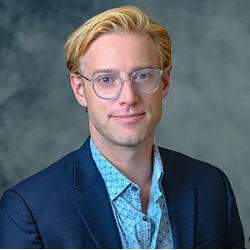
Nick Micinski,
SIS professor

Kelsey Norman,
Fellow, Rice University's Baker Institute for Public Policy
Be the first to hear our new episodes by subscribing on your favorite podcast platform.
Like what you hear? Be sure to leave us a review!