
SIS PhD Graduate Honored for Outstanding Dissertation Research
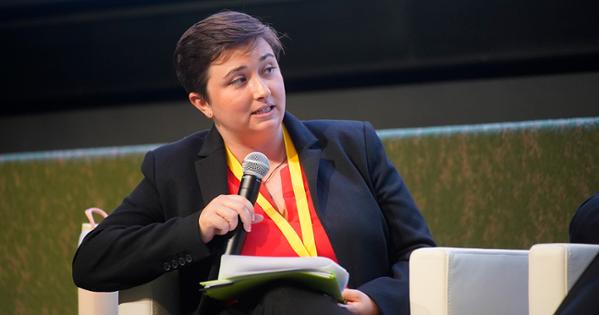
Grace Benson, SIS/PhD ’24, has been awarded $25,000 from the Cosmos Club Foundation for her PhD dissertation, in which she evaluated and compared refugee resettlement programs around the globe and developed policy recommendations to improve such programs.
This year marks the first time the Cosmos Club Foundation is offering the Cosmos Scholars Prize, which recognizes “outstanding PhDs” whose research falls into one of the following fields: social sciences and economics; biological/biomedical; arts and humanities; computer science and mathematics; and physical sciences. Benson is the sole awardee from American University.
“At this early stage in her career, Dr. Benson is already a leading scholar on refugee resettlement,” said Professor Boaz Atzili, the chair of Benson’s dissertation committee. “Her meticulously thought through and gathered dataset is a first of its kind and allows scholars and practitioners to compare, contrast, and draw conclusions about the vastly differing approaches and practices to refugee resettlement policies across different nations.”
We sat down with Benson recently to learn more about her research interests, her experience in the School of International Service (SIS) PhD program, and her future plans.
Sparking Research Interest
Benson’s interest in refugee resettlement began several years before pursuing her PhD at SIS. As an undergraduate at Duke University, Benson became involved in the refugee community in Durham, North Carolina. After graduation, she began working as a case manager for a resettlement organization—an experience that would ultimately inspire her dissertation research.
“I loved the job. I thought it was my dream job, but I really had no work-life balance,” Benson recalled in a recent interview. “I think that’s something you hear from a lot of people that work in resettlement, and essentially, that’s what got me interested in considering other models of providing service delivery and trying to figure out what best practices exist and how other places tackled dealing with so many people with so many diverse needs at the same time.”
When deciding to pursue her PhD starting in 2018, Benson said she found SIS had a “unique blend of policy and practice” that aligned with the kind of dissertation she hoped to research and write.
“I wanted [my dissertation] to be something that was really useful and practical, and I knew that I wanted to look at something that had policy implications that would have real effects on people’s lives,” Benson said. “I thought SIS was just the perfect place to do that. It really was a fantastic, encouraging environment to do that kind of work.”
Research Process
Over the course of five years, Benson conducted a comparative analysis of 26 different resettlement countries, which are responsible for “99.9 percent of all refugees who have ever been resettled,” she explained. Benson analyzed more than 1,200 different data sources and conducted 16 interviews across six countries to gather additional information on resettlement policies and available data.
From that analysis, Benson identified four different approaches to resettlement and conducted a case study on the US, Norway, Australia, and Brazil—four countries that represent four different approaches to refugee resettlement. Her analysis led her to develop several policy recommendations to “improve [the] accessibility, availability, and flexibility of resettlement programs.”
Her final dissertation is entitled, “Policies for Belonging: A Global Comparison of Refugee Resettlement Programs.”
“Grace knows as much as anyone today about the diverse policy landscapes, potentials, and challenges of refugee resettlement,” said SIS professor Lauren Carruth, a member of Benson’s dissertation committee. “She is emerging as a leader in a new generation of scholars and advocates who will help change the course of global migration and displacement policy and through research, and I am confident she will make a significant difference in lives of refugees.”
An Eye Toward the Future
Since finishing her dissertation, Benson has been focused on applying her research internationally.
She has been meeting with government officials from the countries she examined in her dissertation to share the tailored policy recommendations she developed from her analysis. In February, she presented her work at the Consultations on Resettlement and Complementary Pathways (CRCP), a multilateral forum run by the United Nations High Commissioner for Refugees (UNHCR).
With her $25,000 prize from the Cosmos Club Foundation, Benson plans to use the funding for a consultancy with the UNHCR. She is slated to begin the consultancy in November, during which she will be expanding her dissertation research and analyzing refugee resettlement programs in 34 countries.
“Through this additional research, I won’t just be looking at what services are provided; I’ll also be looking at what data countries collect on refugee outcomes. I’ll be examining how these services affect people's ability to integrate into their societies and contribute economically, culturally, and socially,” Benson explained. “I'm really excited about the next step because my dissertation wasn't able to do all of that—it was really just looking at what services are provided and not what the effects are. And so hopefully this next step will be able to extend it a bit more and make it useful.”
At a time when refugee policy is shifting around the globe and many federal research grants have been terminated, Benson said she is thankful for the award money to continue funding her research in this area.
“We have seen really huge changes in resettlement policies among countries that have historically resettled refugees. They’re now closing their doors. It’s not just the US; it's Germany, it's Belgium. A lot of other countries are shrinking their resettlement programs,” Benson said. “It’s a really hard time to be working in this field, and it's really disheartening to see all the dismantling that's been done within the system in the US. So, it's great to be able to continue my work in this way that's not tied to federal research funds.”