
American University
International
The United Nations Turns 80
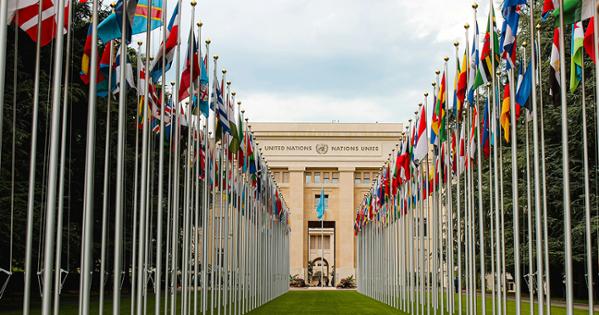
This October marks 80 years since the founding of the United Nations. Created on the heels of the destruction of World War II, the UN was created to maintain peace and prevent another world war. Today, it is the largest multilateral organization in the world with 193 member states.
On its 80th anniversary, we asked SIS professor Michael Schroeder to discuss the history of the UN, explain how it has changed, and consider its future.
- What led to the creation of the UN after World War II?
- The United Nations was a reaction to the aggression, devastation, and atrocities of World War II and the perceived shortcomings of the UN’s predecessor—the League of Nations. The lofty aspirations of its 51 founding Member States were encapsulated in the Charter’s mission “to save succeeding generations from the scourge of war.” The participating governments, at least in principle, wanted a standing organization to collectively respond to immediate threats to peace, prevent disputes from escalating into war, and address what they understood as the underlying sources of conflict: poverty, mass atrocities, and the peaceful and managed unwinding of empires.
- At the same time, there was a strong dose of self-serving great-power politics from the outset. The United States, the Soviet Union, and the United Kingdom focused primarily on establishing a Security Council to which the rest of the membership would delegate primary responsibility for peace and security. It gave the so-called Permanent Five (including China and France) special privileges, including a standing seat and a wide-ranging veto, which afforded them disproportionate influence over how the world would respond to threats to peace—and often even over what would be defined as a threat to peace. In doing so, the Permanent Five ensured that Security Council decisions advanced—or at least did not significantly harm—their national interests.
- How has the UN changed over 80 years, and what has remained the same?
- The core structure of the UN has remained remarkably stable. The Charter mission “to save succeeding generations from the scourge of war” remains vital—and aspirational. The five permanent members of the Security Council still hold veto power; only the number of nonpermanent seats has increased. The Charter itself has been revised only rarely and in limited ways. The same foundational tensions persist—between great-power privilege and the UN’s claim to universal membership and problem-solving; between state sovereignty and the protection of human dignity and rights; and between declared collective ambition and limited political will.
- But the founders would also find much today that they likely would not have conceived back in 1945. Many changes have come more through working methods and operational practices than through formal structural reform. Innovations in peacekeeping, crisis diplomacy, and electoral assistance initially emerged out of necessity and expediency. Some UN agencies steadily expanded their mandates to meet new challenges—the UN High Commissioner for Refugees (UNHCR), for example, saw both its mandate and the populations it serves expanded dramatically over the decades. More generally, the UN has evolved into a highly complex and often overlapping UN System of agencies, programmes, and funds.
- Second, decolonization moved from being one of many issues on the early UN agenda—handled through the Trusteeship Council—to the central concern of the General Assembly during the Cold War. Under the leadership of newly independent states, the UN’s support for self-determination and rapid decolonization gave rise to a growing number of member states (now 193) and, internally, to enduring North–South debates over economic development priorities and UN budgets, among others.
- Finally, the UN has become a central platform for global norm and standard setting across an ever-widening range of issues—from climate change to emerging technologies, human rights, sustainable development, and migration. In some cases, these norms have been codified in binding international treaties; in many others, they take the form of nonbinding frameworks, action plans, and declarations—like the Global Compact on Migration or much of the recent Pact for the Future—that promote collective action, especially for those actors committed to advancing them.
- Has the UN lived up to expectations?
- For many people—nope. The Cold War left the Security Council paralyzed for decades, often preventing the UN from doing much more than containing violent conflicts. In the 1990s, failures in Rwanda, Bosnia, and Somalia exposed the limits of post–Cold War optimism—the idea that the UN could build a robust system of collective security within an ascendant US-led liberal order.
- Further, the UN has historically been better at creating new mandates and bureaucracies than at fulfilling those mandates or coordinating those bureaucracies. Intergovernmental negotiations—and divisions—have often produced lowest-common-denominator agreements and vague, underfunded commitments that leave climate, human rights, and development champions understandably underwhelmed.
- But given the realities of world politics, I’ve also wondered if that is the most appropriate standard. The world’s governments are not only deeply divided, but many have mixed feelings about an empowered international organization. Indeed, these foundational problems are beyond the UN’s control—so much so that former Secretary-General Dag Hammarskjöld famously said the UN was “not created to bring us into heaven, but in order to save us from hell.” He made this statement during the Cold War, but it applies more broadly.
- By this standard, the contributions of even a flawed UN cannot be easily dismissed. As David Bosco argues, the Security Council keeps the major powers talking. This diplomatic “talk shop” buys time—delaying escalation and limiting the spread of wars in the hope that a window for de-escalation will open. Recent research from Lise Howard goes a step further and finds that the Security Council has overall “proven remarkably effective” at reducing war—even if the evidence gets overshadowed by the Security Council’s high profile and tragic failures.
- Further, a strategic UN Secretary-General—as U Thant demonstrated during the Cuban Missile Crisis—has sometimes used quiet diplomacy and face-saving to defuse crises that could otherwise have led to global catastrophe. Similarly, UN peacekeeping operations have not only enjoyed notable successes like Namibia and Liberia but facilitated ceasefires and reduced the duration of conflicts and civilian deaths, and its humanitarian agencies save millions of lives each year.
- In short, the UN—even if imperfectly and often inefficiently—continues to prevent localized conflicts from spiraling out of control and, to some degree, reduces human suffering.
- Where does the UN stand at 80, and where is it headed?
- Eighty years on, the UN's future is highly uncertain. A worsening budget and liquidity crisis has led some seasoned UN watchers to ask if tomorrow’s UN will be run “out of a burger van on 44th Street.” UN Secretary-General António Guterres recently told Member States that the UN is “racing toward bankruptcy.” The US, which anchors the UN budget, owes roughly $1.5 billion to the regular budget, rescinded previous funding to UN humanitarian relief and development agencies, and slashed future budget contributions. China also has an unpaid bill of approximately $192 million, and many donor states are tightening the aid budgets that support UN agencies.
- Further, the fiscal crisis is only one manifestation of an increasingly unfavorable environment. The organization has played a limited role beyond humanitarian assistance in the wars in Ukraine, Gaza, and Sudan. The Security Council has not authorized a major UN peacekeeping mission in over a decade. Even before today’s era of renewed geopolitical competition, public trust was eroding—undermined by both member state and public frustration, as well as by populist leaders who rally supporters by attacking multilateralism and the UN itself.
- New challenges—from artificial intelligence to pandemics and climate displacement—demand forms of coordination that the UN’s mid-20th-century machinery struggles to deliver. The hope was that the 2024 Pact for the Future would jumpstart a renewed multilateralism, but critics argued it read more like an aspirational declaration than a roadmap for revival.
- In short, this time the crisis feels different. When I first started following the UN in the early 1990s, the conversation focused on how to reform the organization to meet the moment—a focus that continued even after the disastrous missions in Rwanda, Bosnia, and elsewhere. Today, there is a yawning gap between visions of the UN’s future. Some advocates and Member States have hoped the Pact for the Future can serve as a roadmap for renewal. In contrast, if the most damaging trends continue, we may also be witnessing the UN drift toward becoming a so-called zombie organization.
- Still others, including, ostensibly, the Trump Administration, want the UN to narrow its focus and to “get back to basics,” though there is little agreement on what those basics are or how to achieve them. For some analysts, this means refocusing the UN on preventing humanity’s descent into hell through crisis diplomacy, containing conflicts, and mitigating as much of the suffering they cause as possible. Yet such a narrowed vision will be a tough sell in much of the world.
- At 80, the hope remains there is still just enough interest in the world’s capitals to justify continued financial, political, and diplomatic investment.