
How One SIS Alum Found a New Career After Unexpected Layoff
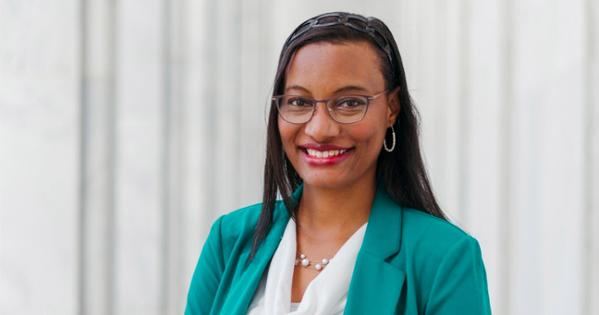
Losing a job is never easy, particularly when it was unexpected and your dream role. It can make you feel like your entire world is flipping upside down. For more than 1.1 million Americans this year, this has become a stark reality.
For Summar Lyons, SIS/MA ’14, the news that her work at Partners of the Americas, a nonprofit whose work was largely funded by the US government, was being affected by the early 2025 executive stop-work orders hit her hard. The job she loved, one she had spent over a decade working her way through the ranks, was suddenly gone.
“It was disorienting. It was uncertain. And again, there was that denial and disbelief,” she says.
But here’s what Lyons learned in the months since: an SIS degree doesn’t just open doors; it teaches and supports you in finding new ones when the old doors close. Through her own resilience and from attending SIS and AU career events, Lyons was able to secure a new role that is closely aligned with her passions.
As more than 300 SIS alumni and students have faced similar challenges this past year, Lyon’s story offers vital proof that setbacks don’t define your career trajectory. With the right mindset and supports, you can redirect it toward something even better. It is a reminder of what an SIS degree really offers: the tools to navigate uncertainty, a network that shows up when it matters, and the adaptability and resiliency to navigate through all of life’s curveballs.
Activating the Networks and Supports
Those early days of trying to follow all the rapidly changing headlines reminded Lyons of March 2020. That same uncertainty and fear crept up. But this time, she knew exactly what to do: stay grounded and find a way to move forward.
“I need to activate my network as soon as possible to let them know that I’ve been touched by this mass layoff,” she remembers being her first thought. But she also knew she had to ensure she was covered financially and mentally before she could move forward. She immediately applied for SNAP, Medicaid benefits, and unemployment with DC before activating side gigs to cover herself financially. Pet sitting provided income, but it was her continued work with Teens of Color Abroad (TOCA)—an organization she had partnered with before—that kept her centered. When the TOCA team heard about her layoff, they immediately offered her a part-time role supporting their language immersion program for young global leaders.
“Although my time at Partners of the Americas ended earlier than anticipated, I remained grounded in the same mission: helping young people access opportunities to grow, lead, and thrive,” she says.
Staying connected to that purpose, and to a network that believed in her work, proved critical to her mental health during the uncertainty. It allowed her to navigate the job search without losing sight of why she had chosen this career path in the first place.
She had spent over a decade at Partners of the Americas, so grieving that loss was necessary but so was preparing for her next opportunity.
“Where do people look for the jobs?” she recalls asking herself. “They go to LinkedIn.”
As she was scrolling through her LinkedIn feed, where she follows a number of SIS professors from her time at AU, she found two things that immediately drew her in. The first was the announcement of a GoFundMe campaign that SIS professor Nina Yamanis launched in the days after to be able to provide emergency funds for those impacted by the layoffs (nearly $20,000 was collected in just a few short weeks from SIS faculty, staff, and alums). The second was the announcement of an event hosted by the AU Career Center, “What’s Happening with Public Service Jobs? A Candid Conversation.” She immediately clicked register.
Seizing Your Opportunities
After the event ended, which included a mix of undergrads and a handful of alumni, she says, “I felt like I was seen. I felt like I was heard. I felt like I wasn’t alone.”
The AU Career team provided both the emotional space and support for the collective grief, as well as tangible next steps. She made it a point to sign up for Handshake, to stay in contact with both the AU and SIS Career teams, and then eventually showing up for a career fair that changed her entire course.
While the career fair seemed geared toward entry-level positions, Lyons did not want to waste this opportunity to find new organizations. “At least I was there. I was taking the first step forward in thinking about looking for work again,” she says.
She walked through Bender Arena—the same place where 11 years prior she crossed the stage to receive her master’s degree—browsing the numerous tables for opportunities that interested her or seemed aligned with her background. “It was an odd, full circle moment…I was thankful that I had a place to come back to get support for this next chapter in my life,” says Lyons. “I thought, ‘If AU supported me in my career trajectory back then with my master’s in hand, it could surely support me again.’”
Tucked away in a corner, she spotted a table for Teach for America. She chatted with a representative who encouraged Lyons to follow the organization online and handed her some pamphlets.
She headed home with a ton of reading material and dove into following those she met on LinkedIn. As she was parsing through the websites of the organizations she met at the fair, she found an opportunity at Teach for All, which is a global network of organizations, including Teach For America, that recruits and trains individuals to teach in underserved communities. She applied for a brand-new role that involved “supporting young people to make their early career choices in public service and purpose-driven work.”
Lyons saw “a deep sense of alignment” between this role and her former one, so she dusted off her cover letter and resume and hit submit. The stars seemed to align, and by September, Lyons officially joined the team for their Rising Generation initiative.
A New Season of Life
When Lyons thinks about how her SIS education prepared her for this moment, she needs to transport herself back more than a decade—back to 2012 when she first stepped back into a classroom after having served for three years in the Peace Corps as a youth development volunteer in Costa Rica.
“It was a totally different lifestyle in terms of being acclimated to a different culture and trying to navigate that whole experience,” she recalls. “And then that experience came to an end, and then I was going to get my master’s degree. And that in and of itself was another kind of transition.”
That transition from field work back to academia was an experience that would shape her positive mindset as she went through this difficult moment. “I got through that difficult period of figuring my way out back in academia again. I can surely figure out my way forward in this next season of life,” she says.
For others who find themselves in a similar place, Lyons’ advice is simple: “You have to have a big dose of patience as you search for the various opportunities that are out there.” She also emphasizes the importance of finding the right kind of support networks, as she remembers some folks in her life meant well but ultimately made her feel more discouraged about the job landscape.
One of the things that drew Lyons to SIS in the first place was that she knew she would “be in an environment where there were like-minded people who care about doing good in the world.” She says it’s important to share these stories of difficult times “so that they can be a source of hope for people who are in a similar situation and so that they know they’re not alone. So they know that there are possibilities to still find work that you thrive in and find work that is still very much related to your purpose.”
Her message to students and recent graduates who are considering public service work? “It is important to not lose hope, because I feel like this is such a need. I feel like right now more than ever…there’s still a pathway into this kind of work…Service is still important. Tackling these issues are still important, and we need all hands on deck.”
For those navigating their own career transitions, whether due to layoffs or other challenges, the SIS and AU Career teams remain committed to providing the support, resources, and community that help Lyons find her way forward. As Lyons’ story proves, setbacks do not have to be endpoints; with the right support, they can become a launching pad into a bright future.