
SIS Students Award $46,000 to Nonprofits in Philanthropy Capstone
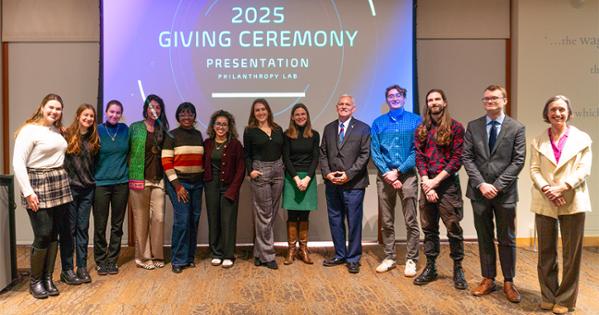
For many seniors, their undergraduate capstone classes end with the submission of a research paper for a grade. But for students enrolled in Professor Stephanie Fischer’s Philanthropy Lab, their semester instead required students to become grantmakers and ended with the presentation of two oversized checks.
On Thursday, December 4, students in the class gathered in the School of International Service’s (SIS) Founders Room to announce how they would distribute over $40,000 to eligible 501(c)3 organizations ranging from area nonprofits to international organizations. Students spent the past semester learning about what philanthropy truly means from guest speakers and class activities, creating evaluation guidelines and metrics, and conducting site visits.
This course is part of a partnership with The Philanthropy Lab, a nonprofit that provides funds to universities for a true hands-on philanthropic education. The funds for this class were generously donated by a Texas donor and an anonymous donor. American University president Jonathan Alger’s presence at the event unlocked an additional $5,000, bringing the total distribution to $46,000.
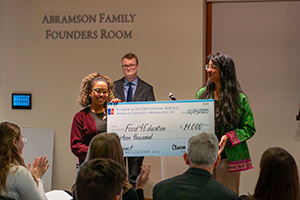
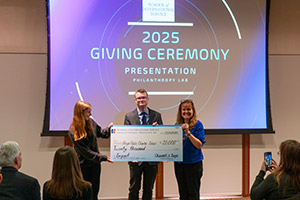 Taking home the top award of $20,000 was Briya Public Charter School located in Washington, DC. Briya uniquely takes a two-generation approach to learning by educating both young learners and their parents simultaneously, focusing on closing equity and opportunity gaps, particularly within immigrant families. The distinguished award recipient of $14,000 was Food for Education (F4E), a Kenya-based organization that works to ensure school children are fed and, therefore, better able to learn in school.
  Four other finalist organizations will receive $2,000 apiece. They are FRESHFARM, Humans for Abundance, Martha’s Table, and GOAL Global. Five other organizations hosted site visits by the class and will receive $800 including Thrive DC, Yaay Me!, Bread for the City, Seed Programs International, and AU’s own The Market.
Trust the Process
Students in the class found that identifying common values and issues amongst a very diverse group of experiences and individuals was more difficult than they first imagined. One student presenter, Michael Staller, explained to those in attendance at the event: “We asked ourselves: Do we listen to our hearts or our minds? What does it mean to be strategic in philanthropy? Should we seek justice or direct relief? Can we do all of these things at the same time?”
Ultimately, the students landed on four core values—community, justice, human dignity, and civic engagement—to shape their grant guidelines, focusing on smaller organizations that actively served youth and families in education and food security.
Site visits brought the class’s work to life. Each student would attend two site visits. For many, this was their opportunity to really see the organization for who they were beyond an annual report, financials, or a website. “The enthusiasm and passion of the people we met with during our site visits was contagious. Our site visits left us feeling energized and hopeful,” noted Kendall Moree. “Whether they had been at the organization for decades or for only a few months, their outlook, joy, and drive were impossible to miss.”
The decisions the students made were not easy. After three hours of deliberation, the class finally reached a consensus through what student Emma Baumgarten described as trusting the process, speaking up when they had questions or wanted to make a change, and respecting each other’s opinions and ideas.
While every student had their own personal reason for signing up for the class in the first place (besides getting those final three credits to graduate!), they all accomplished what they’d set out to do: good in the world. “I’m so pleased we have the opportunity to experience this journey and to further these mindsets of generosity of mind, spirit, and action. I wish for all of us, particularly these graduating students, lives of purpose,” said Fischer in her closing remarks. “The purpose comes from service, and this something that is on your diploma from the School of International Service.”