
Racial Capitalism: From the Transatlantic Slave Trade to Today
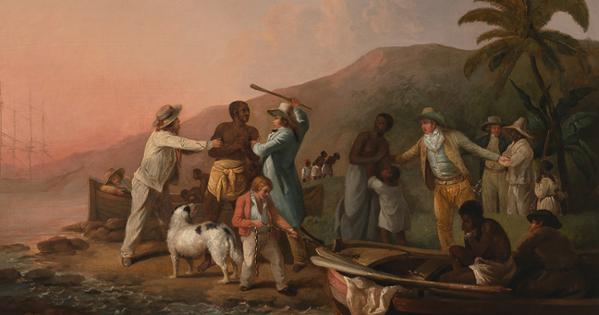
Each year, Black History Month offers an opportunity not only to reflect on the past, but to examine how the legacies of American history continue to shape the present. One of the most consequential and enduring of these legacies is the relationship between race and capitalism.
The United States is often thought of as the emblem of capitalism and free markets—the land of opportunity where success is available to anyone willing to work toward the American Dream. Indeed, America continues to be the world’s largest economy, and in 2025 accounted for 902 of the world’s billionaires—that’s close to a third.
Although the decades since segregation ended have brought certain gains for the African American community, including a rise in Black businesses and the emergence of a Black elite, experts have pointed out enduring inequalities for Black Americans across the class spectrum (perhaps it is worth noting that of those 902 American billionaires, only 14 were Black).
To understand the relationship between race and capitalism, we spoke with Jordanna Matlon, a professor at American University’s School of International Service and a scholar of racial capitalism and the Black diaspora. In this Q&A, Matlon traces the evolution of racial capitalism from colonialism to the present, examining how the commodification of Black bodies during slavery has evolved since, and why inequalities persist in today’s economic landscape of media, culture, and consumer life.
- In previous work, you’ve argued that colonialism and the Transatlantic Slave Trade were not “primitive” forms of capitalism but central to its development. Can you explain that relationship, and what scholars mean by the term “racial capitalism”?
- The term "racial capitalism" was first used in activist and scholarly debates to make sense of labor struggles in apartheid South Africa. However, the historian Cedric Robinson popularized its meaning as pertains to the capitalist world system in his critique of Karl Marx's “historical materialism,” which, he argued, discounted the role of race in the formation and persistence of capitalism.
- According to Marx, wage labor was fundamental to capitalist society, whereas slavery and colonialism were relegated to “primitive accumulation,” which was necessary to the formation of capitalism but did not count as capitalism proper. Scholars of colonialism and slavery take serious issue with this because not only does this framework exclude processes (raw material extraction and plantation colonies) and regions (Africa and the Americas) that were fundamental to capitalist industrialization from being called “capitalist,” but also, and perhaps more significantly, because it denies agency to the colonized and enslaved.
- How did slavery shape modern ideas of property, ownership, and exclusion? What changed after abolition, and what stayed the same?
- Slavery, or more precisely racial slavery, was formative to modern, liberal notions of property. The creation of the identity "Black" during the transatlantic slave trade was a means to erase enslaved Africans' identities and convert them into commodity objects. The Codes Noir in the French empire codified Blackness as slaveness, while similar equivalencies were established in the British colonies through laws like the Virginia Slave Laws of 1662, which decreed that children born of enslaved women would themselves be condemned to slavery. To be a slave meant to be barred from owning property, or even to make a familial claim on your own children, so enslaved children were of their mothers but belonged to their mother’s master, to be bought and sold at will. Racial slavery, in short, normalized the racialization of who could be property and who could own property.
- After abolition, the persistence of legacies of accumulation and dispossession prevented Black people in the United States from "catching up" with White people in terms of wealth. Liberalism privileges the property owner, so while it is formally colorblind, how it manifests as a product of historical injustices is racialized. Ongoing discriminatory policies from both the state and the private sector further exacerbate racial disparities. We saw this with the Jim Crow South, the New Deal, redlining, and predatory mortgages leading up to the housing market crash of 2008, to name but a few examples.
- You describe the New Deal as extending a “gentler form of capitalism” to White workers while many Black workers at the time were effectively excluded from benefits and programs such as Social Security, labor protections, or access to housing. Why is that moment still important for understanding racial inequality today?
- The New Deal was a classic example of federally manufactured discrimination. It was incredibly progressive for White workers, but excluded farmworkers and domestic workers who comprised the majority of Black labor. Alongside exclusion from a constellation of other significant state initiatives at the time, Black Americans were barred from the entitlements of what was, for their White counterparts, a generation of unprecedented middle-class expansion.
- Many people associate Black advancement with legal and political rights, particularly the Civil Rights Movement. However, you’ve written that racial capitalism didn’t disappear with civil rights reform, only adapted. How is it adapting today, and what developments concern or encourage you looking ahead?
- Before the Civil Rights Acts were passed, discrimination was legal. Now—and I will preface that "now" with recognition of this highly uncertain moment in which we are living, when the achievements of the Civil Rights Movement are being actively contested, if not reversed—discrimination is no longer de jure but de facto. As I discussed above, the liberal order is one premised on property ownership. Formally, we might all be treated equally under the law, but if you live in a wealthier neighborhood, can afford a private education, have access to better lawyers, all that leads to unequal outcomes.
- The gains from affirmative action were always limited at best, particularly in the private sector job market. The differences in accumulation between Black and White Americans remain extreme. The Pew Research Center reports that in 2021 the wealth of a typical White household is almost 10 times as much as that of the typical Black household. The election of Barack Obama to the nation's highest office has fed a narrative of Black progress post-Civil Rights. And yes, there is now a Black elite. But structurally—how things are for the majority of Black people—their position has not improved remarkably. As for recent developments, well, we are now witnessing the backlash from the gains that were made in real time, and the future is frighteningly uncertain.
- Living in such a highly digital age, how does racial capitalism manifest today in American media and pop culture?
- Racial capitalism has been significant for understanding American media and pop culture well before the digital age! Blocked from more traditional forms of work, there is a legacy of Black success being spectacular, represented by iconic figures in the worlds of media and sport. And this is where the Black billionaires of today still come from, albeit having diversified their products by way of entrepreneurial self-branding.
- The conversation around Black American cultural products and cultural appropriation is, I think, most productive when we center questions not of who has the right to "use" something but of recognition and ownership—in other words, who created something first, and who has been able to profit off that thing. Black American cultural producers have and continue to be denied recognition of or compensation for their innovation and talents.
- Furthermore, in the contemporary digital age, I would be remiss to not acknowledge the emergent forms of algorithmic and surveillance capitalism that render Black Americans second-class citizens by racially profiling them, misidentifying them to agents of the state, or channeling them towards predatory consumer products.
- When Blackness becomes a commodified or marketable asset, what does that mean for consumers or business owners, Black or otherwise, who want to engage it thoughtfully or ethically?
- Racial capitalism had its beginnings in the commodification of Black bodies. It was a system that, by converting people into property, negated their very humanity. This legacy positions Black people to be excellent critics of commodification as a means of measuring human worth. Indeed, there is a troubling throughline between that initial valuation of Black people via the very devaluation of their humanity and the branding that is so prevalent in iterations of Black capitalism at present.
- What we find when Blackness is put to work for capital accumulation is that it still tends to perpetuate a cycle of racial capitalist dispossession, if only because of who is ultimately at the top of the commodity production chain—say, corporations or major banks—and who is at the bottom—such as miserably-paid, non-White manufacturers in the Global South. To target systemic racial disparities, we need to think about cultivating solidarity and community uplift, such as through mutual aid programs like the free breakfast program that the Black Panther Party rolled out in the 1960s.
- This is not to say that Black people should not own businesses. A potent form of racial terror has involved the destruction of Black livelihoods as occurred in the razing of Tulsa, Oklahoma’s Black Wall Street, in 1921. And a key form of civil disobedience leading up to the Civil Rights Acts involved Black folk withholding their consumer power via boycotts or insisting on consumer parity via sit-ins. But just having more Black businesses does not itself rectify the deeply rooted disparities in, say, finance, or address state-sanctioned repression (economic or otherwise).
- On a smaller scale however, to think about consuming ethically, we need to consider the whole commodity chain. Are the workers paid a living wage? Are the materials damaging to our or others’ ecosystems or health? Are our pensions investing in companies that do these bad things, or contributing to politicians who support them? These are questions that we should be asking not just for racial justice but for justice, plain and simple. But if there is one key lesson that racial capitalism teaches us, it is that racial justice is in fact justice, plain and simple.