
SIS Alumna Pledges $50K Gift for AU Giving Day
At the School of International Service, we know experiential learning can present life-changing opportunities for students. Whether it’s a study abroad experience, a research conference, or an internship, experiential learning provides opportunities for students to bridge theory and practice and apply what they learn in the classroom to the real world.
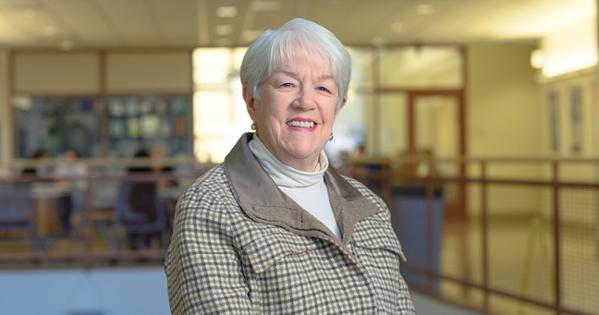
On this AU Giving Day, SIS will unlock a $50,000 gift from Charlotte Jones-Carroll, SIS/BA ’67, in support of experiential learning opportunities when 50 donors give to SIS. This year’s Giving Day will run for 36 hours starting on February 25, though early gifts are being accepted now.
We recently asked Jones-Carroll to share some of her favorite memories from her time at American University, why philanthropy is important to her, and why SIS is special to her.
- What are some of your favorite memories from your years at American University?
- When I was at AU in the 1960s, SIS had all of us together in a number of first- and second-year classes. We quickly formed friendships, some of which last until today. My smaller group of friends built relationships with several of the professors and we visited their homes and organized suppers for them (once some of the group moved off campus and had kitchens). These relationships with professors endured until our 25th anniversary! Part of AU’s attraction was being in Washington, DC. I loved taking the bus down Massachusetts Avenue (no Metro back then). We visited the mosque, the Phillips Collection, the Smithsonian museums, the Library of Congress (to do our homework!), and the National Cathedral. The international students at AU were also a source of fun and learning. SIS was especially full of graduate students from distant places. I was also active in interfaith events on campus and expanded my knowledge of faiths well beyond those I knew from my Florida upbringing. This connection gave me a seat on the Student Senate at the time.
- Can you tell us a bit about your career path after graduating from SIS? What role did SIS play in your career journey?
- I had come to AU to learn what I needed to join the foreign service, inspired by Miami’s bicultural experience and JFK’s creation of Alliance for Progress. Ultimately, thanks to what I learned, I decided joining the foreign service and having to defend our Viet Nam policies was not for me. Fortunately, I had a great economics professor (Jim Weaver) who built my interest in economic development, and by graduation, having passed the Civil Service Management Intern exam, I joined USAID. After 11 years with them (including some leave without pay to get my MPA at Princeton), I moved to the World Bank where I worked in Latin America, Africa, and East Asia, as well as Strategy and Budget offices, for the next 21 years.
- My ability to get hired and work in these two institutions had everything to do with my SIS training. Working to reduce poverty in developing countries turned out to be just what I wanted to do all along.
- As a coda, when I retired early from World Bank, I had acquired an interest in peace and conflict resolution. That specialty did not exist when I was at SIS, but 30+ years later, I was able to start my retirement by taking many courses at AU in peace and conflict as an alumna. I went on to practice some of these peace building skills in the next two decades through service on non-profit boards.
- Why is philanthropy important to you?
- I seem to be both a “give back” and “pay it forward” person. As an undergraduate, AU provided a scholarship that covered half my tuition—important given I came from a modest family. Princeton covered my tuition and living expenses. I have been a donor to AU for at least 50 years—at levels from $100 to $1500 a year—as an attempt to give back to one of the institutions that saw possibilities in me. Now, as a retiree and community elder, I am focused on the upcoming generations. I see very inspiring and talented young people at AU and the World Bank. I find it fulfilling to help such people make their way through their studies and early careers, in hopes of making the world better. I see that I can live perfectly well from my pension and social security—and having downsized recently, my living costs are moderate. I believe it isn’t necessary to be super affluent to become a philanthropist.
- What motivates you to give back to SIS, and why is SIS special to you?
- Back when I was in high school and decided on an international career, I was very attracted to study in Washington, DC, without ever having been here. The school guidance counselors only had outdated books describing universities. They searched and found Georgetown’s School of Foreign Service...but reading the fine print, saw that females were not accepted at that time! Georgetown was an all-male school!
- Serendipitously, my mother (who married at 17 and did not go to college) remembered a high school friend of hers had moved near DC. She tracked down the address, wrote to her friend, and amazingly found out that AU had a newish School of International Service that DID accept females. So here I came and have been grateful to this inclusive university ever since.
- Editor’s Note: The School of Foreign Service at Georgetown University allowed women to enroll beginning in 1944 in order to “shore up enrollment numbers which were declining because of the war,” according to their website. In 1970, the school dropped its quota system of one female student to every eight male students.