
How One Alumna Found a Passion for Ethics and Research at SIS
In 2020, on the heels of the shooting of a young Nigerian man by the Nigeria Police Force’s Special Anti-Robber Squad (SARS), tens of thousands of young people took to the streets to protest police brutality and demand the disbandment of SARS. The #EndSARS protests lasted for several days in October 2020 but came to an abrupt end when Nigeria’s security forces shot and killed at least 12 peaceful protesters in Lagos.
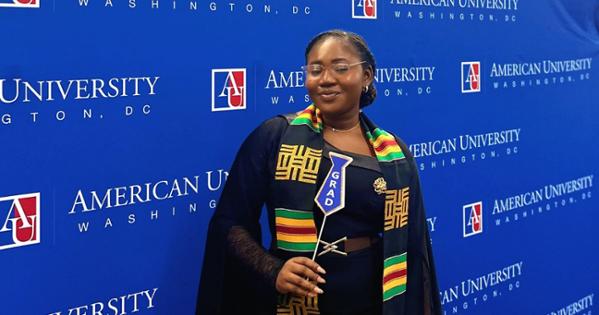
It was in watching this tragic scene unfold in her home country that Matilda Ajibola, SIS/MA ’24, felt a pull to study human rights.
“After that incident, I was really angry. It made me really furious,” Ajibola recalled. “I kept thinking, ‘This is wrong. What is happening in our world today?’ And that was my motivation to really study human rights and also be able to apply it.”
Thus began Ajibola’s journey to Washington, DC, and the School of International Service, where she enrolled in the master’s degree program in Ethics, Peace & Human Rights (EPHR).
Human Rights Education at AU
When considering graduate schools, Ajibola knew she wanted to study human rights, ethics, and conflict resolution in DC. She applied to multiple DC-area schools, but ultimately chose the EPHR program at SIS because of its focus on ethics-based human rights.
The EPHR program is designed to prepare students to be ethically informed thinkers and practitioners in response to pressing global issues. Students graduate from the program prepared to apply ethical frameworks to policy analysis and develop peaceful solutions to international challenges.
“I wanted to approach ethics from a human rights perspective, and I wanted to do something very practical,” Ajibola said. “I love being theoretical, yes, but I also wanted to get hands-on experience and just apply myself to so many issues that we have here in the world.”
One of the most impactful parts of Ajibola’s experience at SIS was taking human rights courses taught by Professor Jonathan Crock. It was in his class that Ajibola was encouraged to publish her first research article.
“If you take any of [Professor Crock’s] classes, you’ll be sure to at least produce and publish one article or blog post,” Ajibola said. “That was the very first publication I ever had, and it was just really amazing because it takes somebody to believe in you and somebody who actually wants to see you grow to push you to publish, and he did that for us.”
Crock’s classes bridged human rights theory with real-world examples, providing a grounded foundation that changed the way Ajibola approached ethics, she explained. Ajibola said Crock’s classes also helped to instill confidence that publishing research wasn’t just something professors could do—student researchers are also capable of getting published.
During her graduate studies, Ajibola authored six publications on some of today’s most pressing social issues, from regulating AI to systemic violence against women. Her article on the future of biotechnologies was published in Bioethics Today—a publication of The American Journal of Bioethics, the leading journal in the field.
"Matilda is an inspiring example for others in answering my challenge to transform from student to published author and drive real-world impact,” Crock said.
As she leaned into her research and graduate studies, Ajibola also began teaching what she was learning in her SIS classes to friends and acquaintances back in Nigeria through online seminars on WhatsApp.
“I did some teaching sessions and talked to people back home about their basic human rights and explained that these are things they have just by being human,” Ajibola said. “I did that because I just wanted people to know their rights, and I was tired of the government trampling on people’s rights.”
Post-Grad Path
After graduating from the EPHR program, Ajibola started a joint PhD in bioethics and philosophy at St. Louis University. Her PhD research examines how to create a way to safeguard human participants in research, especially as artificial intelligence is changing the face of research.
“We have rules and safeguards for research involving humans, so if you’re going to be carrying out any research that has to do with humans, you have to follow these guidelines,” Ajibola explained. “But many of these principles and laws are outdated because some of them were developed in the 70s and 80s. There are beginning to be holes in the guidelines specifically because of AI.”
One of Ajibola’s current research projects analyzes how AI is changing research and the problems that would come from allowing AI to conduct research on human subjects. While they do not yet exist, Ajibola says new regulations will soon be needed to cater specifically to the use of AI in research involving humans.
In addition to pursuing her PhD, Ajibola also serves on two institutional review boards that oversee research and teaches a “foundations of healthcare” class at SLU for pre-med students that focuses on ethics in healthcare.
Looking to the future, Ajibola says she hopes to one day teach ethics as a university professor and continue to do research on bioethics and AI. She credits her experience at SIS with providing her with a foundation in human rights that she now applies to her work on a daily basis.
“AU is such a wonderful school, and it really helped me in the way I research now, the way I interact with people, and it gave me a confidence I didn’t have before,” Ajibola said. “I’m now studying ethics, philosophy, and bioethics, and I couldn’t have been here without AU honestly.”