
SIS Joins Global Leaders at NXT Conclave in New Delhi
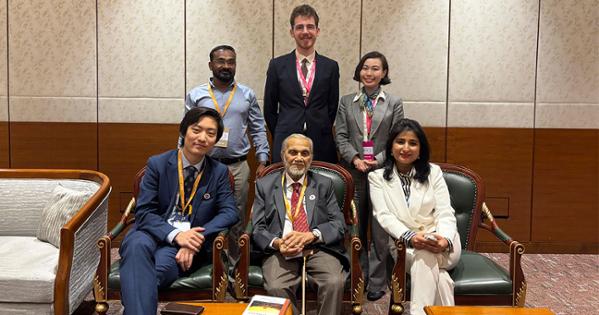
In March 2026, a small delegation from American University’s School of International Service (SIS) traveled to New Delhi, India, to participate in the NXT Conclave. The Conclave brought together global voices—heads of state, parliamentarians, scientists, and scholars—to discuss India’s evolving role on the world stage.
The AU group of NXT Fellows, a selective cohort of emerging leaders that the program seeks to support with resources and networks, were nominated and accompanied by Professor Hansong Li, and represented three levels of the university’s academic community. Henry Moskov, an undergraduate Olson Scholar, brought his research on the comparative intellectual histories of Indian and Chinese space programs. Telmen Altanshagai, SIS/MA ’25, contributed her expertise on energy policy across South Asia and the Gulf region. Sujin Heo, a PhD candidate, brought her expertise on intercultural encounters, global intellectual history, and colonial legacies in world order. 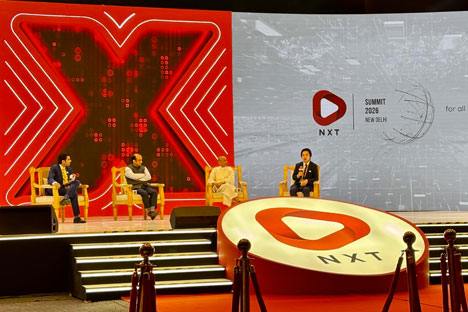 Professor Li also participated as a speaker during the main forum, joining panels on AI in education and comparative world philosophies.
For the AU delegation, the Conclave offered a rare opportunity to engage directly in some of the world’s most consequential conversations. The delegation met numerous leaders across academia, industry, and policy, as well as current and former prime ministers of India, Nepal, Australia, and Bhutan. Li praised Moskov, Altanshagai, and Heo for “maintaining the highest energy and showcasing the best of AU” throughout the conference.
To hear more about the experience of attending this year’s NXT Conclave, we asked Moskov (SIS/BA ’26) to share a few of his own reflections on this unique opportunity.
Henry's Reflections
In mid-March, I had the privilege of representing American University at the NXT Conclave in Delhi as part of the NXT Fellowship program. The Conclave’s mission was to bring both India’s greatest minds across governmental positions and academic subjects and non-Indian interdisciplinary experts to discuss where contemporary India stands in the international landscape and where India is heading. Throughout the Conclave, there were a multitude of presentations from top scientists, CEOs, astronauts, foreign ministers, members of various countries' parliaments and national assemblies, and former and current prime ministers, including Prime Minister Modi.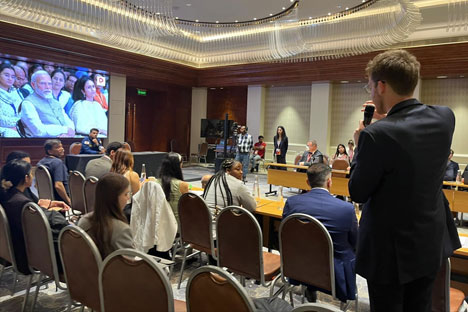
Throughout the exciting array of guests that had come to speak on their fields of expertise, there was a maintained focus on India and the “Bharat mission”—that is, India, using the indigenous title of “Bharat” to command its own growth narrative and destiny on the world stage as it advances more and more in the particulars of economic and political strength.
My role as an NXT Fellow was to be introduced to these high-profile conversations happening and to make meaningful contributions to them. Every day in the program, we had the opportunity to speak in individualized small-group sessions and masterclasses with the honored guests of the NXT Conclave. These individualized experiences gave us the opportunity for more informal interactions with the speakers and engage in a dialogue concerning the various subjects they represented. For instance, one day I was able to speak with the former Australian prime minister about political theory; another, a theoretical physicist on the philosophy of scientific research methodologies; or on another, a historian about what Hinduism represents in India’s civilizational claims.
Furthermore, NXT Fellows were expected to produce a short piece of research and accompanying presentation related to something in the sphere of Indian affairs, which, if a significant enough topic, would be selected for further development via a research grant and Indian publication. My particular topic was on the early philosophy of science behind 1960s Indian astrophysics and how such methodologies related to political modernity. Other topics included modern Indian defense pacts, responsible urban development, the role of Indian religion in promoting women’s development, and more.
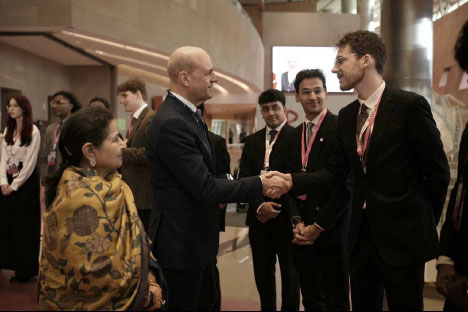 Beyond this, there was a constant stream of networking both with the attendees of the Conclave and the other fellows present, as they were some of the finest minds representing an international array of prestigious institutions. Together, we created the NXT Fellowship community that took every advantage we could of this opportunity and one another for all our respective career, intellectual, and personal growth.