
The Food We Never Eat
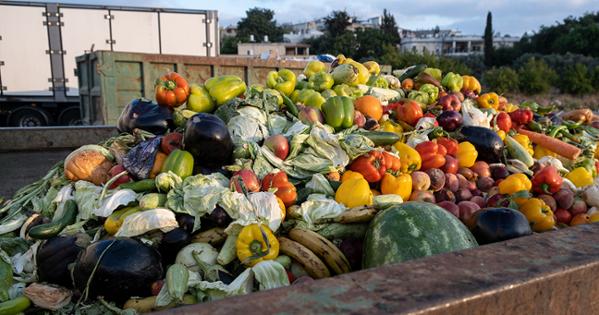
Despite food insecurity impacting one in six Americans, the Department of Agriculture (USDA) estimates 30-40 percent of food winds up in landfills every year. Whether it’s the wilted greens in the back of your fridge or the leftovers you forgot about, the Environmental Protection Agency (EPA) reports that 96 percent of food waste ends up in landfills, where it produces methane—a greenhouse gas that contributes substantially to global warming. In fact, the United Nations estimates that if food waste were a country, it would be the third-largest greenhouse gas emitter in the world, behind only China and the United States.
Food waste is a major problem on college campuses as well—one that American University’s (AU) Office of Zero Waste is committed to reducing through its composting and food recovery programs.
“In composting, you're able to collect a lot more of the methane emissions and make sure that it doesn’t get released,” explains Owen Krzywda, SIS/BA ’25 and a recycling specialist at Zero Waste. Krzywda joined the office as an undergraduate student and spent three years on the composting team. He now works full time while completing his master's in Global Environmental Policy at the School of International Service.
In 2025, AU composted about 215,000 pounds of food—roughly triple the figure from just a few years prior. The Office of Zero Waste now diverts around 6,500 pounds from landfills every week through composting alone. The program is run by Zero Waste Manager Caroline Boone and staffed almost entirely by student workers.
It’s an impressive operation. And yet, as SIS faculty and students who study food systems will tell you, composting bins and donation programs, however vital, cannot solve the problem of food waste alone. It’s a problem that begins long before food even reaches a dining hall or grocery store, and one that researchers at SIS are looking for ways to solve.
“The Farm Problem”
SIS professor Garrett Graddy-Lovelace specializes in agricultural policy and agrarian geography and is a researcher on the National Science Foundation-funded RECIPES project—a $15 million grant to research food waste and the largest externally-funded grant in AU’s history. She describes food waste as a “crisis of surplus.”
“I've been doing research in the USDA archives, and there are boxes and boxes called 'the farm problem,’” she explains. “And when you go inside the boxes, it turns out ‘the farm problem’ isn't scarcity; it's the tendency for farmers to overproduce when they're in capitalist markets.”
It works like this: when prices are high, farmers plant more. When the resulting oversupply drives prices down, farmers plant even more to compensate for low profits. Without a mechanism to regulate supply or provide a price floor, the system produces a perpetual treadmill of overproduction—food that exceeds demand and winds up as waste.
Graddy-Lovelace traces this dynamic back more than a century. In the wake of World War I, U.S. farmers, who had been incentivized by Washington to produce more for the war effort, faced a crisis as the price of wheat collapsed when returning farmers-turned-soldiers flooded the global market with production.
This collapse set off the now-familiar cycle of low prices and overproduction with devastating ecological and economic consequences. Mass soil erosion from the razing of native grasses and the overcultivation of wheat in the American plains rendered large swaths of farmland infertile, creating what is now known as the Dust Bowl. Economically, between 1930 and 1935, 750,000 farms were lost to bankruptcy or foreclosure. The whole crisis became a root cause and contributor to the Great Depression.
Out of that catastrophe came the original Farm Bill as part of the New Deal: essentially a supply management policy to reduce overproduction and encourage prices to rise by incentivizing farmers to produce less and buying up surplus to be distributed to food banks or stockpiled in public granaries as emergency reserves.
Through what the policy called “parity,” the government also set price floors—similar to minimum wage—that enabled farmers to cover production costs while still earning a livable income.
“The government acted as a regulator; it did not pay a subsidy. Parity is not a subsidy,” says Graddy-Lovelace. “It's just the government saying to the corporate buyer, ‘You have to pay this farm gate price so that the farmer is covering their cost of production.’ From the farmer's perspective, you agree to have a base acreage, a quota, and you don't grow more than that. And in exchange you're guaranteed a market at the end of the harvest.”
That model—imperfect as it was and historically skewed toward white male farmers—functioned as a brake on overproduction. Unfortunately, it did not last.
Corporate Consolidation
By the 1980s, parity and other supply management programs had eroded under decades of pressure from agribusiness interests and free market ideology. Farmers were encouraged by then-secretary of agriculture Earl Butz to “get big or get out.” The 1980s farm crisis—another wave of bankruptcies and foreclosures that devastated rural America—was in part a consequence.
“When the market is free, that means every farmer is a solo actor,” says Graddy-Lovelace. “And each corporate buyer can pit the farmers against each other for very low prices.”
Laurel Levin, an SIS master's student in Global Environmental Policy who is co-authoring a paper on overproduction and agricultural policy with Graddy-Lovelace, connects this structural shift directly to corporate consolidation. Today, a small number of enormous companies, including multinationals like Cargill or the meat processor JBS, control much of the agricultural market.
“When you have consolidated economic power, it wields consolidated political power,” Levin says. “When civil society demands food justice or fair wages, companies like Cargill or JBS are literally in the room with legislators, writing the laws.”
The consequences cascade through the entire food system.
“A big push for the overproduction and waste of grain is so that there can be cheap feed for confined animal feeding operations,” Levin says.
On the production side, many seed producers also own pesticide and fertilizer companies that benefit from overproduction, according to Levin.
“It’s a package deal,” she explains. “So the more the farmers plant the seeds, the more they have to buy the chemicals. And then the more they buy the chemicals, the more the soil erodes, so the more fertilizer they need. It's this trap.”
Choke Points Create More Waste
Recent years have highlighted the choke points our current food system is vulnerable to and the impact corporate consolidation has had on its adaptability—from dairy farmers having to pour out millions of gallons a day during the COVID-19 pandemic, to the numerous outbreaks of lethal and highly contagious bird flu in commercial facilities. Today, the U.S. blockade of oil against Cuba has left farmers without the fuel needed to harvest and distribute crops, contributing to both mass wastage and a growing hunger crisis.
Meanwhile, immigration enforcement has introduced a new form of disruption. Graddy-Lovelace works closely with Alianza Nacional de Campesinas, an alliance of female farmworkers in the U.S. Its members report that ICE activity targeting farms and agricultural workers is keeping workers away from fields during critical harvest windows.
“The farm workers are saying, ‘We know that there's rotted food—from the blueberries in Michigan to lettuces in California.’” Graddy-Lovelace says. “But the USDA, under this regime, certainly wouldn't collect that data.”
That's because many of the USDA grants and data surveys have been cancelled, particularly those relating to climate, racial justice, or food insecurity. Graddy-Lovelace says the agency's data had become “the envy of the world” in recent years before the now-defunct Department of Government Efficiency (DOGE) not only halted new collection but removed existing archives and federal webpages.
“There was an attempt to remove the archival data from the USDA website, and so people on the inside were saving it—same with USAID and EPA,” she says. “But you cannot find the data online in the way you could in 2024.”
In 2025, DOGE abruptly canceled popular federal programs that bought food directly from small and mid-sized local farms to supply nearby schools and municipal systems, leaving farmers who had already planted and invested with no buyers.
“The farmers had invested and were left having planted their fields because they thought they had a buyer, and then the money was cut,” Graddy-Lovelace explains. “All this food went to waste, because you can't just move a lot of food at the last minute.”
What Can Be Done?
As a remedy to these issues, Graddy-Lovelace argues the best solution is updating parity and supply management. That means reviving the logic of parity pricing to end the cycle of low prices and overproduction—not as a return to New Deal programs, but as a new and improved, racially inclusive system that extends beyond commodity crops like grain to the fruits and vegetables people eat day-to-day.
Supply management should also embrace what she calls “regionalization”—investing in local food hubs and aggregators that would consolidate supply from large numbers of small and mid-sized farms to enable them to compete for large institutional contracts (similar to the programs cut by DOGE). This would also make the supply chain less vulnerable to natural disaster, contagions like bird flu, and choke points like fuel or labor shortages.
“The whole point is that it's not the farmer's job to hustle and sell,” Graddy-Lovelace explains. “The farmer's job is to grow a good quality crop and steward the land. And then there's a broader USDA role for coordinating supply so that if gas prices triple or there are major fires in California, a team at USDA can say, 'Okay, we're not getting our lettuces from California this year. Where else?’ Coordinate the supply so that there's not mass wastage and needs are filled.”
Another core focus, Levin says, needs to be strengthening antitrust enforcement to break up the consolidated corporate power whose outsized influence has prevented solutions like these.
“The core principle of antitrust is we need to protect our democracy against consolidated economic power,” she argues. “That was the oil trusts. Now it's the grain trusts.”
Both researchers also emphasize investment in new and diverse farmers—people who want to grow sustainably but lack access to land, capital, and buyers. The USDA, they argue, should be actively building that pipeline, not gutting the programs that support it.
“None of these things are going to happen without broad public support and momentum,” Levin adds. “So, yes, compost your own food, but we also need to be organizing and applying political pressure.”
A Tangible Start
On AU’s campus, the campaign to reduce overall campus waste and divert food from landfills continues and has now spread beyond the borders of AU. Thanks to the recently reestablished AU chapter of the national Food Recovery Network, pushed for by student compost workers at Zero Waste, the chapter diverts food-safe leftovers from the Terrace Dining Room to local food pantries in DC. Last fall over 7,000 pounds of prepared food were donated, with over 5,500 pounds already donated this spring.
“That's been really great,” remarks Krzywda. “Because it's always really frustrating when we're pulling out compost and it's just a whole bucket of macaroni and cheese or pizza that's obviously untouched and still good.”
Although Krzywda’s journey with food waste began as a student composter, through that work he too found a call to action and hopes to carry the work into his career.
“Waste is such a neglected part of environmentalism, even by people who are environmental practitioners,” Krzywda says. “It’s universal to every single group on Earth and is so integral to so many different environmental issues that it's easy to miss or ignore.”
His long-term goal is to bridge the practical expertise he's developed at Zero Waste with the international expertise of an SIS degree to work in international waste management.
As Levin reminded us, the compost bin is not the end of the story. But it can be a valuable jumping off point, and a way to connect tangibly to a problem that stretches from the Dust Bowl to the dining halls of American University, and all the way back to a century-old farm crisis that we never fully learned from.