
From Migration Studies to the DC Mayor’s Office: Serving the District’s Asian and Pacific Islander Communities
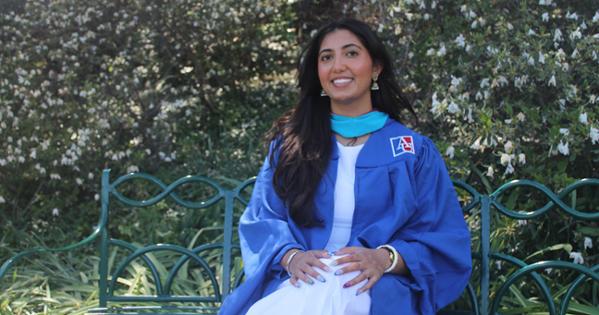
Komal Kaur, SIS/MA ’26, is a recent graduate of the master's program in Ethics, Peace, and Human Rights, and a staff assistant in the DC Mayor’s Office on Asian and Pacific Islander Affairs. The office works to support and advocate for the District’s Asian and Pacific Islander communities, helping connect residents with city services and resources.
Kaur’s academic interests have centered on diaspora, migration, and the ways culture and identity are shaped across communities and borders. She also worked with SIS professor Mariam Durrani on the collaborative research initiative Roti Collective, contributing to research that examines roti and roti-making as a way of understanding histories of migration, displacement, heritage, gender and diaspora. Through research, community events, and public conversations, the collective examines how roti carries histories of migration, colonialism, gender, identity, and cultural heritage.
In this Q&A, Kaur talks about her time in SIS, how her degree in the EPHR program prepared her for local government, and advice for those who are currently studying international relations on how to strategically build their careers.
- Can you start off by telling us about your position with the DC Mayor’s Office and how you found it?
- I am working as a staff assistant in the DC Mayor’s Office on Asian and Pacific Islander Affairs. This office falls under the Mayor’s Office on Community Affairs, which includes 10 offices that work to serve the needs of various populations across the city. In my office, we specifically work to provide language access to DC residents who speak Chinese, Korean, and Vietnamese, and connect them with resources if they speak another language. Aside from the language access work, the office also provides constituent services, oversees grant programs for local business, and does outreach for Asian American, Native Hawaiian, and Pacific Islander (AANHPI)-owned businesses.
- Our office also hosts city-wide events with the goal of cultural exchange and celebration. This past May, we celebrated AANHPI Heritage Month, during which we hosted various events across the city and got to celebrate the rich cultural diversity of AANHPI populations.
- How do you feel the EPHR program prepared you for this role?
- As part of my EPHR degree, I had also completed the Global Migration certificate with Professors Maria De Jesus and Claudine Kuradusenge-McLeod. I think my studies in migration set me up particularly well for this position. Using my foundational knowledge of migration and diaspora groups, I've been able to build a robust understanding of the populations my office is serving and why conditions, outcomes, etc. vary between groups. The umbrella label of AANHPI can be monolithic and reductive of diverse experiences. I feel that my nuanced understanding of migration patterns and historical factors that have shaped these patterns in DC and beyond has given me an important perspective when serving the DC community.
- I have also been working with Professor Mariam Durrani on The Roti Collective project, and this work aligns particularly well with my new role. Our work with The Roti Collective specifically explores various immigrant and diaspora populations in DC through roti—a bread made throughout parts of South Asia, the Caribbean and Africa. Many of the populations we have looked at fall under the AANHPI label. I think that work with Professor Durrani allowed me to get to know DC in a different way before I even began working for the city.
- What advice do you have for current students studying international relations?
- My advice would be to navigate the current challenges our field is experiencing strategically. I know this is easier said than done but, for me, this meant leaning more on my previous work experience and allowing my graduate studies to inform my work in creative ways. Working in industries adjacent to international relations still provides valuable, transferable skills. I'm excited to see how this work will continue to inform my future career goals and aspirations.
- What was your favorite thing about your time at SIS?
- My favorite thing about SIS was my peers and professors! One thing that struck me immediately upon meeting my classmates and cohort was the diverse range of lived experiences. I felt incredibly empowered and supported in every classroom I entered throughout my two years at SIS. I learned from my peers as much as I did from my professors during classes, workshops, panels, etc.
- EPHR and SIS have some of the most incredible faculty members I have ever had the pleasure of working with. My professors supported me and uplifted me through hard times and allowed me to reach my full potential academically and professionally. Our professors are deeply invested in our long-term success and I'm thankful for their support and help in navigating the turbulent time our field is facing.