
How SIS Professor Michelle Egan Turns DC into a Classroom
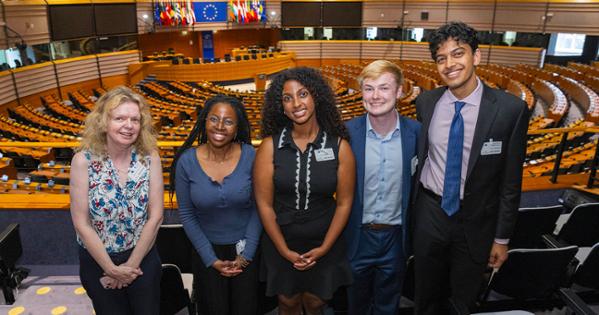
For many students, politics across the pond is something they read articles on or watch on TikTok. But for students at American University’s (AU) School of International Service (SIS), it is something they sit directly across the table, aisle, or classroom from.
Washington, DC, is home to myriad think tanks, government offices, and embassies from every European Union (EU) member state that shapes U.S.-European relations toward areas including trade, security, immigration and democracy.
These four areas are also the focus points of AU’s Transatlantic Policy Center, a Jean Monnet Center of Excellence. Helping to lead this center? SIS professor Michelle Egan, who has built her career around important work surrounding transatlantic relations and a European scholar, but who is widely known at SIS for being a professor invested in her students. Egan treats the city’s rich diplomatic community as an extension of her classroom’s four walls.
“It is wonderful to mentor students and watch them professionally and academically develop their interests during their time at SIS,” Egan says.
From Campus, to Embassies, to the World
Many SIS students first meet Professor Egan in the first-year seminar From Empire to Post-Brexit or her regional course Contemporary Europe, where she encourages you to start thinking like a policymaker from day one. This fall, for example, she is partnering with the Bertelsmann Foundation to bring political forecasting into the classroom.
In between, Egan helps students gain valuable real-world experiences. Last fall, the Transatlantic Policy Center hosted the Mid-Atlantic EU Simulation at AU for the first time ever, bringing together approximately 100 students from up to 10 schools, with each team representing an EU member state. Throughout the simulation, teams visited their representative embassy, as well as the EU Embassy for a briefing, and heard from experts in the field. Students from Egan’s Habits of Mind class participated as Team Austria and Team Bulgaria. Last year’s topics included energy security and Ukraine reconstruction.
While AU has only participated the last few years, the simulation has been held in DC every November since 1993 and is based on real ongoing issues the EU faces, so there’s no researching the final answer or outcome. This year, AU will host again, with SIS students representing Slovakia, Sweden, and Ireland as delegations work on real files surrounding the digital euro, emissions trading after 2030, and the protection of live animals during transport.
Additionally, each year, Egan coaches a small group of AU undergraduates participating in the Schuman Challenge, a national academic competition hosted by the EU Delegation to the U.S. that encourages students to engage in transatlantic policy research.
Under Egan’s mentorship, AU won the inaugural competition in 2017, won again in 2024, and clinched a back-to-back victory in 2025, with the winning team earning a trip to Brussels to present their ideas directly to senior EU officials.
What starts in the classroom can take you across the Atlantic. One student on the 2025 team put it simply: “Young people at American University really can do a lot of cool stuff.”
Back on campus, SIS provides even more opportunities to get a front-row seat to diplomacy. Egan serves as a co-moderator with Professor Garret Martin for events within the Ambassadors Up Close series, providing a behind-the-curtain look at what it means to work in diplomacy and international affairs.
The Transatlantic Policy Center also helps students expand their worldviews by offering small grants to help offset travel costs or living expenses for students who participate in select study abroad programs. “We encourage all students to engage with our Center, to seek out opportunities, and to consider how they might benefit from working with us on our research, events, and policy work,” says Egan.
In the classroom, Egan introduces students to the world of diplomacy by teaching policy, analysis, and theory. While many students might have had a class with Professor Egan as their intro to SIS, many also close out their time with her, too. In her new capstone course, Diplomacy and Statecraft, students will get a taste of what it looks like to conduct diplomacy in practice by working directly on applied research projects for an embassy, engaging with diplomats and practitioners to produce and present policy-relevant analysis.
Her students agree that Egan’s mentorship begins the moment you step foot into her classroom and continues long beyond it. “Professor Egan was there for me all four years,” recalls Kevin Farmer, SIS/BA ’26. “She always follows up with students to forward opportunities. Because of her, I've met several ambassadors, competed in the Schuman Challenge, participated in Model EU, and secured an internship! Without her, the past four years would have been very different.”
The Scholar Behind the Mentorship
The reason that Egan can open so many doors for her students is because of her deep dedication to her research and her network.
Professor Egan has published extensively on global trade and economic policy, collaborated with think tanks like the Wilson Center and the Council on Foreign Relations, and worked alongside government policymakers. She was awarded a Jean Monnet Chair—one of the EU’s highest honors in European studies—and is a founding member of TradeExperettes, a global network of women trade experts bridging the public and private sectors. She was recently named a 2026-27 Fulbright-Schuman grantee.
But what students remember most isn’t her résumé. It’s how that experience shows up for them in the classroom, through mentorship, and in opportunities they might not have expected as undergraduates.
You could be one of those students.