
‘Welcome to the Family’: One Alum's Recipe for Mentorship
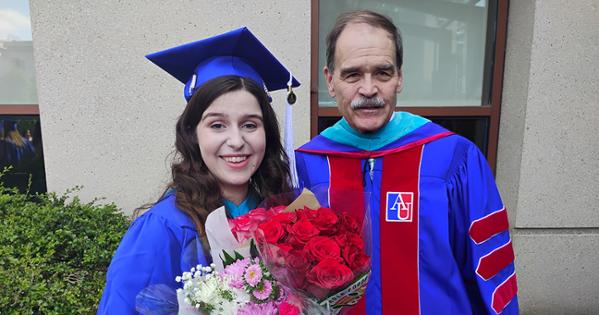
Every month or so, a handful of students in the School of International Service (SIS) find themselves around a dinner table in Bethesda, in the home of alumnus and mentor Tom Snitch, SIS/MA ’77, SIS/PhD ’82. The dinners—or salons, intimate gatherings built as much around conversation as around food—started five years ago when he arrived at SIS expecting to meet three assigned mentees.
“I walked in the room with three mentees, I walked out with six,” Tom recalls. Before parting ways, he invited all six over to his house for dinner. The dinners quickly expanded when he realized many international students—particularly the Sakura Scholars with whom he shares an affinity for Japan—had nowhere to go for Thanksgiving.
“Where else should an international student be on the most ubiquitous of all American holidays, Thanksgiving, than with an American family in an American house?” he points out.
Because Tom trained at a French culinary school, the menu never disappoints. Last year’s Thanksgiving feast featured cherrywood-smoked Chinook salmon, roasted turkey, and Basque cheesecake. Each salon centers on a different topic in international affairs, occasionally with special guests such as a three-star Air Force general or a clerk from the House Appropriations Committee. Recently, the topic was nuclear non-proliferation—something Tom is intimately familiar with as a former senior advisor for nuclear and weapons control.
The salons exist as a nod to those he remembers attending in his early days in the city in the 1970s, when Esther Coopersmith, an American diplomat and philanthropist, hosted her own dinners that mixed policymakers, students, and Capitol Hill staffers around one table. Decades later, Tom seeks to provide that same opportunity for a new generation whose relationships have become increasingly digital.
“We do financially support SIS, and that’s, I think, a good thing. But I truly believe time is sometimes more important than money,” he says. “It gives them sort of an anchor to let them know that SIS is more than just, ‘Some place where I went for four years and got a degree.’ It's a place where there were people who cared about me, who wanted me to succeed, who helped me, and they did it and never asked me for anything other than to go out and excel.”
Mentorship in Action
Each year, the SIS Career Mentoring Program pairs interested students with an alumnus mentor, with this year reaching a record 131 mentors and 189 mentees. It was through this program that one of Tom’s mentees, Ava Ward, SIS/MA '26, first found him. Having just moved to DC with no existing network of her own, Ava jumped at the opportunity to be connected to a mentor.
“Coming to DC, a lot of SIS students are career oriented and they're ready to launch themselves right into the field,” Ava explains. “That's also my belief and perspective, so that's why I chose to join the mentorship program.”
As Ava scrolled through the list of available mentees, Tom immediately stood out. “We're really one and the same person,” she says. “We have all the exact same interests—everything with nuclear security and also with Japan and China. We align perfectly.”
Ava listed him as her top choice, and fortunately the two were paired. He has since become a close mentor to her, providing advice, encouragement, and many a letter of recommendation. She has attended two of his dinners, she says. In addition to an outlet to discuss international affairs, she describes them as providing a sense of comfort, warmth, and welcome to her and other students who are away from home, and as a supportive place to talk about common anxieties like internships or job searches.
Building Your Network
In today’s digital age of AI screening and mass applying to jobs on LinkedIn, Tom is staunch in his belief that building your network is the key to getting your foot in the door. His own early career started, fittingly, with someone else opening a door for him as a shy undergraduate student.
“When I came to Washington almost 52 years ago, I was so shy that if I had to talk in front of a class, I threw up,” he recalls. Recognizing Tom needed help, Armin Meyer, an ambassador-in-residence at SIS at the time, made a call to a colleague at Brookings Institution and landed him his first internship.
“My life changed because someone made a phone call for me,” Tom says. Now, Tom is the one with the broad network of people to call on and others to recommend—something he says he does regularly.
“I'm trying to convey to these students from SIS, you need to start developing your own network, and it starts here, tonight, with these other six or eight people here.”
Answering the Call
A good network goes hand in hand with Tom’s second big piece of advice: answer the door and say yes to opportunities. That approach took him from academia to the Reagan administration, to using satellites and algorithms to determine where bombs were being placed during the Iraq War, to repurposing that technology to prevent elephant poaching in the Serengeti.
“When you hear that knock on the door, don't ignore it,” he cautions. “Or when someone asks you to do something very hard, don't be so quick to say, ‘It's too much work, too tough.’ I mean, putting these Thanksgiving dinners on, we have 25 people in our house and I do all the cooking myself—you know, stuff like that is a lot of work. But it's a lot of joy.”
This is something Ava has taken to heart. In keeping with Tom’s suggestion to say yes, over the summer she led a group of 19 undergraduates on a trip to Japan, and she continues to lean on Tom’s advice and encouragement in her current job hunt post-graduation.
“A job search is really difficult,” she said. “But he's been a very good resource. He continually pushes his mentees to do better. He's a resource because he wants them to do well and he wants to support as many people as possible—just to give back. That's really inspiring to me, and I want to do the same thing someday.”
This is all part of what drives Tom: service. Whether it's cooking a holiday meal for 25 people, reducing nuclear proliferation, or saving elephants that don’t have a clue you exist, doing hard things in service to others is what inspires Tom and why he feels a continued affinity with the School of International Service.
“Hard work brings great joy—as opposed to simply throwing your hands up in the air, which we do about homelessness and crime and everything else. And that's, I think, part of the ethos of SIS. What's the last S in that acronym? Service. Listen, that should be our mantra: We do hard things with great joy.”
But hard things can’t be accomplished alone, nor on an empty stomach.
“To get stuff done, it usually helps to have a family,” he said. “Some call it family, some call it team. Same kind of thing.” That’s why to this year’s incoming class and to each of his mentees, the first thing Tom says is: “Welcome to the family.”