
UNESCO Chair at AU Celebrates 15 Years and New AI Governance Focus
How does the world govern challenges no country can solve alone? That is the founding question of the UNESCO Chair of Transnational Challenges and Governance, established at American University in 2011 as one of 34 UNESCO Chairs around the country and more than 1000 worldwide.
This week, SIS hosted the 15th anniversary celebration of AU’s UNESCO Chair and launched the next phase of the Chair focused on inclusive AI governance with incoming Chairholder, Professor Derrick Cogburn. The event, hosted in collaboration with the AU Institute on Disability and Public Policy and the Internet Governance Lab, included a keynote conversation with outgoing Chairholder Professor Amitav Acharya, a panel on inclusive multistakeholder digital governance with outside partners, the launch of the Transnational Network on Inclusive AI governance from Professor Cogburn, and the presentation of student projects on applied AI and disability inclusive development.

The UNESCO Chair in Transnational Challenges and Governance is a partnership between UNESCO and AU that works to advance knowledge and action in a particular area. Under outgoing Chairholder Amitav Acharya, the focus was promoting global governance and multilateralism, broadening the study of international relations, and developing of dialogue of civilizations. With the advent of AI and other cutting-edge technology, Acharya called this the perfect time to transition the Chair to Professor Cogburn and shift the focus to AI governance.
“The UNESCO Chair has been very important in advancing the agenda of international studies and the world order both academically and practically,” Acharya said in a recorded video played during the event. “But the world has changed a lot since the Chair was established in 2011, and technology is the new frontier for studying international relations and global cooperation.”
The next era of the Chair, as Professor Cogburn outlined, will focus on three new themes:
- AI governance, ethics, and application;
- Internet governance and digital cooperation; and
- Digital rights and disability inclusion
These are all areas Professor Cogburn has prioritized in his career, supported by multiple AU research centers and institutes including the Institute on Disability and Public Policy, the Internet Governance Lab, the Center for Security, Innovation, and New Technology, and the Translating Research into Action Center.
“The rules for AI are being written right now, and we want to leverage this opportunity to be in the right places at the right time and to bring more voices into the global dialogue around AI governance,” Professor Cogburn said at the event.
In one of the panel sessions, Professor Cogburn invited colleagues from external partner organizations to discuss what inclusive multistakeholder digital governance means from a practical perspective. The speakers included Joe Catapano from the Internet Corporation for Assigned Names and Numbers (ICANN), Marc Rotenberg from the Center for AI and Digital Policy (CAIDP), Virginia Atkinson from the International Foundation for Electoral Systems (IFES), Monica Desai from Tech Policy Advisors, and SIS Professor Michelle Egan.
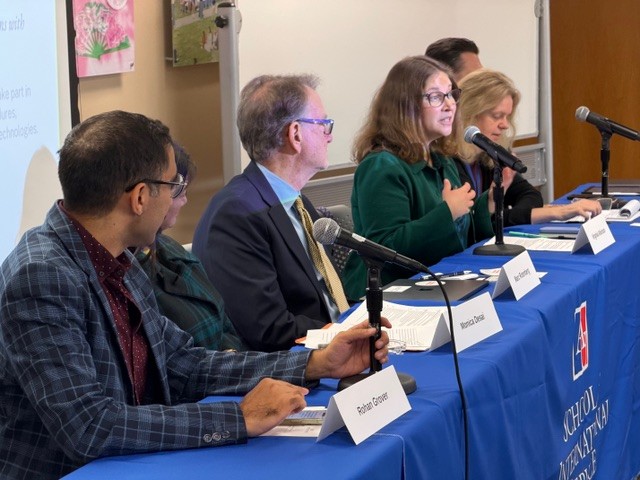
For Virginia Atkinson, the newly AI governance-focused UNESCO Chair will be a partner on ensuring AI works to include people with disabilities in political participation.
“Who gets a seat at the table in determining AI policies and safeguards, and how AI is used in the political process? Often, it’s not people with disabilities,” Atkinson said at the event. “AI is going to be used more in democratic political processes in the future, so we need to work together to make sure people with disabilities are involved in those processes.”
The link between AI and disability rights is already a major focus of Professor Cogburn’s work, and the anniversary event also included a live demonstration of his Convention on the Rights of Persons with Disabilities (CRPD) Disability Rights Data Dashboard by IDPP research associates and AU alums Sharon Wanyana and Conrad Muhirwe, which makes UN disability treaty monitoring searchable and analyzable.
Showcasing the importance of student research and innovation, Professor Cogburn invited students from his SIS graduate class “Applied AI for Global Challenges” to present on their applied agentic AI projects that have been developed in partnership with groups like the UN’s International Telecommunications Union (ITU), the International Center for Advocates Against Discrimination (ICAAD), and the Caribbean Telecommunications Union (CTU).
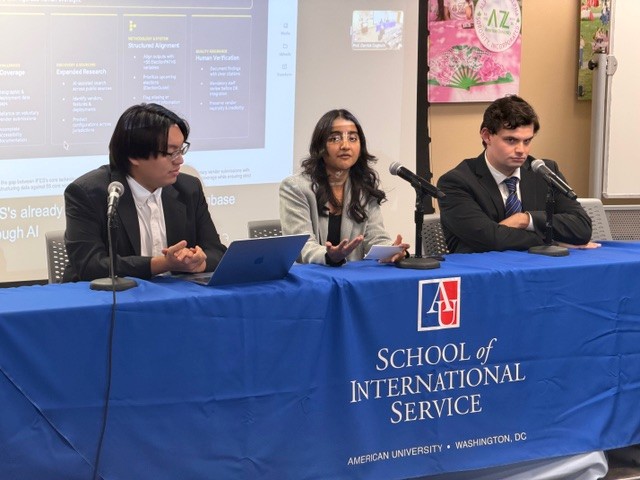
He also introduced the Transnational Governance Fellows, a new student network tied to the UNESCO Chair that will be open to graduate and undergraduate students at AU and all partner institutions. The fellows will be part of TRANSCEND AI, a network of universities, international organizations and civil society groups who want to participate in accessible and inclusive AI. Students at AU may also have the opportunity to complete a graduate certificate in Global Challenges and Applied AI, a proposed 12-credit certificate at SIS built on existing relevant courses at SIS. Finally, during the reception, first-year undergraduate students had the opportunity to present their Complex Problems Integrative Projects on Disability Inclusive Development from their CORE 105 class.
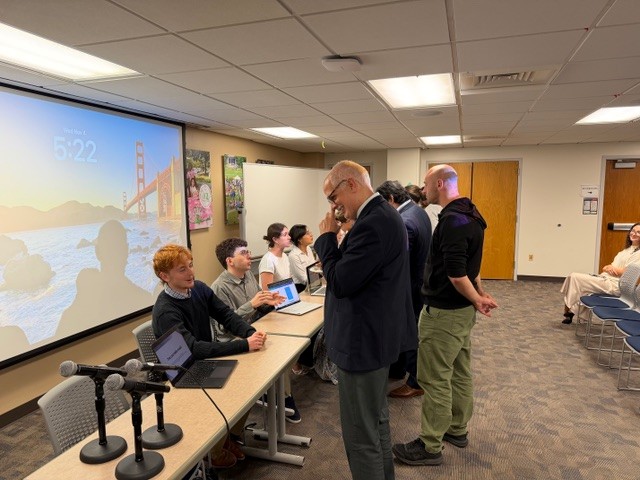
The UNESCO Chair has been a strategic partnership between AU and UNESCO for 15 years, and during her welcome at the celebration event, Provost Vicki Wilkins affirmed her and AU’s support for the renewal of the partnership into the future.