
From Classroom to Newsroom: Gabrielle McNamee on Journalism, Justice, and Life at AU
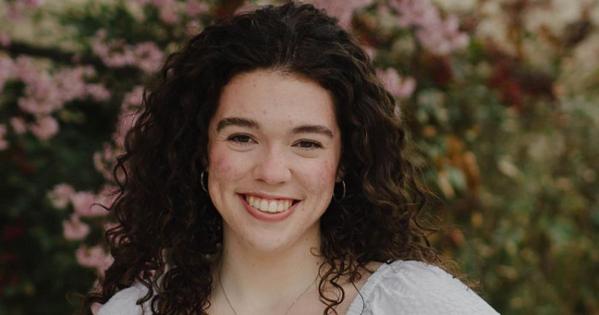
SOC spoke with Gabrielle McNamee, American University’s Editor-in-Chief of The Eagle, whose time on campus has been defined by steady personal growth across both the newsroom and the classroom. A double major in Journalism and Justice, Law & Criminology, McNamee has built her AU experience around reporting, leadership, and an interest in how storytelling and systems of justice intersect. From her early days as a staff writer to her current role leading The Eagle, she has taken on a wide range of positions that reflect both her curiosity and commitment to student journalism.
Alongside her journalism, McNamee has also pursued academic and professional experiences that connect closely to her studies in law and justice, including an internship in governmental affairs and coursework that informs how she approaches reporting and editing. In this Q&A, she reflects on how these two academic paths complement each other, what she has learned from leading a student newsroom, and how she manages the demands of being both a journalist and a Justice, Law & Criminology student.
Q: What first drew you to (student) journalism and to The Eagle specifically?
McNamee: Even when I first began applying to colleges, I knew I’d major in journalism. I was on my high school’s newspaper for two years — first as a general staff writer, then as the editor. My earliest experiences as a student journalist taught me the importance of telling stories that would otherwise go ignored. Local, community-driven work has always been a priority of mine, but writing about businesses and families in Phoenixville, Penn. reinforced my belief in the importance of uplifting the voices of those around you.
At one of my first tours of American University, I attended an informational session about the School of Communication. I soaked up every tidbit of information I could, and at one point, I heard professor Jane Hall speak about the community that existed just within McKinley’s walls. In those moments, I remember thinking I was exactly where I was supposed to be — surrounded by writers and creatives that centered humanity in their work.
Once I stepped foot on campus as an undergrad, the only logical progression was to apply to The Eagle. In every moment since I’ve been on staff, that initial realization in McKinley has been proved true. Being surrounded by a group of student journalists who remain ever-curious and persistent in seeking answers makes me sanguine about the future of journalism and media. Student journalism is fundamental not just to campus and local communities, but to legacy media and journalism as well.
I was reminded of this when I recently attended a discussion with the CEO of the Dow Jones and the publisher of the Wall Street Journal, Almar Latour (SOC/MA ’96, HON ’25). While he was getting his masters degree at American, Latour wrote for The Eagle. The media mogul is one of countless successful Eaglet alumni who learned and practiced the fundamental elements of journalism on our esteemed paper. To me, he is also one of the countless Eaglet alumni who exemplify what we learn in our time on the paper — truly good journalism is rooted in a community to which you can return.
As I lead The Eagle into its 101st year, I carry this with me. Community-based writing and reporting was important to me when I was a 15-year-old amateur with no SAT score to her name. Now, a senior in college and an Editor-in-Chief, I understand its value even more. Most importantly, I understand that it’s papers like The Eagle that help keep this kind of reporting alive.
Q: You’ve taken on multiple roles at The Eagle during your time at AU. How have those experiences shaped your approach to leadership as you step into the Editor-in-Chief position?
McNamee: During my time on The Eagle, I’ve been a sports staff writer, women’s basketball beat reporter, local news reporter, investigative reporter, photographer, podcaster, local news editor, and now, Editor-in-Chief. These various roles have taught me that a newspaper functions best when it functions as a whole.
Even with experience in a range of roles under my belt, there is so much I don’t know. After numerous photography lessons, truthfully, I still confuse the correlation between F-stops and aperture. I’ve written over a dozen basketball game recaps, but I’m still not totally clear on how the number of free throws is awarded. God help me, should I have to file a FOIA without Owen Auston-Babcock on the phone.
Ultimately, as I begin the final role I’ll inhabit at The Eagle, I know we function best as a whole, and I cannot possibly be all of it. We are a staff of practitioners, teachers, and students, working to grow the paper and one another. This year, I hope to constantly push staffers to work together and out of their individual comfort zones, as The Eagle and I can only be as good as our staff.
Q: You’re pursuing a double major in Justice, Law, & Criminology and Journalism. What motivated you to combine those two fields?
McNamee: I was so set on being a journalism student that I didn’t stop to consider my minor or second major. Initially, I had declared an environmental science minor, but it wasn’t until I was halfway through a semester’s worth of environmental science classes that I realized I might not be cut out for a career involving STEM. After some serious reckoning and introspection, I found myself thinking about what has always mattered most to me, even in my writing.
At its core, journalism exists to provide a voice — most often, to the otherwise voiceless. To me, journalists are already actors in justice. How would corruption be addressed if it weren’t uncovered? Who would prosecute crimes against humanity if no one knew about them? What would force companies and executives to answer for their actions if there were no one to hold them publicly accountable?
Journalism and justice combine naturally — it just took a moment to realize.
Q: How do your studies in Justice, Law, & Criminology influence the way you approach reporting, editing, or storytelling?
McNamee: The very first JLC course I took — Intro to Systems of Justice, taught by the irreplicable professor Michelle Engert — consistently emphasized the intricate and often entrapping nature of the American justice system. Though countless television programs have spent decades trying to depict these complications, criminal and legal proceedings are simply too nuanced to boil down to a 45-minute storyline.
In all preceding JLC courses I’ve taken, this seems to be the theme: Often, justice, the path to it, or the lack thereof, is a complex history with countless actors involved.
In all preceding articles I’ve written, I’ve come to realize this, too, is the theme. Majoring in justice and practicing journalism has taught me that storytelling does not exist within a vacuum. Articles freeze a moment in history. The best writing emerges when you stop to center yourself amid the nuance, the history, and the people.
Q: In what ways do you see journalism and the field of justice and law intersecting, particularly in a campus or local context?
McNamee: Learning to report local news in Washington, DC, means I’ve also learned much about Home Rule.
Home Rule, DC’s ability to govern itself despite lacking statehood, guarantees the capital city’s citizens the same rights as the hundreds of millions of their fellow Americans. Under the second Trump administration, MPD has been federalized, the city militarized, and the mayor reduced to a puppet. The Washington Post, historically known for its reports on corruption and abuse, now owned by Trump ally billionaire Jeff Bezos, all but slashed its Metro desk — an institution responsible for bringing decades of local news to DC, Maryland, and Virginia residents.
There is no better place to observe the intersection between journalism and justice and law than in DC. No legitimate representation in the federal government, shrinking local news, and a militarized police state.
Who will write about the National Guard’s disproportionate targeting of DC’s Black youth? Who will bring these concerns before Congress? Who will pass the bill that addresses them?
The ever-present — though recently increasing — inequities in DC depict the mutual relationship between journalism and justice and law. Neither can exist without the other, yet both are necessary in a functioning, democratic society.
Q: You’re currently a Governmental Affairs Intern with the International Union of Painters and Allied Trades. What can you tell us about that role and what you’ve learned from the experience?
McNamee: Working with the International Union of Painters and Allied Trades has redefined my worldview.
As a student, I spend much time studying institutional shortcomings and bureaucratic inequity. It’s one thing to read and write about these phenomena — it’s another entirely to witness them firsthand. Being the Government Affairs intern at the IUPAT has shown me the power of giving underrepresented individuals a voice, be it through journalism, advocacy, or policy.
During my time with the IUPAT, I’ve grown to better understand the nexus between human rights, labor law, and union power. Labor organizations like the IUPAT strive to ensure their members can achieve a dignified, stable livelihood, and the obstacles that emerge are addressed by departments like mine, which work tirelessly to create solutions. One of the first steps toward justice may be uncovering its obstructions, but as I’ve learned during my time with the IPUAT, it would be impossible to get much further without organizations and people working together.
Q: Balancing commitments across both of your majors, an internship, and a leadership role at The Eagle can be demanding. How do you manage your time and stay grounded?
McNamee: Google Calendar. Google Calendar. Google Calendar.
In all seriousness, making a rigid, color-coded calendar to remind me what I’m supposed to be doing at any given moment has helped me keep my head on straight. Often, my stress comes from feeling insecure in my actions. Especially as a leader, making decisions and directions for a staff of over 100 students can be extremely overwhelming. Being reminded I’m in the right place at the right time — even if it’s just on the Metro on the way to work — helps me remain grounded and certain.
Outside of my Google Calendar, I try to spend as much time with my roommates and friends as possible. Whether it be going to concerts, trying new cafes, browsing farmers’ and flea markets, or playing music on my radio show, I’ve found the peace in embedding myself in the community.
Q: What does it mean to you to lead The Eagle at this moment, especially given the current media landscape?
McNamee: Ask any student journalist, and they’ll tell you they have apprehensions about the state of the industry. Local news is dying, press freedom is diminishing, newsrooms are shrinking, and my extended family is ever-curious about what exactly I intend to do with a journalism degree.
Being an independent yet fully-funded newspaper, The Eagle and similarly situated student newspapers have emerged in an exceptionally unique role. Free of executive influence and financial pressure, it has never been more important that we capitalize on our independence. Both historically and sociologically, college campuses have served as an incubator for revolutionary social change. Our uninhibited reporting on this change in the face of a repressive administration is a result only of the exceptional role of student media.
Our former university president, Sylvia Burwell, said it best — American University is comprised of and survives by changemakers. In The Eagle’s spring 2025 print magazine’s cover story, we portrayed this, highlighting AU students and D.C. residents resisting democratic backsliding and unprecedented change. To me, this story perfectly defined the present importance of The Eagle. It has never been more crucial that we continue to report on changemakers — on and off campus.
Q: Looking ahead, how do you see your interests in journalism, justice, and public affairs shaping your future career?
McNamee: In the interest of complete transparency, I really couldn’t tell you what I expect my future career to be. My time on The Eagle has taught me to remain community-driven in my work, and my studies in justice, law, and criminology have shown me the importance of being guided by advocacy. Most importantly, these experiences have taught me that success is not measured by titles or work, but by outcomes.
So, to make a long story short, these interests have shaped me to work tirelessly — always for the greater good, and especially for the underdog.
There could be thousands of articles or policy memos to my name, but until palpable change was equally attached to it, I couldn’t call myself successful.