
SOC Senior Debrief: Mentorship, Professional Projects, and Industry Experience
Note: This profile is one of a three-part series where School of Communication 2026 graduates explain how they grew through academic work and hands-on professional experience over their time at American University.
Ethan Kauffman did not arrive at the School of Communication with a clear cut path, but over time, he built one by leaning into the relationships, resources, and hands-on opportunities around him. As a film and media arts student, his experience reflects how American University School of Communication’s (AU SOC) smaller program structure allows students to work closely with faculty and translate classroom learning directly into professional work.
That dynamic became clear through his involvement with Upstream, Downriver, a documentary project led by professor Maggie Burnette Stogner. After taking classes with her through the Center for Environmental Filmmaking, Kauffman expressed interest in getting involved.
“I was in [Stogner's] office hours one day… and I said, ‘Do you need any help on your project?’” Stogner connected him with an opportunity, and from there, his role grew alongside the project. He began in outreach and distribution, helping guide the film through festivals and onto public television.
“We ended up playing at almost all of the biggest film festivals for environmental filmmaking,” he said. As the Upstream project expanded into a longer film and eventually a series, Kauffman stepped into the role of associate producer, gaining more creative input.
“I got… ‘promoted,’ and that was pretty cool, because it allowed me to have more of a creative say in the overall structure,” he said.
That progression is something Kauffman credits to the accessibility of AU faculty. SOC professors like Stogner, Jamie Sisley, and Claudia Myers have been central to his development, both creatively and professionally. He regularly attends office hours, using them as a space to refine ideas and seek guidance.
“I take advantage of that literally every single week,” he said. “If you establish a good connection with a professor, they’ll bring you along on their projects.” Those relationships, he added, have also helped him better understand the industry and navigate next steps.
“You can talk your ideas out - creatively, but also professionally - like, how do I get a job or an internship?”
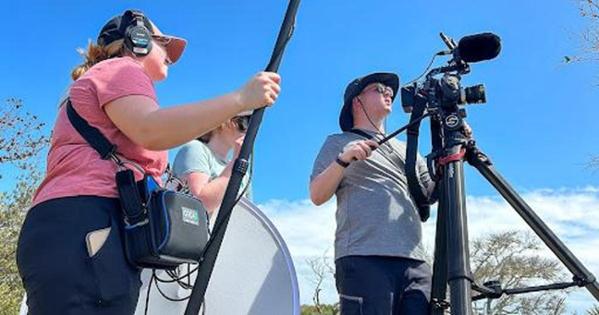
 Inside the classroom, Kauffman’s coursework has emphasized producing work at a professional level. In advanced production classes, he took on multiple roles within a single project; working as a producer, cinematographer, and graphics lead on a 30-minute documentary completed within one semester.
“You’re creating a professional film to a professional production standard, and you have 15 weeks to do it,” he said. “It was kind of like a crash course of everything you’ve learned put together.” The experience pushed him to adapt quickly, including teaching himself new technical skills. “I had never done graphics before, so I had to learn how After Effects worked,” he said. “All of those skills are things you build in other classes, and then this is where it all comes together.”
Those capabilities carried into a range of internships and fellowships that reflect his focus on documentary and environmental storytelling. As a production intern with National Geographic, part of The Walt Disney Company, he worked within the natural history division, supporting executive producers and reviewing edits. “It was a great crash course to really understand how the professional film industry works,” he said. “I was watching cuts, giving notes, and being able to give some of my creative input.” The experience also reinforced skills he developed at AU. “That’s something we do in classes, giving notes, and it translated directly.”
Earlier, as a communications intern with the DC Environmental Film Festival, Kauffman evaluated film submissions, created promotional content, and later continued reviewing films as a screener. Together, these roles gave him a broader view of how documentaries move from production to distribution, and how different parts of the industry connect.
Beyond his academic focus, Kauffman has also taken on a visible role on campus as a student ambassador, sharing his experience with prospective students and emphasizing the value of getting involved. “I love AU,” he said. “Especially once I really got into the film program and started building those relationships.” That shift, he noted, came as he became more engaged with both faculty and coursework. “There are so many opportunities here that I never thought I would have had,” he said.
Kauffman’s time at AU points to a consistent takeaway: the strength of the program lies not just in coursework and available opportunities, but in how students choose to engage with them. “You have to take advantage of your education, you can’t just sit idly by,” he said. Through faculty mentorship, collaborative projects, and industry experience, he has built a foundation that bridges creative development and professional practice, one shaped by both initiative and the environment around him.