
Taking Back Media Power with Associate Professor Sherri Williams
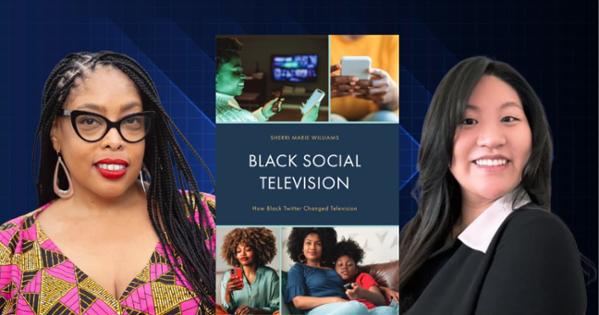
This interview with Professor Sherri Williams has been excerpted from a 2,000-word piece on her groundbreaking new book, Black Social Television: How Black Twitter Changed Television by American University Media, Technology and Democracy Master's student Eunice Kim. The conversation below explores how Black audiences have used digital platforms to reshape media representation, challenge stereotypes, and build new forms of collective activism. An award-winning scholar and professor in the American University School of Communication, Williams argues that media power is never static, and that the fight for authentic representation continues to unfold across screens both big and small.
EK: What has it been like to see people engaging with your work?
Sherri Williams: It's just been good for people to learn more about the kind of digital activism that Black people have been doing in defense of our images and in tradition of how we've always worked. To make sure that we are portrayed in mass media images with a degree of authenticity and humanity.
EK: Was there a moment in your research when you thought, “This isn’t just people talking online, this is actually changing what shows get made or canceled”?
Williams: Yeah, so this was actually, my PhD dissertation. I originally intended for my dissertation to be about how immigrant women use mass media, whether it be television, newspapers, and radio; to learn English. But when I was doing my homework on Sundays, I noticed that whenever The Real Housewives of Atlanta would air on television; everything they said, the things they did, places they went, their catchphrases, the things they wore, would end up trending on Twitter.
EK: With the change of Twitter’s ownership and transition into X, what have you noticed has shifted for Black audiences? And do you think, creators still hold the same power and or the platforms calling more of the shots?
Williams: I think creators still hold the power, but I definitely don't think that Twitter does. Twitter is a cesspool for homophobia, transphobia, misogyny, and racism. There has been a clear exodus from Twitter ever since Elon Musk took it over, and it's not just by typical, everyday people, but also by people who are in the television space.
One of the reasons why Scandal was such a big social media hit was because not only did Kerry Washington borrow some of the social media and digital activism strategies that she was using when she was working on the Obama campaign in 2008, but she also got Shonda Rhimes, the show's creator and producer, to tweet about the show and the rest of the cast.
EK: In your book, you talk about “image warfare”—the fight over who gets to define Black identity. Do digital platforms make that fight easier, harder, or just more complicated?
Williams: I think they really do both. In terms of image warfare, digital platforms and mobile technology give marginalized people, particularly Black people, an opportunity to refute harmful images and do it collectively in ways that can be amplified.
At the same time, these platforms were created by people who, often unintentionally, built them with the same societal prejudices that exist offline. I’m thinking about algorithmic oppression right now.
EK: How do you bring the themes of Black Social Television such as identity, power, and representation into the classroom?
Williams: don't really talk about Black social TV specifically that much. I do bring it into one of my classes, Identity, Power, and Misrepresentation, because it’s about media representations of different marginalized groups across the board. But I mostly teach journalism classes, so it's not really applicable over there.
Generally, what I teach about is how media representations, particularly in the United States, where there is a concentration of media ownership. We basically have these media moguls who are information tyrants, who restrict and constrict what we see and what we hear. The big five companies circulate information that fits into their own interests.
Commercialism and capitalism are the priorities of corporate media, not citizenship. These media companies talk to us like we’re customers—people who are going to buy and consume things—rather than citizens who act on what we see and learn for the betterment of society.