
Congress & The Presidency: A Conversation with the New Editorial Team
Since its establishment in 1984, Congress & the Presidency: A Journal of Capital Studies has emerged as one of the premier academic publications examining the American legislative and executive branches. Published by the Center for Congressional and Presidential Studies (CCPS) at American University’s School of Public Affairs (SPA), the journal serves as a crucial bridge between scholarly research and practical understanding of American governance.
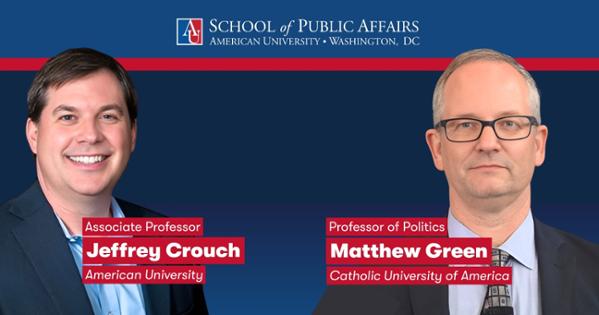
SPA Associate Professor Jeffrey Crouch, a CCPS fellow and an expert on federal executive clemency and presidential pardon power, co-authored Newt Gingrich: The Rise and Fall of a Party Entrepreneur (University Press of Kansas) with Matthew Green in 2022. In a new twist to their partnership, Green, a Professor of Politics at the Catholic University of America, now joins Congress & the Presidency as co-editor. This team, along with Reviews & Book Editor Adam Warber, will oversee a journal known for its methodological openness and scholarship that examines contemporary issues alongside historical perspectives. The journal's editorial board includes some of the most distinguished scholars in American politics, representing institutions such as Yale, Princeton, Stanford, MIT, and others.
Crouch, and now Green, oversee recent innovations in the journal that include the James A. Thurber Article of the Year Award, named for SPA Professor Emeritus Jim Thurber, which recognizes outstanding scholarship published in the journal. The journal also periodically produces special issues addressing fundamental and timely topics in congressional and presidential studies, such as underrepresented aspects of diversity in legislative and executive branch scholarship and the upcoming special issue on the unitary executive theory. Congress & the Presidency is one of five journals hosted by SPA that cover subjects from public policy, government, and law.
To better understand the journal's current direction and future vision, we spoke with the editorial team about the impact of recent additions, emerging trends in the field, and the journal's unique role in bridging scholarship and policy.
How does Matthew Green’s arrival as a co-editor help the publication, especially in evaluating submissions? How will his insight help Congress & the Presidency continue to bridge political science and history?
“Matt is an award-winning expert on Congress and has published articles in a variety of venues, including Congress & the Presidency,” the editors note. His background on contemporary and historical congressional politics perfectly complements Jeff's ongoing interest in the presidency, and the two have collaborated on several projects in the past. Matt's involvement with the journal will provide a fresh set of eyes for evaluating submissions, particularly on topics related to congressional politics, and hopefully will encourage other top scholars to consider Congress & the Presidency anew as a possible outlet for their work."
Has the recent political polarization and institutional tension between Congress and the presidency influenced the topics researchers are submitting and the questions the field is asking?
"The journal has recently published a number of excellent studies of polarization, extreme party conflict, and tension in congressional-presidential relations," the editors respond. "They include Thurber Award-winning articles by Ruth Bloch Rubin; Huchen Liu; and Terri Bimes, Casey Dominguez, and Dan Grushkevich. But there is still a great deal to explore, and we would love to have more submissions on those topics. Interestingly, the effects of social media on Congress and the presidency have become a more popular subject of submissions as well."
What topics or areas of research have emerged that deserve more scholarly attention in congressional and presidential studies? Are there gaps in the literature that you'd particularly like to see addressed?
"The return of the Trump administration has injected new life into scholarly debates on many topics," the editors explain, "including the influence of the president over the House and Senate, parallels between today's politics and historical eras of assertive presidents, and whether Congress can reestablish itself as a powerful, independent branch of government. We welcome additional submissions on these and related subjects. In fact, we are currently working on a special issue focusing on the unitary executive theory, which is particularly timely."
Given that the Center for Congressional and Presidential Studies has a mission to serve scholars, policymakers, and the public, how do you think about the journal's role beyond academia? Do you see opportunities for the research published in Congress and the Presidency to inform actual governance and policymaking?
"We aim to be on the cutting edge of emerging debates in both academia and in the policymaking world on the history, role, and influence of the president and Congress," the editors emphasize. "Given the journal's unique niche—publishing research on our national legislative and executive branches of government that is easily accessible to laypersons and scholars alike—we see considerable opportunity for Congress & the Presidency to influence policymakers in Washington, D.C."
Finally, what else is new with Congress & the Presidency?
Starting in February, Jessica Wurpel joins Jeff, Matt, and Adam as the journal's new Editorial Assistant, replacing Mark Tenenbaum, who served as Managing Editor for the past year and a half. The journal thanks Mark for his many contributions as he moves on to a full-time, non-academic position after successfully defending his dissertation.