
Irish America Rises
The Irish-American lobby was heavily involved in the Northern Ireland peace process in the 1990s but was largely dormant when the Brexit referendum occurred in 2016. Against the odds, Irish America reemerged post-Brexit to shape the U.S. foreign policy approach, working with European partners to prevent the reimposition of a hard border on the island of Ireland.
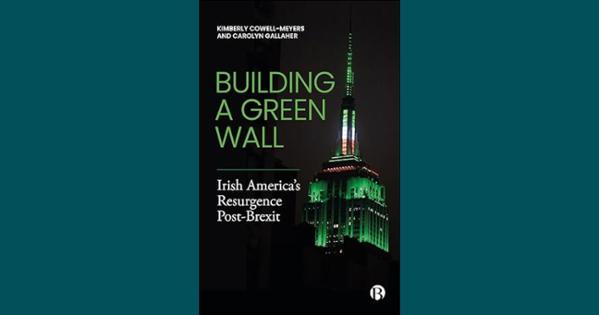
Building a Green Wall: Irish American Resurgence Post Brexit, by SPA Associate Professor Kimberly Cowell-Meyers and SIS Professor Carolyn Gallaher, explores this unique ethnic lobbying success. Just published, the book draws on extensive media coverage and in-depth interviews with 35 Irish American activists and key actors in Ireland, Northern Ireland, and the UK to explain how Irish American lobbying protected the Belfast/Good Friday Agreement from Brexit-related threats to Irish unification.
“When the peace agreement was signed, Irish America retreated from the foreign policy stage,” said Cowell-Meyers. “We saw their remobilization as the British government undertook or proposed various policies that threatened Northern Ireland and the peace process.”
Cowell-Meyers and Gallaher, who began these interviews in 2018, enjoy significant relevance in this academic space. They organize an annual conference on Northern Ireland in D.C. with Ulster University and Georgetown University and maintain contact with interested parties. They also participated in a Queen’s University, Belfast study abroad program and cultural exchange, instructing so-called “peace babies.” When the British House of Commons voted down Theresa May's Brexit withdrawal agreement, the authors were on a conference panel, updating panelists in real time.
Interviewees, including academics within the policy and business communities and former or current public officials, spoke off the record. Their influence, surprisingly, didn’t cost a dime. “When you think about ethnic lobbies, you think about money greasing the wheels,” said Cowell-Meyers. “There's no money trail here at all, because they didn’t need it to move their agenda along.”
“We interviewed Democrats and Republicans,” said Gallaher. “In this very, very partisan moment, Irish America is bipartisan around these issues.”
Brexit and the Irish Trade Dilemma
Brexit posed a particular trade issue for the island of Ireland. Some citizens of Northern Ireland want to remain a part of Ireland, while others prefer to be part of the United Kingdom. The end of The Troubles had functionally removed the land border between the Republic of Ireland and Northern Ireland, allowing citizens to move freely back and forth.
“The Good Friday Agreement erased borders in a post-nationalist way,” said Cowell-Meyers. “In other words, Northern Ireland remained part of the UK, but the very large minority of Irish Catholics living in Northern Ireland who did not identify with the British state could hold an Irish passport and define themselves as British, Irish, neither, or both.”
Since Northern Ireland left the EU along with Britain, Brexit meant that the border may be reimposed, as a customs checkpoint in what is, essentially, a single economy.
“The Irish American lobby argued that the hard border represented a real danger [to cohesion and peace],” said Gallaher. “If you put that infrastructure back up for the purposes of monitoring trade, you're going to stir up issues that the peace process had worked to creatively rearrange. It would be a target, potentially, for dissidents.”
Irish America Rises
In 2019, these activists formed the Ad Hoc Committee to Protect the Good Friday Agreement, headed by former Congressmen Jim Walsh and Bruce Morrison. Soon, they realized the need to lobby for a Brexit withdrawal agreement that preserved the open border.
When the Brexiteers came after their own U.S.-UK trade deal, Irish America saw its chance. A trade agreement must be approved by the House Ways and Means Committee. Fortuitously, Richie Neal, then co-chair of the Congressional Friends of Ireland caucus, also chaired that committee. With the backing of Speaker Nancy Pelosi, who visited the UK and Ireland in support, Neal articulated a very strong position: if Brexit resulted in a hard border, there was no chance of a trade deal passing.
Meanwhile, the Republic of Ireland sought EU backing on the land border issue and got it and sent envoys to Washington long before the British sent their own.
“[The UK’s] every effort failed, because, by that point they had been "out-diplomatted" by the Irish,” said Cowell-Meyer. “When they tried to articulate their position, it fell flat because the ground had already been fertilized by the Irish.”
Under significant pressure, Boris Johnson eventually put the border in the Irish Sea. The withdrawal agreement established that, while goods with the potential to pass into the EU will need higher levels of scrutiny, no land border would be established.
A Unique Ethnic Lobby
The book examines multiple ways in which Irish America defied the predictions of the ethnic lobby’s literature: for all the academic and popular predictions on their waning influence, they overperformed. The authors consider it a special lobbying force due to its coherent political culture, dense networks, proximity to political power, quirky institutional opportunities (most notably, annual St. Patrick’s Day events in D.C.), and deep societal good will.
“Historically, U.S. policy towards Ireland was that it was in the UK's domain,” said Gallaher, explaining Irish American overperformance. “If there was a conflict, what the UK wanted would reign.”
“The Irish brand sells,” added Cowell-Meyers. “They have [a great deal] of soft power, general goodwill, and the sense that Irish America aligns with U.S. national strategic interests.”
One interviewee characterized Irish America as "high-minded, well-connected, dedicated, and tireless," mentioning a core Beltway group who excel at whisper campaigns. “We don’t need [to hire] a lobbyist,” he said. “We’re all willing to do it.”
The authors also noted a kind of purity in their efforts.
“We discovered the fundamental nature of their investment in the peace process: it was a personal moral position as opposed to a purely political maneuver,” said Gallaher. “They understood that the ’98 peace process put to an end 30 years of horrific violence. It opened up a pathway for normal life in Belfast, and for economic development in Belfast and Derry, and for a second and third generation of peace babies.”
“The U.S. did not have a policy on Brexit,” said Cowell-Meyers. “Irish America created it. They used their leverage, the trade deal, very effectively. They organized the apparatus of American foreign policy to constrain what the British could do.”
Building a Green Wall: Irish American Resilience Post Brexit is available for purchase from Bristol University Press.