
Daniel Mendelsohn Delivers Annual Lincoln Scholars Lecture
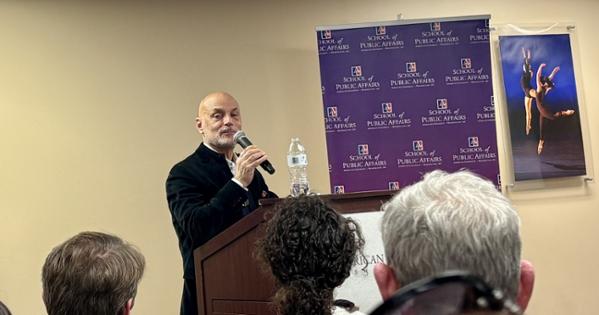
Acclaimed author and classicist Daniel Mendelsohn of Bard College delivered the annual Lincoln Scholars lecture on November 6th at American University’s Butler Board Room, sharing insights from his recent translation of the Odyssey.
Mendelsohn’s close reading and translation of the timeless Greek epic offers a lens into modern political tensions surrounding borders, boundaries, and identity.
Mendelsohn began framing the Odyssey’s central hero, Odysseus, as the original “great adventurer” of Western tradition. Odysseus’ exploits, Mendelsohn mentions, shaped the cultural reverence afforded to later “adventurers,” such as Christopher Columbus. History would mythologize this brand of figure as “suave”, “heroic”, and “masculine.”
In the face of this, it is tempting to view Odysseus and the wider Odyssey as simply a “celebrat[ion] of white heteronormativity,” steeped in and substantiating Western mythologies. Mendelsohn's translation work underscores the epic’s multitudes, however.
Turning to the Odyssey’s proem (preface), Mendelsohn argued the text intentionally “shies away” from naming or explicitly defining its hero, holding Odysseus — both King of Ithaca, and a sort of ‘nobody’ due to his estrangement — in suspension.
Mendelsohn then examined two ancient Greek words underscoring a similar duality: polytropos, meaning “someone with roundabout ways,” or “non-traditionally resourceful,” and plánēs, meaning “wandering” or “roaming astray.”
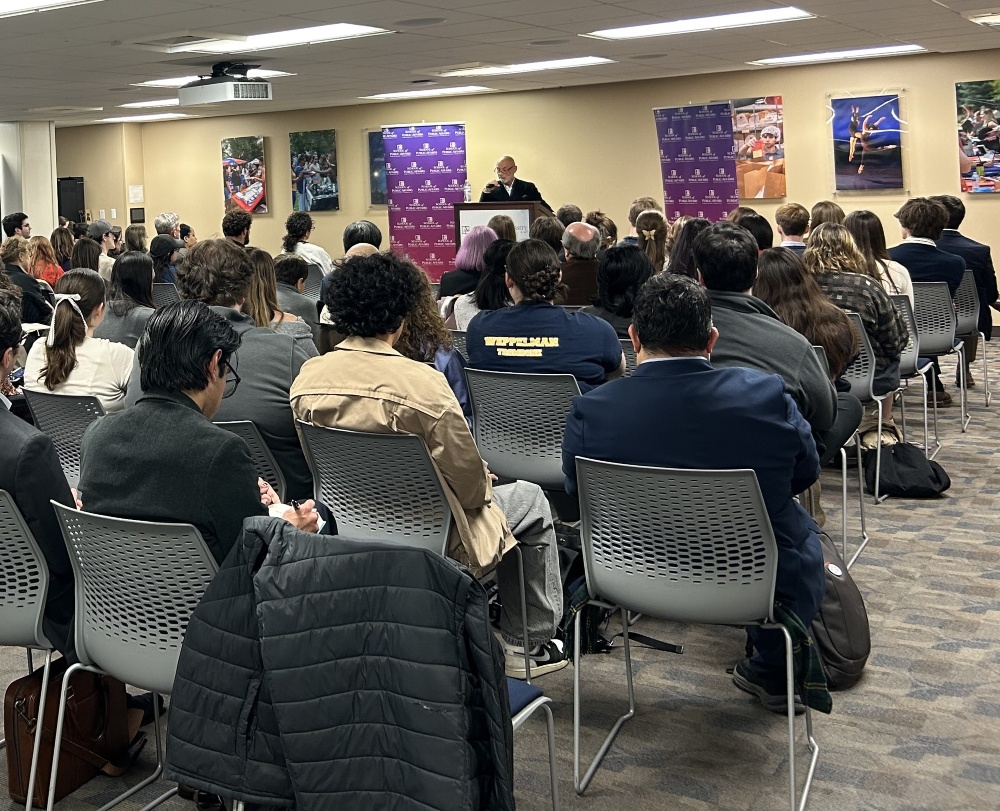
From this, Mendelsohn discerned two distinct facets in Odysseus: an “active,” prideful, “roundabout, eager wanderer” in line with the Western explorer concept, and a “passive,” “nontraditional” side of our hero that frequently experiences “struggle.” He posited one of the Odyssey’s earlier passages — that of Odysseus and Polyphemus — as a powerful articulation of this dual tension.
Infamously, Odysseus blinds Polyphemus by fraudulently introducing himself as ‘Outis’, a Greek word meaning ‘no one.’ When Polyphemus calls for help, he declares that ‘Outis’, i.e., ‘no one,’ is hurting him, allowing Odysseus and his men to escape from the cyclops’ cave.
In effect, Medelsohn explained, Odysseus succeeds by embracing a certain passive unremarkableness.
Shortly after his triumph, however, Odysseus succumbs to pride. He boasts to Polyphemus and self-identifies himself as “Odysseus, of Laertes, whose home is Ithaca.” This enables Polyphemus to identify and curse him, a punishment for active self-aggrandizement, Mendelsohn posits.
Further, active hubris continues to punish Odysseus throughout the Odyssey. Similarly early in the epic, he attacks the Ciconians, slaughtering and enslaving, but ultimately reaps great losses for himself and his men.
Wholly separate from this reckless disregard, Mendelsohn notes, the Odyssey rewards Odysseus for “experienc[ing] abjection and neediness.” When Odysseus eventually returns to his home city, the goddess Athena transforms his appearance, aging his body, ruining his clothes. With this new face, he is insulted, mocked, and abused by those he encounters. It is only after this subjection and humiliation that the narrative delivers Odysseus back to his family.
Mendelsohn notes, however, that Odysseus’s recognition by a palace attendant, prompting this return, is not followed by a reunion sequence; rather, Homer leans far back into Odysseus’s history, recalling his naming at birth.
Emboldened by this recollection, Mendelsohn focused a translational eye on the hero’s name. He interprets ‘odússomai’ — the Greek origin of ‘Odysseus’ — to mean “he who inflicts and suffers hateful pain.”
In this, he concludes that “[Odysseus is] a man literally defined by his name,” inherently dualistic, passive and active, and steeped in strife.
Mendelsohn concluded his lecture by reflecting on Odysseus’ broader identity forged through hardship. “The Odyssey grants our hero his identity [only] after enduring poverty and statelessness”, he observed. Understanding Odysseus’ complexity, he argued, helps us to understand the humanity at the heart of contemporary issues concerning borders and displacement.
“After all,” he reminded the audience, “the first boundary we must confront is that between us and others.”