
Exhibitions Summer 2026Opening June 13
- A. Brockie Stevenson: An American Vision
- Ghost in the Machine: Works by Timothy Makepeace
- Where Water Keeps Time: Graphite Drawings by Janis Goodman
- Susan Goldman: Prima Vista
- Bonnie Lautenberg: ARTISTICA! Where Hollywood Meets Art History
- Richard Dana: People, Places and Otherwise
- Gail Rebhan: What Questions Do We Ask?
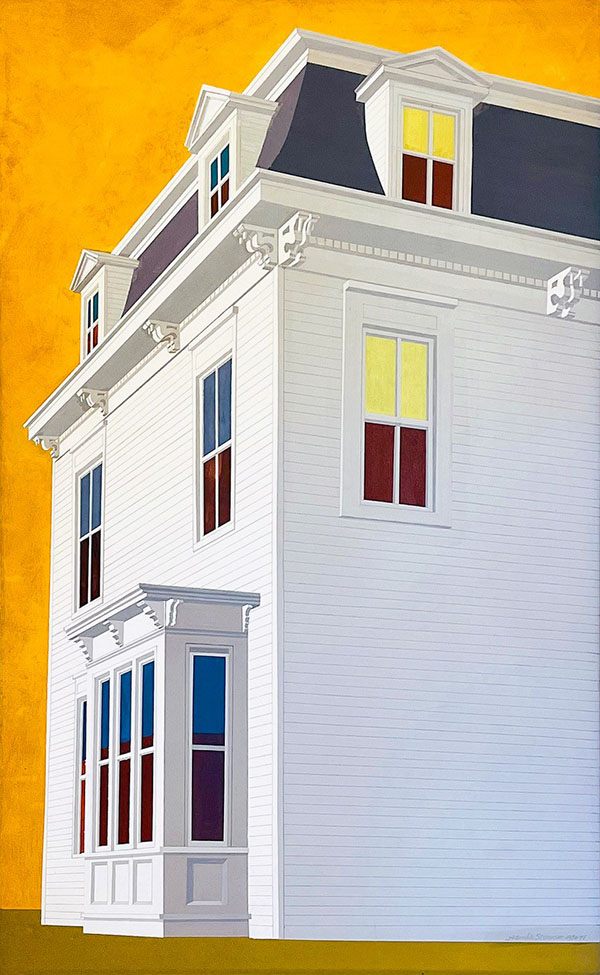
A. Brockie Stevenson: An American Vision
Alfred Brockie Stevenson (1919–2009), Artist
Edith Graves, Curator
Enter a world of stillness where small-town America is rendered with quiet precision. White clapboard houses, fire stations, storefronts, and locomotives stand not as nostalgic emblems, but as enduring meditations on order, solitude, and care.
A. Brockie Stevenson, long based in Washington, DC, devoted his career to observing the built environment of America with an exacting and patient eye. Trained at the Pennsylvania Academy of the Fine Arts, a World War II combat artist, and a dedicated teacher at the Corcoran School of Art and Design, Stevenson shaped generations of artists.
Working with disciplined geometry and flattened planes of color, his carefully calibrated compositions are situated within the lineage of American Realism alongside figures such as Charles Sheeler and Edward Hopper. For Stevenson, craft was a moral commitment. This exhibition of eleven paintings and eight silkscreens invites us to slow our gaze and contemplate his transformation of ordinary structures into timeless studies of light and silence.
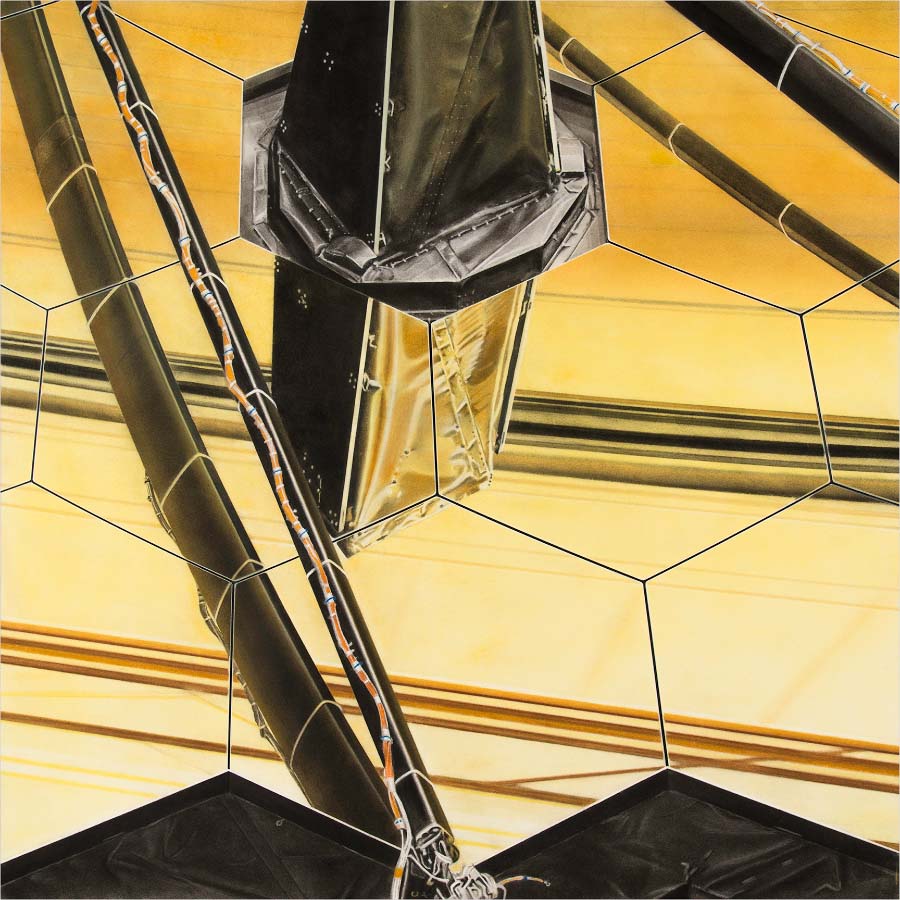
Ghost in the Machine: Works by Timothy Makepeace
Timothy Makepeace, Artist
Thomas Drymon and Michael O’Sullivan, Curators
Over a 40-year career, Tim Makepeace has maintained a singular focus on both the material world and its immaterial presence. He continues this dual investigation with Ghost in the Machine, turning his attention to the James Webb Space Telescope (JWST)—the most powerful infrared space observatory ever devised. The telescope was launched in 2021, but in 2017 while the telescope was still under construction at NASA’s Goddard Space Flight Center, Makepeace was invited to observe and create artwork in response to this technological marvel.
Since those early visits, Makepeace’s keen powers of observation and unfettered imagination have taken him to places previously unconceived.
Rich in detail and expansive in scope, this exhibition extends the artist’s long engagement with the industrial landscape. Yet rather than simply document a piece of exquisite space hardware, Makepeace’s newest works ask probing questions: What is the relation between the physical and ephemeral; space and time; the finite and the infinite; the cosmic scale and the subatomic? What do our efforts to understand the world around us reveal? Do we loom large or small in an expanse whose boundaries we have not even begun to define?
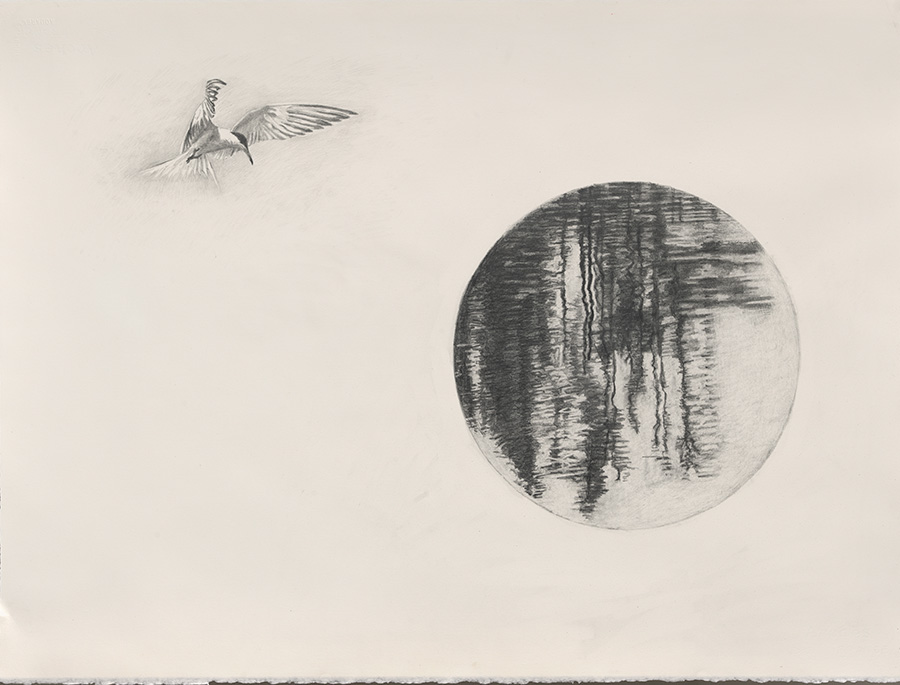
Where Water Keeps Time: Graphite Drawings by Janis Goodman
Janis Goodman, Artist
Laura Coyle, Curator
Janis Goodman invites you to experience 25 years at Greenlaw Cove on Deer Isle, Maine, through her eyes and with her affection. Step into the landscape as she does: enter through expansive, immersive drawings, then lean in close to more intimate works that reward careful looking.
Light moving across water draws her in, but so do the cove’s finer details—marshes, osprey nests, granite outcroppings, waterfowl, and mudflats. Each demands its own visual language. Goodman responds by adapting her mark-making, even devising custom tools to capture the rhythms and textures of a place in constant flux. Every work carries a vivid sense of presence, shaped by years of returning to a landscape that is never quite the same.
Best known for her colorful abstract paintings, Goodman has been a vital force in the Washington, DC arts community, teaching for more than thirty-five years at the Corcoran School of the Arts & Design and supporting the arts through public work and media, including her role as an art reviewer for WETA TV.
This exhibition, on view for the first time, is dedicated to the power of place. What begins as direct observation becomes something more layered—memory, material, sensation, and time reworked in the studio. As you move through the exhibition, you’re invited to trace that transformation. The result is a compelling meditation on how we see, remember, and make meaning of what is special to us
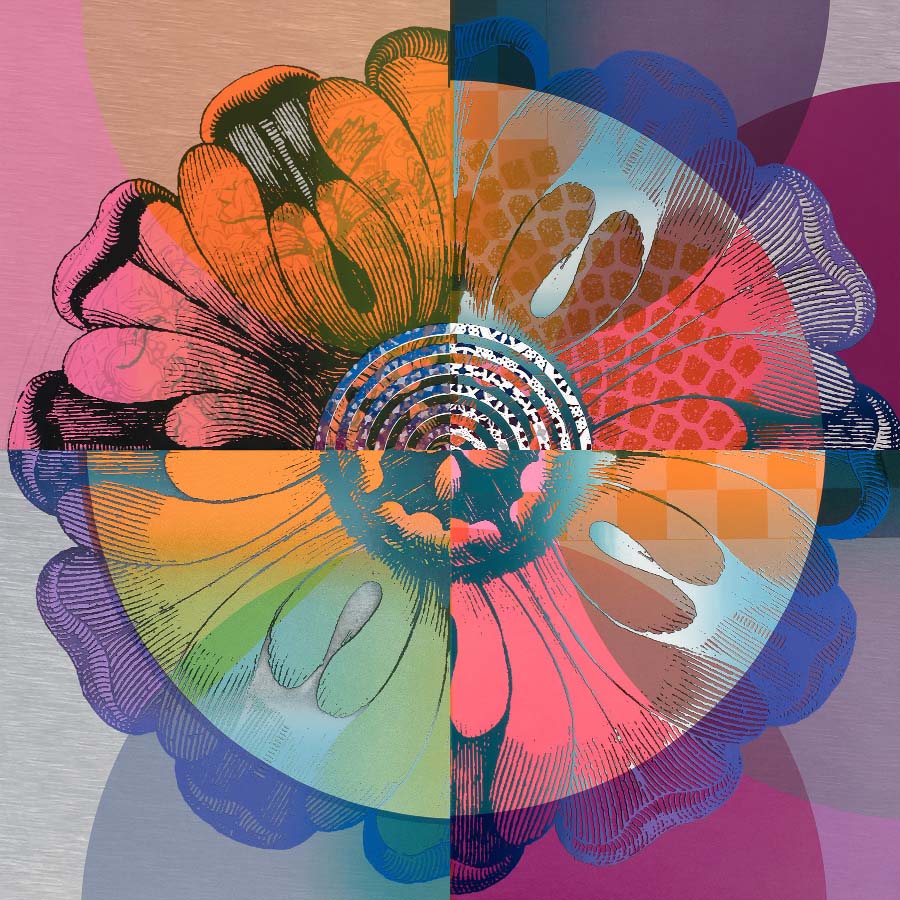
Susan Goldman: Prima Vista
A Project Space exhibition
Susan Goldman, Artist
Jack Rasmussen, Curator
In Prima Vista—an Italian phrase meaning “at first sight”—artist and master printmaker Susan Goldman turns away from the visible world and toward inner vision. These works do not depict recognizable places or scenes; instead, like a flower dissolving into a horizon, images arise from an initial moment of awareness, before thought takes hold.
Working with large-scale prints on aluminum, she embraces translucency, layering, and reflection to create compositions with luminous color, fluid movement, and intuitive mark-making. Goldman gives form to what is glimpsed and inwardly felt before it is understood. In Prima Vista, seeing is not about recording what is there, but about honoring what appears within the mind’s eye—immediate, alive, and unbound by representation.
Though her approach is intuitive, it is deeply informed by decades of experience. Shapes and colors emerge through a process of looking, revising, and responding, guided by a physical and perceptual sensitivity to color. “Threads of art history,” she says, “run through everything. Consciously and unconsciously, my habits, my instincts, and the artists I admire shape what I do. At some point, I realize I have made my own art history. I know I’m in new territory. It feels right.”
Susan Goldman is the founding director of the Printmaking Legacy Project®, a nonprofit dedicated to documenting and preserving printmaking practices, and Lily Press®, an independently owned fine art printmaking atelier and studio located in Rockville, Maryland. Goldman has played a significant role in the region’s arts community through her teaching and collaborative work, while maintaining an active studio practice with exhibitions nationally and internationally. This is her first solo museum exhibition.
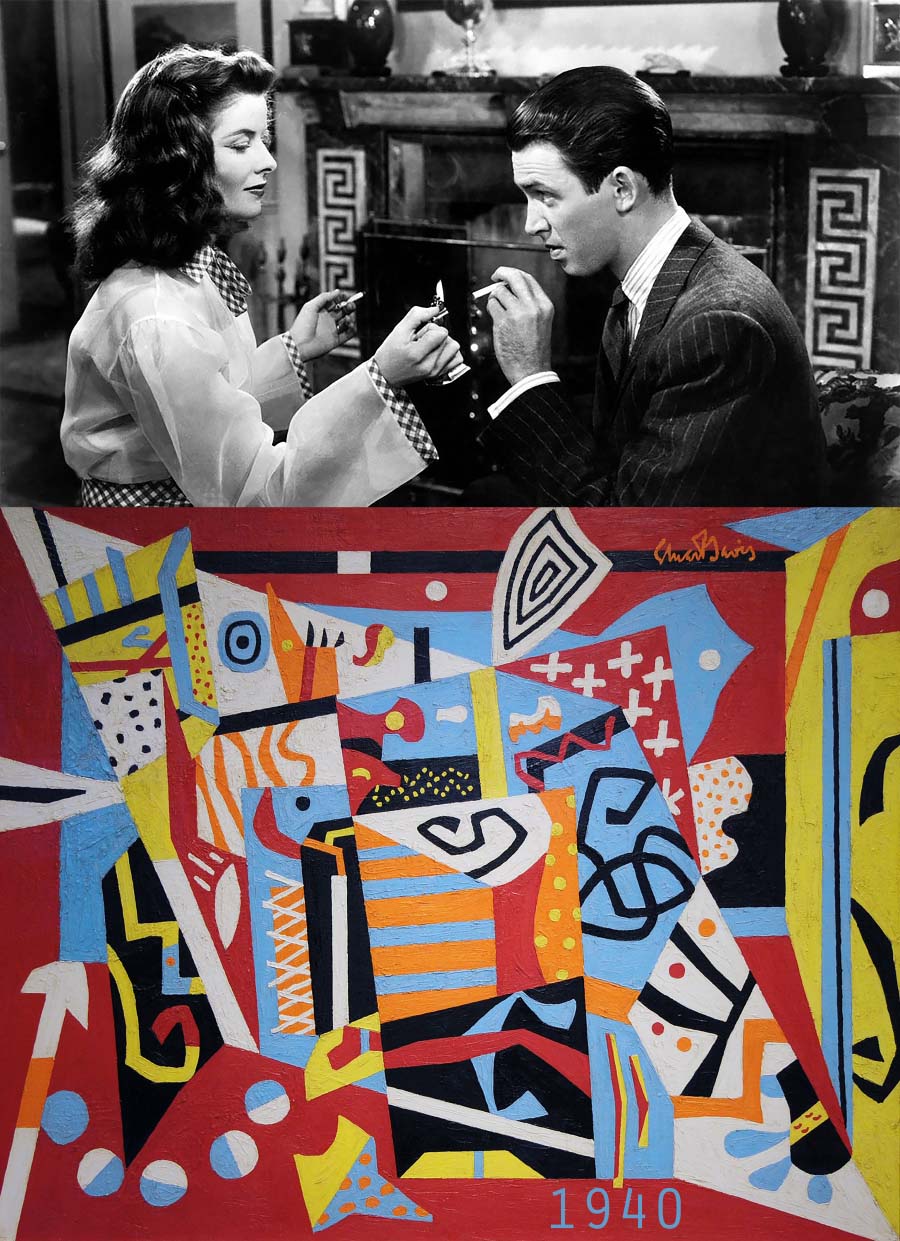
Bonnie Lautenberg: ARTISTICA! Where Hollywood Meets Art History
Bonnie Lautenberg, Artist
Known for her photography across politics, music, and the arts, Bonnie Lautenberg creates a lively visual history lesson by pairing iconic works of art with film stills from the same year.
As you look, you begin to see art and film side by side in a new way, noticing how images “speak” to one another across media. Her process is intuitive—sometimes she starts with a painting and searches for a cinematic counterpart; sometimes a film image leads her to an artwork. Lautenberg began this series in 2017 and continues to expand it, including new work created especially for this exhibition at American University Museum.
As you move through the exhibition, you’ll encounter pairings that span decades of film and art. René Magritte’s The Lovers (1928) meets a still from The Mysterious Lady, starring Greta Garbo and Conrad Nagel. The Golden Age of Hollywood appears in a pairing of the 1940 film The Philadelphia Story with a painting by Stuart Davis, once owned by Lautenberg’s parents. Singin’ in the Rain, starring Gene Kelly, joins a work by Yayoi Kusama, noting a shared texture between Kusama’s surface and the brick and rainfall in the still. In another instance, Barbra Streisand in Funny Girl meets Tom Wesselmann’s American Nude No. 99, where a subtle echo, a cigarette, links the two images.
Across these works, Lautenberg places two powerful visual languages on a single plane. The result is open-ended: a field of formal, emotional, and historical connections that invites each viewer to look, compare, and draw their own conclusions.
Richard Dana: People, Places and Otherwise
Richard Dana, Artist
Nancy Sausser, Curator
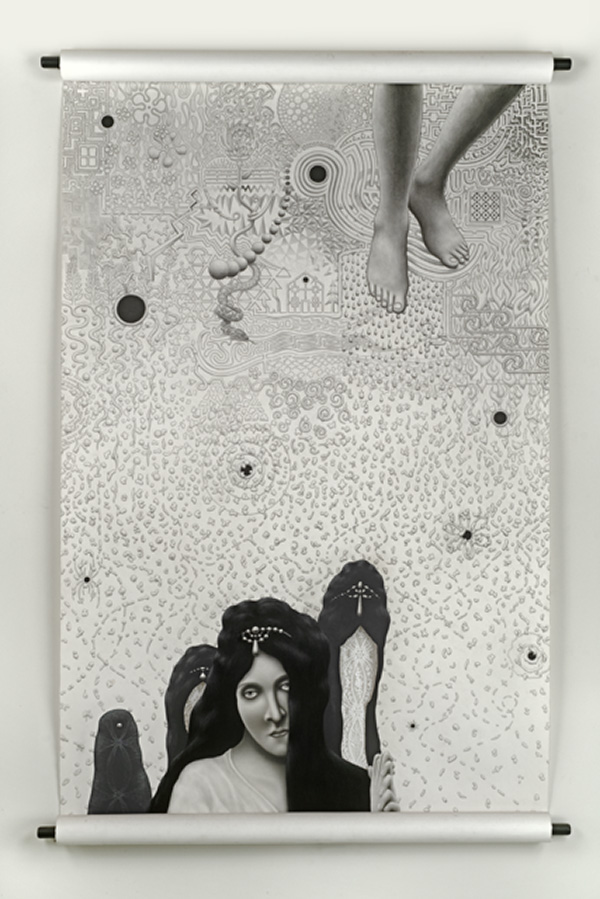
For more than four decades, self-taught artist Richard Dana has returned to drawing as his most essential form of expression. This exhibition brings together a wide-ranging selection of works in graphite, charcoal, and ink, spanning early to recent pieces.
As you move through the exhibition, you’ll encounter a vivid and often unexpected visual world: a young genie emerging from a bottle in a barren landscape, a startled businessman holding a baby in a midnight office, enigmatic portraits, and phantasmagorical structures and terrains. Dana’s work moves fluidly between the recognizable and the surreal, suggesting parallel worlds that feel at once strange and familiar.
Experimentation drives Dana’s practice. Drawing on sources as varied as the human condition, the natural world, science, and global cultures, he transforms observation and imagination into images that are both intricate and open-ended. Using simple materials with remarkable range, Dana creates images that are visually rich and emotionally resonant. Rather than prescribe meaning, he invites you to engage, question, and find your own connections within these layered and evocative works.
With 25 solo exhibitions and participation in over 140 group shows, Richard Dana has exhibited widely in major American cities and in twenty countries. Before “morphing into an artist”, he worked as a Soviet affairs analyst for the government.
Gail Rebhan: What Questions Do We Ask?
Gail S. Rebhan, Artist
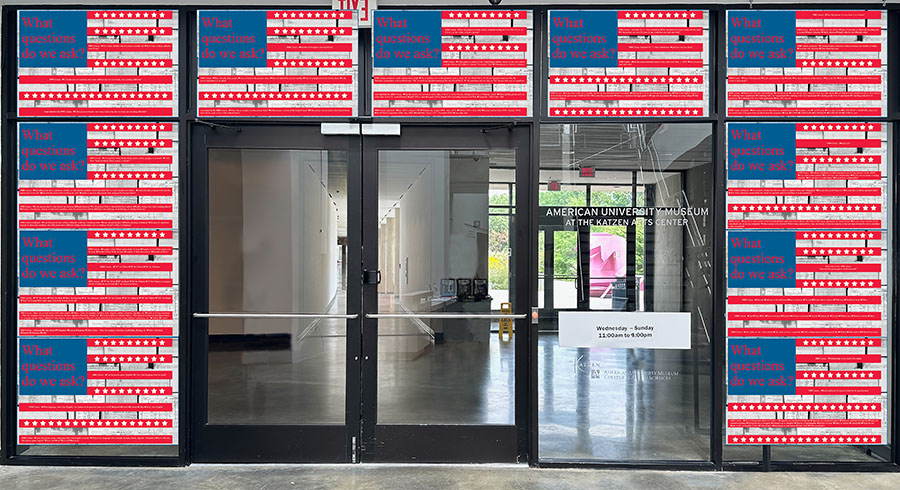
In What Questions Do We Ask?, artist and photographer Gail Rebhan transforms the language of the US census into a compelling visual record of American history. At the museum entrance, you encounter census questions from 1790 to 2020, revealing how what is asked reflects what a society values, debates, and seeks to understand.
Organized by themes such as race, disability, language, technology, and work, each piece traces how a single line of questioning evolves over time. These shifts point to broader cultural change, showing how census data not only records the population but can also shape public policy and national priorities.
The works layer these questions over an American flag motif, grounding them in a shared national identity while inviting closer scrutiny. Historic census forms serve as visual backdrops, while a mix of government typography and expressive handwriting underscores the passage of time. As you look, patterns and shifts begin to emerge, reflecting an evolving society.
Through this body of work, the artist offers a condensed social history of the United States, asking you to consider how the past informs the present—and how the questions we ask shape what comes next.