
The Physics of Snowflakes: Why Flakes Have Six Sides and None Are Alike
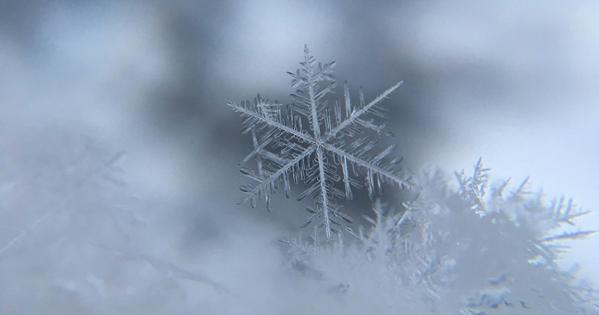
As a major winter storm threatens to blanket Washington, DC—and much of the country—in snow and ice this weekend, most people are focused on grocery runs, school closures, and slick roads. But inside every flake falling from the sky is a physics lesson. Why do snowflakes almost always have six sides? Is it really true that no two are exactly alike? And does the structure of the flake change if it’s a wet, sleety snow?
American University Department of Physics Professor Nathan Harshman explains the hidden science inside every falling snowflake, from the formation of ice crystals to the atmospheric twists and turns that shape each flake’s journey.
PH: Is it really true that no two snowflakes are alike?
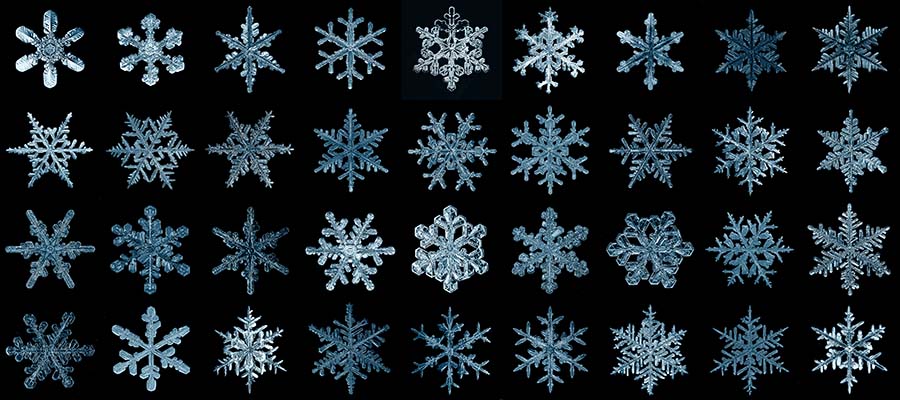
NH: A snowflake contains around a billion billion (1018) molecules. There is a branch of mathematics called combinatorics that counts the different ways you can assemble sets using rules (like symmetry or energy conservation), and let me assure you that the number of ways to assemble a billion billion molecules into a hexagonally symmetric pattern is quite large enough that in our universe, no two snowflakes have even been the same.
PH: When people talk about snowflakes being “perfectly symmetrical,” what do they mean?
NH: Snowflakes can be made of multiple crystals. But a single snow crystal, what you think of as the classic, beautiful snowflake, has the same symmetry as a hexagon. So even though some snow crystals have complex, lacy, fractal structures, and others look like simple prisms, we say they all have hexagonal symmetry.
One way to think about the symmetry of a snow crystal is in terms of what kinds of actions map the object back onto itself. For a snow crystal with hexagonal symmetry, you can rotate it by 60 degrees, and it maps back onto itself, or you can reflect across six different axes and map it back onto itself. The set of symmetry maps is called a “group,” and group theory is how mathematicians, physicists, and chemists turn symmetry into math and science.
PH: Why do snowflakes have six sides?
NH: Why do water molecules stick together in a hexagonal pattern? That is complicated and has to do with the arrangement of electrons and protons in a water molecule, and how they shift when close to other molecules. Calculating all that from first principles of quantum mechanics is still a hard technical challenge!
PH: That does sound complicated. Can you tell us how this pattern starts, and how water molecules grow into a snow crystal?
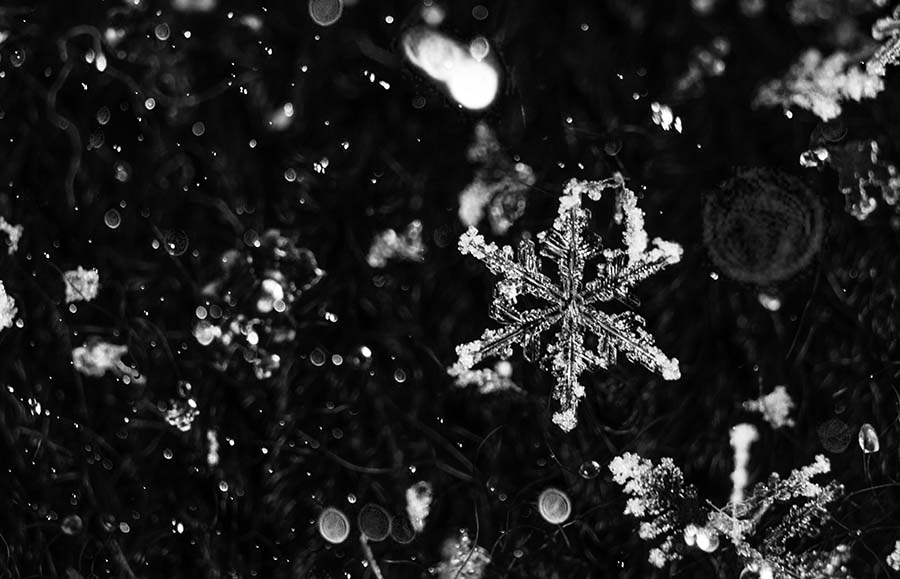
NH: Cold molecules of water in the atmosphere are weakly attracted to each other and start sticking to each other. That’s called freezing! Because of the way the electrons in the water molecules arrange themselves, when they stick together, the molecules align themselves in a regular pattern called a crystal lattice. This lattice has hexagonal symmetry, with oxygen atoms at the corners of the hexagon.
This only happens if the freezing takes place slowly. If the water freezes too fast, then it doesn’t form a tidy lattice. That’s what happens in sleet: liquid water freezes quickly as it falls, and the molecules are just sloppily stuck together.
For physics aficionados, this hexagon form of ice, the most common of Earth, is called Ice Ih and the lattice of water molecules has space group symmetry 194. There are also other crystal lattices of ice that can form under extreme conditions, and they are all given Roman numerals (like Kurt Vonnegut’s famous but fictional Ice IX in his book Cat’s Cradle).
One more comment to clear up a common misunderstanding: water molecules have a V-shape with the hydrogen atoms sticking out from the oxygen atom. Sometimes you will hear people saying that the hexagonal symmetry comes from the V-shape, but that’s not true. The V-shape doesn’t have the right angle for that, and the hydrogen atoms can be quite mobile in the ice. Only the oxygen atoms carry the hexagonal symmetry.
PH: Snow forms in chaotic, fast-changing clouds—so why do snowflakes end up looking so orderly?
NH: In the atmosphere, a snow crystal begins when a small group of molecules, maybe as few as 100, slowly come together to form a hexagonal plate. This is called nucleation, and can be caused by impurities in the atmosphere, or maybe even just small fluctuations in temperature and pressure.
Once this core crystal forms and begins to fall, it keeps picking up new molecules. The most likely place to gain molecules is at the corners of the plates. As molecules add to the corners, that makes more corners, and this leads to dendrites, the lacy arms of snow crystals. That process is called faceting, and the resulting snow crystal is surprisingly symmetric and orderly, even though there is no coordination among the different corners. They all accumulate new molecules in the same local environment, so all the dendrites end up developing in nearly the same way.
However, if you look closely at a snow crystal, the symmetry is not perfect. If you could capture the snow crystal and take a high-resolution picture (like some scientists have done), you would see slight imperfections and distortions.
PH: Do temperature and humidity influence the way a snowflake grows?
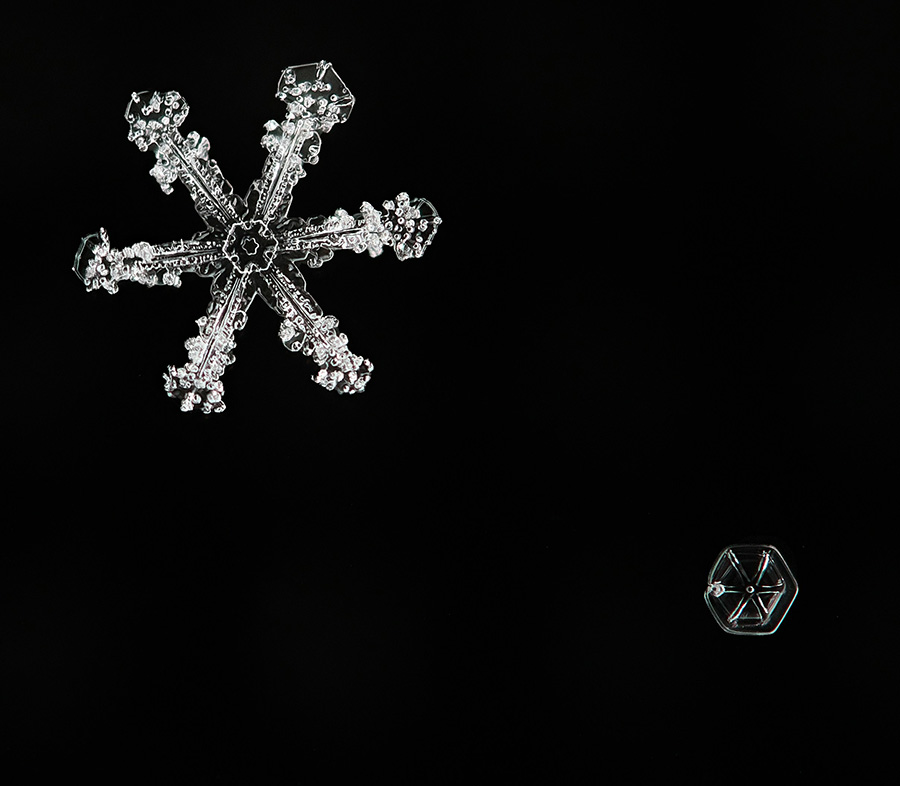
NH: Absolutely. The temperature and humidity of the atmosphere play a major role in how snowflakes form, shaping everything from their size to their final structure.
Snow crystals can range anywhere from long hexagonal needles to simple hexagonal plates to diamond dust crystals to huge dendrite crystals (okay, maybe not huge, but the largest-ever crystal photographed was about one centimeter). And then, depending on the conditions as they fall, they can clump into even larger snowflakes composed of many crystals.
PH: If you could share one surprising fact about snowflakes, what would it be?
NH: Snowflakes taste exactly like peppermint in childhood, but only if you catch them in just the right spot on your tongue. So, you should go outside when it snows and practice catching them with your mouth! ❄️
Photos 1, 3, and 4 by Damian McCoig, Megs Harrison, and Zdenek Machacek via Unsplash