Contact Us
Contact:
Ashby, Riya
Don Myers Technology & Innovation Building, Room 206A on a map
Physics 4400 Massachusetts Avenue NW Washington, DC 20016-8079 United StatesDepartment of Physics
Welcome to the Physics Department at American University! Our research labs and facilities include the Institute for Integrated Space Science and Technology (ISSTI), Design and Build Lab (DaBL), and DC Space Grant Consortium.
Recent Grants, Awards, and Research
-
Philip Johnson received from NASA a $1,326,970 grant for “Remote Sensing of Planetary Atmospheres in the Solar System and Beyond" and a $33,816 grant for “Improving Photochemical Models for Cold and Hot Planetary Atmospheres using New Ab Initio Reaction Rate Coefficients.” He also received from NASA supplemental funding of $86,057 (new total: 244,894.17) for "Revealing Primitive Material Preserved in Solar System Small Bodies,”, supplemental funding of $88,821.15 (new total: $458,811.83) for “Spectroscopic Investigations of Processed Planetary and Astrophysical Ices with the Sublimation Laboratory Ice Millimeter/submillimeter Experiment,” supplemental funding of $58,288.28 (new total: $405,044) for “Interpreting Cassini CIRS Data with a Photochemical Model using Improved ab initio Reaction Rate Coefficients,” and supplemental funding of $119,759.60 (new total: $1,158,864.60) for "Remote Sensing of Planetary Atmospheres in the Solar System and Beyond."
-
Frederick Bruhweiler received from NASA supplemental funding of $26,564 (new total: $278,289) for “Development of the MeDDEA Instrument for the PADRE CubeSat Mission to Observe the Sun In High-Energy X-rays” and supplemental funding of $80,000 and $298,000 (new total: $795,924.82) for “Continued Development of IR & Visible Spectrometer and Imaging Arrays for Ground-based & Space-borne Planetary Observations.” He also received supplemental funding of $22,408 (new total: $67,224) from the Space Telescope Science Institute for the project “High Resolution Spectroscopic Mapping of Mass Loss in Luminous Blue Variables”
-
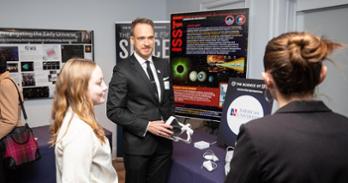
Students Eli Rockenbeck won the “Piers J. Sellers Award for Interdisciplinary Science” from the organizers of a poster presentation event at NASA Goddard.
-
Students Madeleine Bartin, Evelyn Bristol, and Ally Friedman won first place for their presentation at the 10th annual Optical Sciences Winter School & Workshop at the University of Arizona.
-
Gregory Harry received received $20,839 from Stanford University for the project “Mirror Coatings for Next-Generation Gravitational-Wave Detectors: A Path to Discovery" and $139,844 from NSF for "Collaborative Research: Development and Characterization of AlGaAs Coatings for Gravitational-wave Detectors.”
-
Thomas Fauchez received $29,252 from Blue Marble Space Institute of Science for “Constraining the Habitability of M-Dwarf Planets Using Computationally Efficient Climate Models.”
-
Vladimir Airapetian received a $28,698 grant from UCLA for the project “Observationally Constrained Modeling of the Origin and Impacts of Exoplanetary Space Weather.” He also received supplemental funding of $35,642 from the Space Telescope Science Institute for the project "An X-ray through Radio Exo-Space Weather Campaign to Study the Infant Sun DS Tuc.”
-
Will Barnes received supplemental funding of $163,182 (new total: $310,643) from NASA for the project “How Are Active Region Properties and Heating Connected?” He also received from NASA a $14,576 grant for “Modeling Energy Release and Beam Heating in NuSTAR Hard X-Ray Coronal Transients”; a $21,864 grant for “Enhancing Consistency and Discoverability across the Sunpy Ecosystem”; $18,020 for “The Euv Snapshot Imaging Spectrograph (Esis) II”; and supplemental funding of $26,561.66 (new total: $56,561.66) for “The CHIANTI Atomic Database — Essential Infrastructure for Heliophysics.” He received a $7,407.99 grant from the Southwest Research Institute for “Joint EUV coronal Diagnostic Investigation Mission.”
-
Nathaniel Roth received a $21,325 grant from the Space Telescope Science Institute for “Composition of an Interstellar Object — Unique Insights into Protoplanetary Disk Midplane Chemistry.” He also received a $75,645 grant from the National Science Foundation for “Collaborative Research: Elucidating the Composition of our Solar System's Most Primitive Materials — Comprehensive Chemical Analysis of a Halley-Type Comet.”
-
Boncho Benev received a $330,562 grant from the NSF for “Transformative studies of cometary volatiles in the era of modern near-infrared spectrographs.”
-
Frederick Bruhweiler received supplemental funding of $40,000 (new total: $417,924.82) from NASA for “Continued Development of IR & Visible Spectrometer and Imaging Arrays for Ground-based & Space-borne Planetary Observations.”
-
-
Nathaniel Roth received supplemental funding of $14,514 from the Space Telescope Science Institute for project “An Empirical Calibration of the NIRSpec IFU Point Spread Function to Enable High Contrast”; $18,854 grant from the National Radio Astronomy Observatory for "Subsurface Thermal Photometry of NEAs: Characterizing the Regolith”; a $76,576 grant from NASA for "Comet Chemistry Beyond the H2O Sublimation Zone: Interferometric Imaging and Spectroscopy of Distant Comets”; and a $14,043 grant from the Space Telescope Science Institute for “Quantitative Study on the Search for Sulfur-bearing Molecular Ice Signatures.”
-
Nathan Harshman received supplemental funding of $50,000 from the NASA for the project “District of Columbia Space Grant Consortium Budget Proposal for National Space Grant College and Fellowship Program: Opportunities in NASA STEM FY 2020-2024.” Ealier this year he received supplemental funding of $860,000 from NASA" for the project.
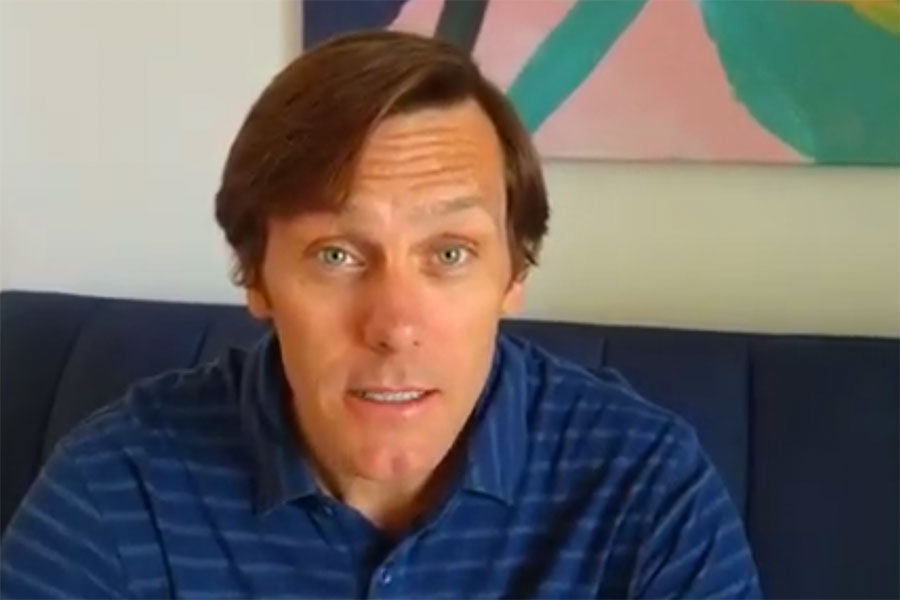
60 Seconds on Preparing for the Future Space Industry
0:57
Prof Nate Harshman connects students and faculty of diverse backgrounds and skill sets with NASA's space missions through the DC Space Grant Consortium.
Read more about cosmology, AU physics—and whimsy in From the Subatomic to the Cosmological: AU’s Professor Nathan Harshman.