
Contact Us
Kerwin Hall, Room 306 on a map
SPA: Graduate Admissions 4400 Massachusetts Avenue NW Washington, DC 20016 United StatesNews Updates

Shadowserver’s Stewart Garrick to Discuss International Cybercrime Investigations with SPA Students
Stewart Garrick, Special Projects Manager at The Shadowserver Foundation and former Senior Investigating Officer at the UK’s National Crime Agency, will join Adjunct Professor Matt Saglam’s Cyber Risk and Threat Intelligence class on November 3, 2026. The course is offered through SPA’s Cyber Policy and Management Graduate Certificate Program.
Garrick brings 30 years of UK law enforcement experience, including work on the international investigations behind the Gameover Zeus and Dridex botnet takedowns. At Shadowserver, he contributes to a nonprofit organization that supports efforts to disrupt cybercriminal infrastructure through technical analysis, sinkholing, and victim notification.
The conversation will explore a central challenge in cybersecurity: turning threat intelligence into evidence and coordinated action across borders, jurisdictions, and institutions. Students will examine how law enforcement, nonprofit organizations, and private industry work together to disrupt cybercrime and help protect affected communities.
For the class’s 28 students, whose backgrounds include international relations, public policy, law, and counterterrorism, the session will connect cyber policy and risk management with the practical realities of international investigations.
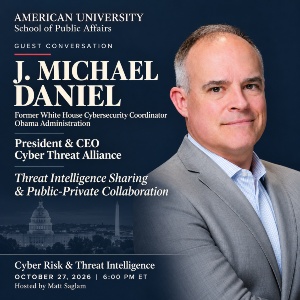
Former White House Cybersecurity Coordinator Michael Daniel Speaks with SPA Students
J. Michael Daniel, President and CEO of the Cyber Threat Alliance and former White House Cybersecurity Coordinator under President Barack Obama, joined Adjunct Professor Matt Saglam’s Cyber Risk and Threat Intelligence class on October 27, 2026. Offered through SPA’s Cyber Policy and Management Graduate Certificate Program, the course connects cybersecurity challenges with policy and risk management decisions.
The conversation explored international cooperation, public-private partnerships, and AI’s impact on cybersecurity. Students discussed how regional threat priorities shape international collaboration and how threat intelligence helps leaders reduce uncertainty and make informed decisions. The session also examined how AI increases the speed and scale of cyberattacks, creating a need for faster defensive capabilities.
A central theme was the importance of building partnerships around shared interests while recognizing the different missions and expectations of government and industry. For the class’s 28 students, whose backgrounds include international relations, public policy, law, and counterterrorism, the discussion connected classroom concepts with practical lessons from national policymaking and industry collaboration.

Adjunct Professor Matt Saglam Spoke on AI and Enterprise Security Panel
Matt Saglam, Adjunct professor at Justice, Law, Criminology, and Security Department and SPA’s Cyber Policy and Management Graduate Certificate Program joined cybersecurity leaders at AT&T Stadium on September 24 for a panel on AI and enterprise security. He discussed how AI is expanding the reach of cyber threats and why organizations need clear controls over data access, AI agent actions, and human oversight as they adopt these tools. Saglam teaches Cyber Risk and Threat Intelligence course in the program.

Memorandum of Agreement (MoA) was signed between American University and Orion Policy Institute, a Washington, DC-based think tank.
The agreement involves a collaboration “that will provide students at AU with internship opportunities to gain hands-on experience in policy research, data collection and analysis, and digital communications within a non-profit think tank environment.
Records of Critical Cyber Attacks (ROCCA) is a structured, open-source database that systematically records critical cyber incidents conducted by state and non-state actors. Unlike general cyber incident datasets, ROCCA focuses exclusively on incidents planned to produce significant societal, political, or economic impact. These include strategic cyberattacks and operations, disruptive and destructive attacks targeting critical infrastructure, and cyber operations linked to geopolitical competition, conflict, or financially or politically motivated non-state actors. The dataset covers incidents from 2005 onward and is continuously updated.
The dataset is designed to support quantitative policy analysis, attribution research, and geopolitical risk modeling. It draws from publicly available incident records and extends them through a multi-stage automated enrichment pipeline
Professor Suleyman Ozeren, Director of the Cyber Policy and Management Certificate Program, serves as the coordinator and principal investigator of the ROCCA Project, as well as the primary point of contact for American University. SPA students have also begun contributing to the project, gaining hands-on experience in cybersecurity research.
As cyber threats continue to grow in scale, complexity, and geopolitical significance, ROCCA aims to provide researchers, policymakers, and practitioners with a structured resource for analyzing patterns, trends, and strategic implications across the cyber domain.

Exploring Careers in AI-Enabled Cybersecurity Policy with AU Students
We were delighted to welcome Daria Bahrami from Dreadnode as a guest speaker in Professor Suleyman Ozeren’s Cybercrime and Public Policy course, part of the Cyber Policy and Management Certificate Program at the School of Public Affairs, American University. Daria led an engaging conversation on careers in AI-enabled cybersecurity policy, offering students valuable insights into this rapidly evolving field.
Reflecting on her own professional journey, our speaker shared key insights that have shaped their approach to navigating this evolving field.
With cybersecurity policy still taking shape at the federal, state, and local levels, emerging professionals have a unique opportunity to define its future. We are grateful for the speaker’s insightful contributions and continued engagement in these timely conversations.

Guest Lecture Spotlight: Matt Saglam of SOCRadar® on the Dark Web and Illicit Marketplaces
We were honored to host Matt Saglam of SOCRadar® Extended Threat Intelligence as a guest speaker in our Cybercrime and Public Policy course, part of the Cyber Policy and Management Certificate Program at the School of Public Affairs, American University.
Matt delivered a powerful and eye-opening lecture on dark web marketplaces, offering students a rare window into the hidden ecosystems that enable illicit activity beyond the reach of conventional search engines.
His talk explored how cybercriminals exploit the anonymity of the dark web to traffic in stolen data, illegal drugs, firearms, counterfeit documents, and hacking tools. Matt also demystified the infrastructure that supports these transactions—from cryptocurrency-based payments and reputation systems to decentralized forums that mirror legitimate e-commerce platforms.
The session provided both a technical deep dive and a broader policy perspective on the dark web’s role in enabling cyber-enabled crime. We are grateful to Matt for sharing his expertise in such a timely and impactful way.

Contributing to the Future Work-Based Learning for Cyber Jobs
Professor Monty McGee was a leading contributor to the Center for Security and Emerging Technology (CSET) report on the Future of Work-Based Learning for Cyber Jobs. The report, "explores how practitioners, researchers, educators, and government officials view work-based learning as a tool for strengthening the cybersecurity workforce."

The Changing Threat Landscape and US Cyber Policy
Professor Suleyman Ozeren, the Director of the Cyber Policy and Management Certificate Program was a featured guest speaker in the Managing Tech in the Information Age course, part of the Key Executive Leadership Program at SPA. His talk, titled The Changing Threat Landscape and US Cyber Policy, provided critical insights into evolving cyber threats and the policies shaping national security.
The discussion covered key cyberthreat trends in 2025, such as ransomware attacks, AI utilization in cybercrime, and deepfake technology. He also examined the structure of U.S. cyber policy and how it adapts to emerging threats, including the critical role of public-private partnerships in strengthening national cybersecurity. Participants engaged in a dynamic conversation on the challenges and future directions of cybersecurity policy.

From AI Hype to Responsible Policy & Governance with Artur Kiulian
On October 14, 2024, the Khan Institute welcomed Artur Kiulian—serial entrepreneur, social impact advocate, and AI specialist—for a guest lecture with SPA’s Prof. Monty McGee’s “Cyber Threats and Security” course. The lecture delved into AI governance and regulation, covering essential topics such as balancing innovation with safety, the reality behind AI’s capabilities, and the challenges of keeping pace with rapid technological advancements. Artur also discussed the importance of sovereign AI, collaborative approaches to governance, and the development of risk assessment tools.

2024 Aspen Cyber Summit
On September 18, 2024, the SPA faculty and students along with the Khan Institute team, several faculty affiliates attended the 2024 Aspen Cyber Summit. The day featured engaging programming and insightful discussions. Special thanks to Dr. Sasha O'Connell, AU Khan Institute Strategic Advisor and Aspen Senior Director of Cybersecurity Programs, for her key role in organizing this outstanding event on behalf of the Aspen Institute.

Why Cyber?
First-generation alumna Mercedes Subhani (SPA, CLEG, '20) revisits her path to the cybersecurity field. Read the full story.
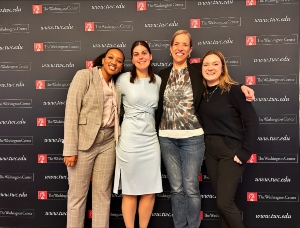
SPA Cyber Students take part in The Washington Center's Cyber Accelerator Program
SPA’s Sasha O'Connell, Executive in Residence and Director of the THSP MS Program, along with three impressive SPA alumni, took part in The Washington Center's Cyber Accelerator Program! A big shoutout to SPA alums Crystal Assenmacher, Lama Mohammed, and Bailey Winsor for their exceptional performance on the early to mid-career professionals' panel! #SPACyber #SPAProud
More News

Risks to Cybersecurity from Data Localization
SPA Cyber Professor Drew Bagley has co-authored a paper on data localization policy efforts and their impact on cybersecurity.
2023 Counter Ransomware Initiative
SPA Cyber student Kuhu Badgi and Olivia Bohart attended a closed panel event at the Center for Strategic and International Studies (CSIS). They both took the opportunity to ask question and speak with Deputy National Security Advisor Anne Neuberger after the event. Read about their experiences.
Kuhu's Write-up
Olivia's Write-up
Special issue on domain name system (DNS)
SPA Cyber Professor James Burrell published a guest editorial in the Journal of Cyber Policy on international cybersecurity policy and governance.